ar
ar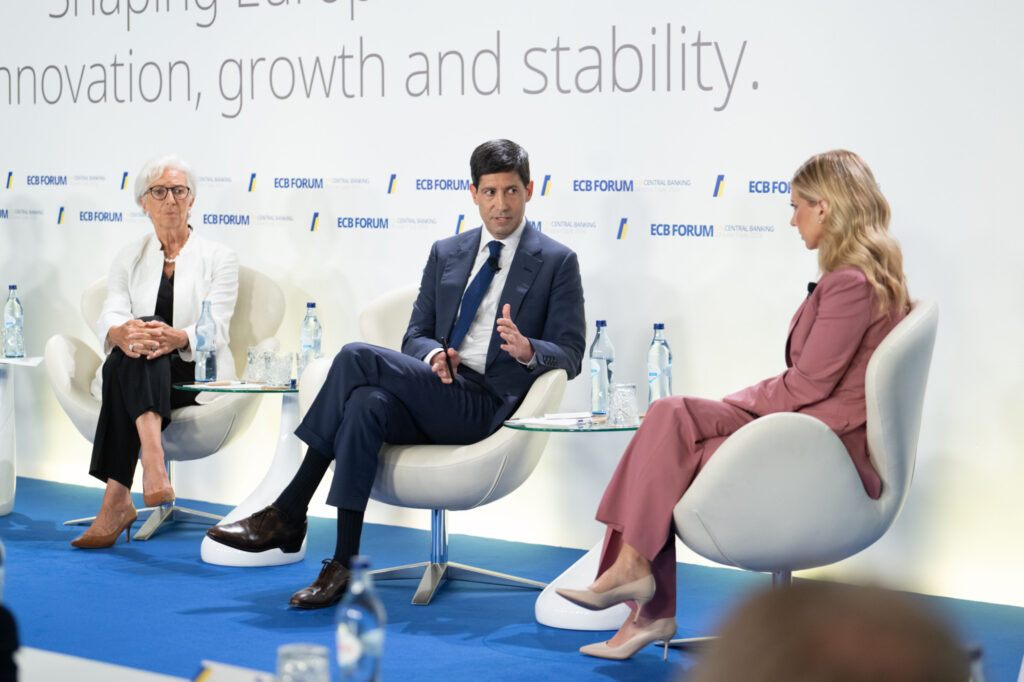
- Warsh used his international debut to defend the Fed’s independence and reaffirm that the 2% inflation target is not up for negotiation.
- Central bankers are shifting toward faster data, less forward guidance, and more flexible scenario-based policy as economic shocks become harder to predict.
Federal Reserve Chairman Kevin Warsh used his first major international appearance to send a clear message, that the Fed will not soften its inflation target, no matter the political pressure.
Speaking at the ECB forum in Sintra, Portugal, alongside top central bankers from Europe, the UK, and Canada, Warsh laid out a vision built on independence, better data, and a return to policy fundamentals.
No Room for Loose Policy
The new Fed chairman was direct about the US central bank’s position on price stability, stating they would be disappointed in anyone tolerating inflation above the 2% target.
This came just days after the Supreme Court ruled that President Trump could not remove Fed Governor Lisa Cook, a decision that reinforced the central bank’s independence even as it expanded presidential power elsewhere. Warsh confirmed he had reviewed the ruling but does not expect it to change how the Fed operates. ⁽¹⁾

Despite pressure from the White House for rate cuts, Warsh reaffirmed the Fed’s independence and gave no hints about the July 28 meeting. Markets still lean toward a rate hike in September, though economists note the odds of a quick pivot to cuts have faded since Warsh took over. ⁽²⁾
Betting on Real-Time Data
A recurring theme was Warsh’s frustration with government statistics.
He argued that years of high inflation were due to policy decisions built on old data. To fix this, he formed five new task forces, with staffing announcements expected next week. One task force will focus on finding better and faster ways to track real-time economic data. ⁽³⁾
Warsh set an ambitious timeline for this shift, saying he hopes that within nine to twelve months, the Fed will rely less on backward-looking government surveys and more on real-time data to read the economy as it happens. ⁽⁴⁾
He tied this urgency to artificial intelligence, describing the pace of economic change as exponential and arguing that new tools are needed to catch shifts as they unfold rather than after the fact.
A Global Return to First Principles
Warsh wasn’t alone in this thinking. Central bankers from the ECB, Bank of England, and Bank of Canada shared a similar reluctance to offer forward guidance on rates.
Warsh described this as a broader global shift back to basic central banking principles, moving away from the large balance sheets and heavy market signaling that followed the 2008 financial crisis.
Bank of England Governor Andrew Bailey flagged a different risk of rising leverage across bond markets, hedge funds and private credit. He stated that regulators are monitoring closely to see whether this leverage could turn from a contained risk into a broader shock to the financial system. ⁽⁵⁾
Europe’s Case for Resilience
The ECB’s contribution to this debate centered on why Europe has been able to handle recent shocks without major disruption. Stronger banking supervision, deeper fiscal tools, and a credible inflation target near 2% have made the eurozone more resistant to shocks from high energy prices, tariffs, and geopolitical tensions. ⁽⁶⁾
Still, officials stressed that today’s shocks behave differently from those in the past. They can escalate and reverse quickly, as seen with oil prices swinging from near $120 a barrel in March to around $73 after a recent interim peace deal tied to the Middle East conflict.
This volatility is pushing central banks toward scenario-based planning rather than rigid forecasts, allowing them to test decisions against multiple possible outcomes before committing to a path. ⁽⁷⁾
The Bottom Line
Warsh was consistent in his message about independence, discipline on the 2% target, and a shift toward faster, more reliable data.
Combined with similar signals from European counterparts, the message from the ECB forum points to a coordinated global recalibration in how central banks read the economy and communicate their next move.