ar
ar
- Crude oil climbed above $100 per barrel as the Middle East conflict continues to disrupt supply, with the Strait of Hormuz effectively impassable and around 20% of global oil flows at risk.
- Higher oil prices could push US inflation back toward 3% by late 2026, complicating the Federal Reserve’s path and reinforcing expectations that rate cuts may remain off the table, while also reviving stagflation concerns.
- Asia faces severe exposure, with Japan, India, and China all heavily reliant on Gulf oil imports, while global markets sold off sharply in response.
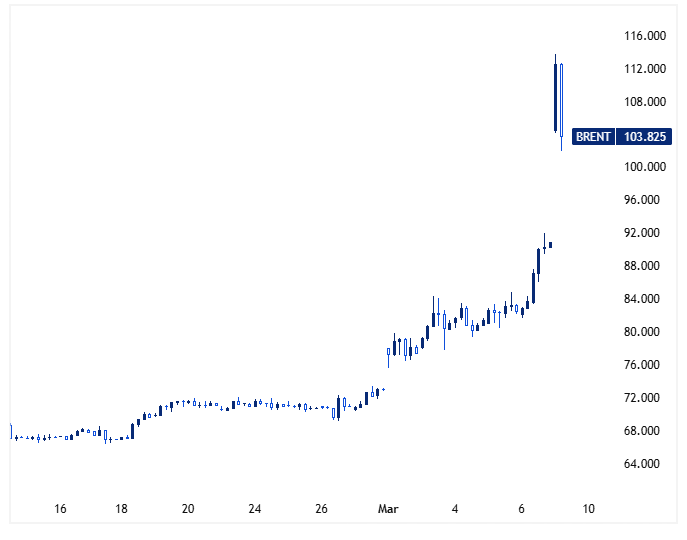
By the time Brent crude crossed $100 a barrel earlier today, the message was clear: the Middle East crisis has expanded beyond a regional conflict and is now drawing broader attention from global markets and economies.
Oil prices surged as the ongoing conflict in the Middle East disrupted production and shipping routes across the Persian Gulf.
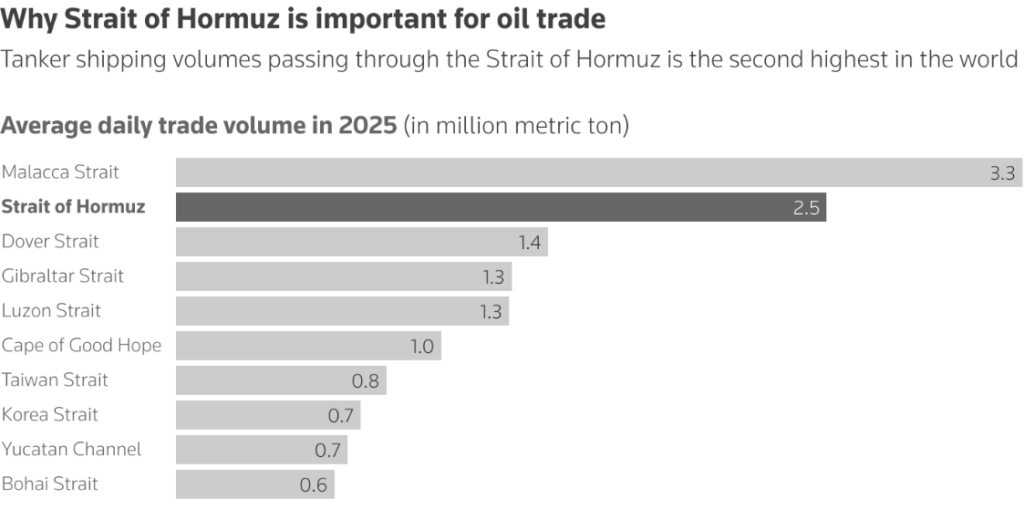
Alongside the conflict, shipments moving through the Strait of Hormuz were also halted, sending shockwaves throughout financial markets, given that the strait is a key route for around 20% of the global oil supply.
Brent crude surged as high as $119.50 a barrel earlier in the session, while WTI briefly touched $119.48, before paring some gains on the news of potential emergency reserve releases. Even after the pullback, Brent was still up more than 16%, on track for the largest single-day jump in history.
The Price at the Pump Is Just the Beginning
For ordinary Americans, the most visible consequence is at the gas station. The national average has already climbed to $3.45 per gallon, up nearly 50 cents in a single week. Diesel, the lifeblood of trucking and freight, hit $4.60, an 83-cent jump in the same period.
But gasoline prices are only the most visible symptom of a deeper issue. Every $10 increase in the price of a barrel of crude oil adds roughly 0.15-0.25% to headline inflation over the following six to twelve months. With oil now trading above $100, economists estimate that headline inflation could push back toward 3% by late 2026. ⁽¹⁾
This factor places the Federal Reserve in a very uncomfortable position, as the US central bank had cut interest rates three times late last year, bringing the Fed Funds rate down to 3.75%. Markets were also pricing in further easing this year, but those expectations could fade soon. Former Treasury Secretary Janet Yellen put it plainly: the Middle East situation puts the Fed “even more on hold, more reluctant to cut rates.”
Stagflation, a term that is very toxic, combines both stagnant growth and rising inflation. This term plagued the US back in the 70s, when oil prices skyrocketed due to OPEC members imposing an embargo on the US and other nations during the Yom Kippur War, alongside major regime and economic changes in the Middle East. US Senate Democratic Leader Chuck Schumer has called on President Trump to release oil reserves to help stabilize markets and bring prices down. ⁽²⁾
G7 finance ministers and the International Energy Agency were also set to discuss a coordinated emergency reserve release earlier today, which helped pull prices back from their session highs. Saudi Aramco made rare, prompt supply tenders in an attempt to calm the market. ⁽³⁾
Weeks or Months of Higher Prices?
The duration question is everything, as the next flag will be whether it eventually gets to a point where Gulf nations have to start shutting in oil wells, which could keep oil prices elevated.
The IMF has long estimated that every sustained 10% rise in oil prices results in a 0.4% rise in global inflation and a 0.15% reduction in global economic growth. At prices now approaching or maybe even exceeding $110 a barrel, up 40% or more from the start of the year, those numbers, compounded over months rather than weeks, begin to describe something closer to a recession than a disruption. ⁽⁴⁾
IMF estimates suggest that a 10% rise in oil prices can increase global inflation by around 0.3–0.4% while reducing global economic growth by roughly 0.1–0.2%. If oil prices remain above $100 per barrel for a prolonged period, this could increase recession risks by adding inflationary pressure and slowing economic activity, similar to the strain seen during past oil shocks. ⁽⁵⁾
But the more alarming scenario for policymakers is the second-order effect: wages rising to compensate workers for higher living costs, businesses repricing services to protect margins, and landlords passing on higher energy bills through rent.
Once those dynamics take hold, inflation becomes self-sustaining and far harder to bring down without triggering a recession.
A Chokepoint That Cannot Be Easily Bypassed
The Strait of Hormuz has always been the jugular vein of global energy. But what makes this crisis particularly severe is that the strait hasn’t formally closed, it has simply become economically and practically impassable.
Insurance premiums for vessels transiting the region have surged to six-year highs, and major oil companies, commercial operators, and insurers have withdrawn from the route entirely, creating what analysts call a de facto closure. ⁽⁶⁾
The damage is already occurring. Iraq’s oil production from its southern oilfields has fallen 70% to 1.3 million per day, as the country cannot export through the strait.
Kuwait Petroleum Corporation began reducing its output over the weekend and declared force majeure on shipments.
Iraq and Kuwait have now joined Qatar in reducing production, with analysts expecting the UAE and Saudi Arabia will be forced to follow as their own storage fills up. ⁽⁷⁾
Asia Bears the Heaviest Burden and is Moving to Act
If the US faces a more difficult situation, Asia might face a similar crisis.
Japan’s vulnerability is particularly clear, as it heavily relies on oil imports from the Middle East, with 70% of them shipped through the Strait of Hormuz. The Japanese government has confirmed that its oil reserve storage facility will prepare for a possible release of crude.
Japan is better positioned than most to counter a short-term disruption, as the nation holds emergency oil reserves equivalent to 254 days of domestic consumption, among the largest stockpiles in the world, encompassing government-owned inventories, private-sector stocks, and jointly held reserves with oil-producing nations. ⁽⁸⁾
Tokyo last drew on those reserves in 2022 as part of an IEA-coordinated release following Russia’s invasion of Ukraine. Industry Minister Ryosei Akazawa had said early last week there were no specific plans to release reserves, but Kyodo News reported Friday that Japan is now actively considering doing so either in coordination with other IEA members or unilaterally if necessary. ⁽⁹⁾
India’s position is even more precarious, as the country imports more than 85% of its crude oil, mostly from Gulf suppliers, which are now all either cutting output or facing shipping issues. China, though it has amassed strategic reserves of nearly one billion barrels, still draws a significant share of its imports from the Gulf. ⁽¹⁰⁾
Markets Remained Pressured
Financial markets across the region have already responded with alarm bells. Japan’s Nikkei 225 tumbled more than -7% during the Asian session, with European indices also facing trouble as the German DAX dropped -2.4%. Meanwhile, the UK’S FTSE 100 is down -1.6%.
Currency markets were rattled too, with both the Euro and the Pound dropping -0.7% while the Yen reached a six-month low.
Safe-haven flows have been moving into the US dollar, which has historically drawn support when oil prices rise, partly because the US is a net oil exporter. At the same time, markets have scaled back expectations for Federal Reserve rate cuts, as higher oil prices could add to inflationary pressure.