ar
ar
- Oil prices surged from weekly lows yesterday as tensions between the US and Iran re-ignited and revived supply disruption fears.
- US Treasury yields rose as markets weighed the risk of higher for longer interest rates, adding pressure on precious metals.
Geopolitical tensions are back rattling markets and creating more diplomatic uncertainty between the US and Iran.
Oil prices staged a rally alongside a rise in Treasury yields yesterday, while precious metals moved lower.
Oil Jumps More Than 2% on Middle East Flare-Up
Brent oil jumped more than 2%, around $98 per barrel yesterday, hitting one-week highs as new tensions flared in the Middle East.
Fresh escalation, including reported incidents involving Kuwait and Bahrain and a US military response, has deepened regional unease and kept attention on the risk of further disruption to energy flows through the Strait of Hormuz.
Oil eased slightly earlier today to around $96 per barrel following a ceasefire deal between Israel and Lebanon.
Diplomacy between the US and Iran remains uncertain, as Tehran has not responded to Washington over the last few days, and back-channel talks have been paused.
President Trump, however, said negotiations were still ongoing and claimed Iran had agreed in principle not to seek a nuclear weapon. ⁽¹⁾
Supply Concerns Add to the Pressure
Oil markets are already dealing with tight supply conditions, with the International Energy Agency warning that global oil inventories could fall to critical levels this year. ⁽²⁾
US crude inventories fell for a seventh straight week, dropping by 6.8 million barrels last week, according to data from the American Petroleum Institute. ⁽³⁾

OECD Warns of Recession Risk if War Drags On
The Organization for Economic Co-operation and Development warned that the global economy could face growth risks if the conflict drags on, with some economies already facing recession risks and high inflation. ⁽⁴⁾
The OECD stated that if the conflict was resolved soon, oil and gas production in the Middle East could resume and gradually return to pre-conflict levels, alongside forecasts of 2.8% growth in 2026, a slowdown from last year’s 3.4%. ⁽⁵⁾
If energy disruptions persist, global growth could come under much heavier pressure, with some forecasts pointing to a slowdown to 2.1% this year and 1.8% next year.
Economies with greater dependence on Middle East energy supplies, particularly in Asia, are expected to be among the most exposed if the disruption continues. ⁽⁶⁾
Precious Metals Pull Back as Rate Expectations Rise
Precious metals traded under pressure, with both gold and silver facing renewed volatility as markets reassessed inflation risks and the possibility of higher interest rates.
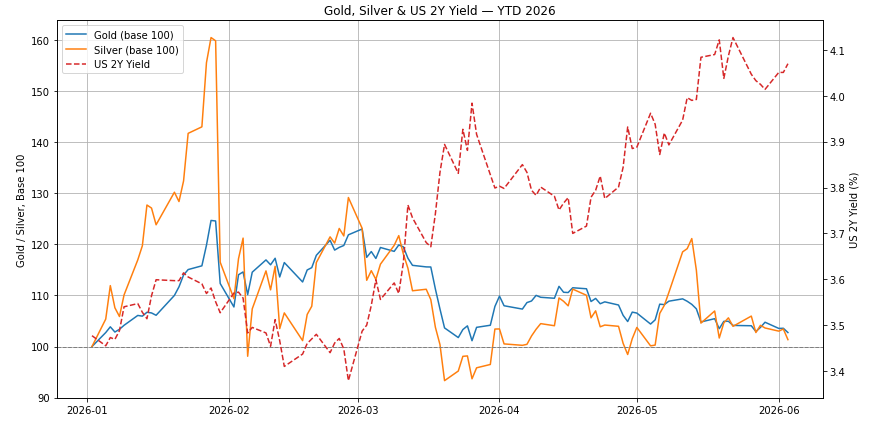
That prospect is weighing over precious metals, which pay no yield and become less attractive when interest rates rise.
US Treasury yields rose after a stronger-than-expected ADP report showed private payrolls increased by 122,000 in May, above forecasts of 117,000. Alongside solid April job openings data, the figures suggested the labour market remains resilient. ⁽⁷⁾
The US 2-year yield climbed 3.9 basis points to 4.082% while the 10-year yield rose 3.8 basis points to 4.49% yesterday. Markets are still trying to assess whether the Federal Reserve will keep interest rates unchanged or hike later this year, especially if inflation remains elevated. ⁽⁸⁾
All eyes now turn to Friday’s Nonfarm Payrolls report, which is expected to provide the clearest signal yet on the direction of monetary policy.