ar
ar
Chips won. Software lost. Everything else was noise.
That was the first half of 2026 in three sentences. Beneath decent-looking index numbers, one force decided who made money and who didn’t: artificial intelligence infrastructure.
It drove index performance, split sectors into clear winners and losers, shaped earnings season, and even factored into central bank decisions as inflation ran hot.
How did Global Indices Perform?
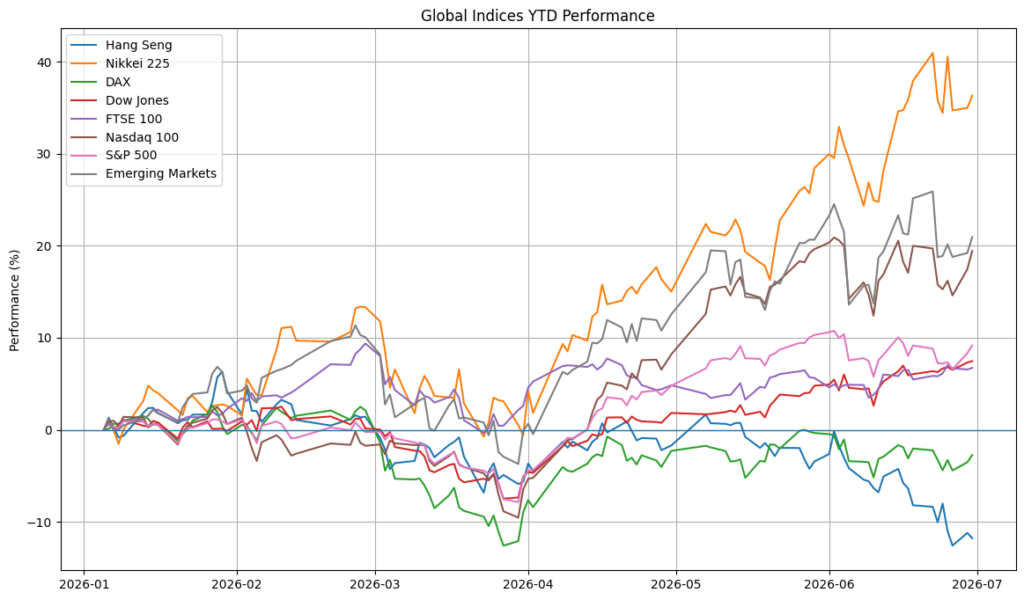
Japan was the major winner in the first half of the year, with the Nikkei 225 gaining 38%, far ahead of every other major benchmark. The Nikkei’s surge was driven by a combination of AI hype, a weak yen, foreign inflows and Japan’s fiscal policy support.
The biggest driver has been the global AI trade, where Japanese tech stocks such as SoftBank and Fujikura benefited from heavy investments because of their exposure to semiconductors, data centers and AI infrastructure. ⁽¹⁾
The yen also played a major role, holding at its weakest level in decades. That made Japanese exports cheaper, supported earnings expectations and attracted more capital inflows.
Other regions also performed well, while some others lagged.
- Emerging markets were the strongest area, up 19.9% in the first half of the year, helped by South Korea and Taiwan’s semiconductor boom amid renewed interest in AI hardware and supply chains, plus cheaper valuations.
- The Nasdaq gained 18%, also riding the AI boom as mega-cap tech, semiconductor, cloud, and data center stocks kept increasing their capital expenditures. However, the first half wasn’t smooth, with heavy profit-taking and investor rotation weighing on the index at times.
- The S&P 500 rose 8.46%, supported by strong earnings, AI capex, and resilient US economic data.
- The Dow added 7.87%, benefiting from a blue-chip rally supported by industrials, resilient US growth, and a late tech boost after Alphabet joined the index.
- The FTSE 100 climbed 7.11%, supported by banks, commodities, defensive cash flows, and a weaker pound that aided inflows, though it missed out on the AI boom.
- Germany’s DAX rose just 1.31%, as early gains from large-cap tech earnings faded due to weak industrial performance and cautious sentiment in European stocks, which erased most of the rally.
- The Hang Seng was the worst performer, down 13.25%, pressured by China’s growth concerns, weak property activity, and mixed appetite for Chinese stocks.
Sector Leaders and Laggards
The focus here is on the US stock market, where tech stocks mainly led the way in gains. But that still doesn’t mean all sectors in tech benefited. AI hardware won, while software stocks lost out.
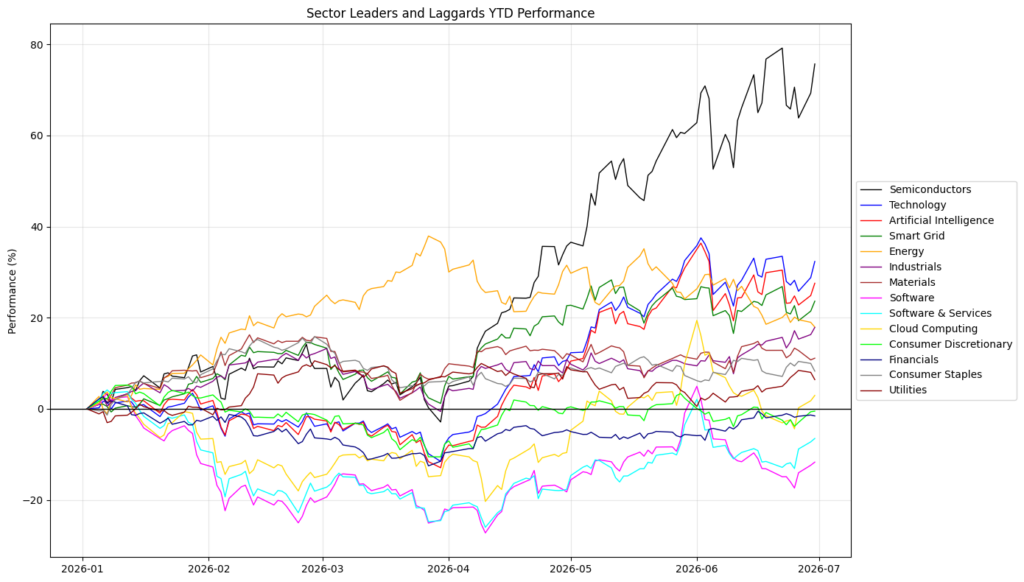
Energy and materials contributed too, but unevenly. Oil spikes helped producers early, then gave back gains as ceasefire hopes trimmed the supply-shock premium late in the half.
Top 20 Large-Cap Winners
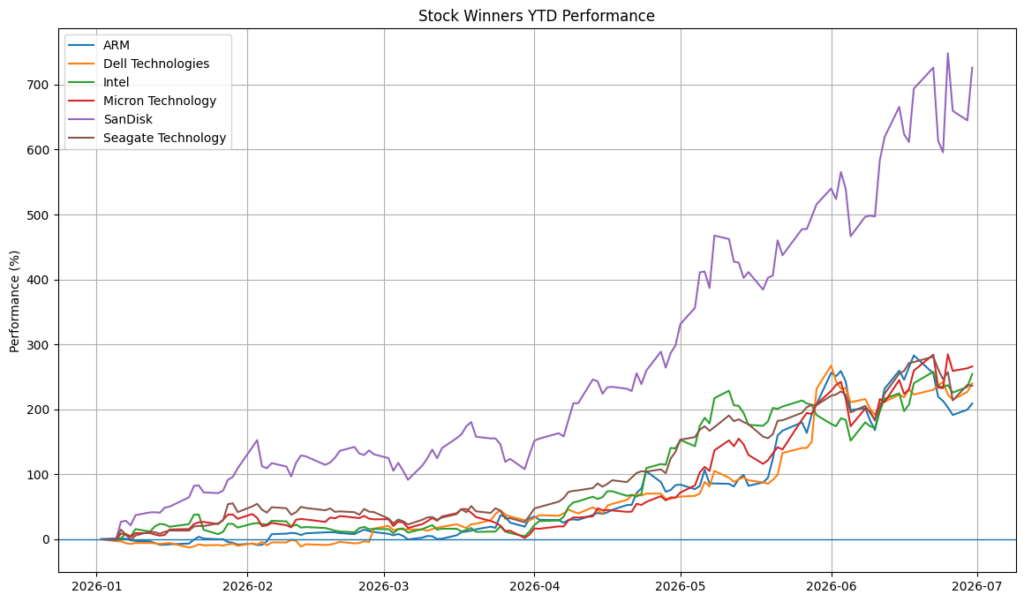
Every name at the top of the leaderboard connects to memory, storage, semiconductors, data-center power, or AI infrastructure.
Memory and storage names led the pack by a wide margin. SanDisk topped the list with a 780.74% gain, riding the AI storage and flash memory boom. Micron Technology followed at 296.91%, driven by demand for HBM, DRAM, and AI memory chips. ⁽²⁾
Intel rose 247.75% on its AI hardware turnaround story, while Seagate Technology gained 227.58% on data-center storage demand. Dell Technologies climbed 219.73% as AI server orders picked up, and Arm Holdings rounded out the group with a 205.80% gain tied to its AI-adjacent IP licensing model. ⁽³⁾
Top 20 Large-Cap Losers
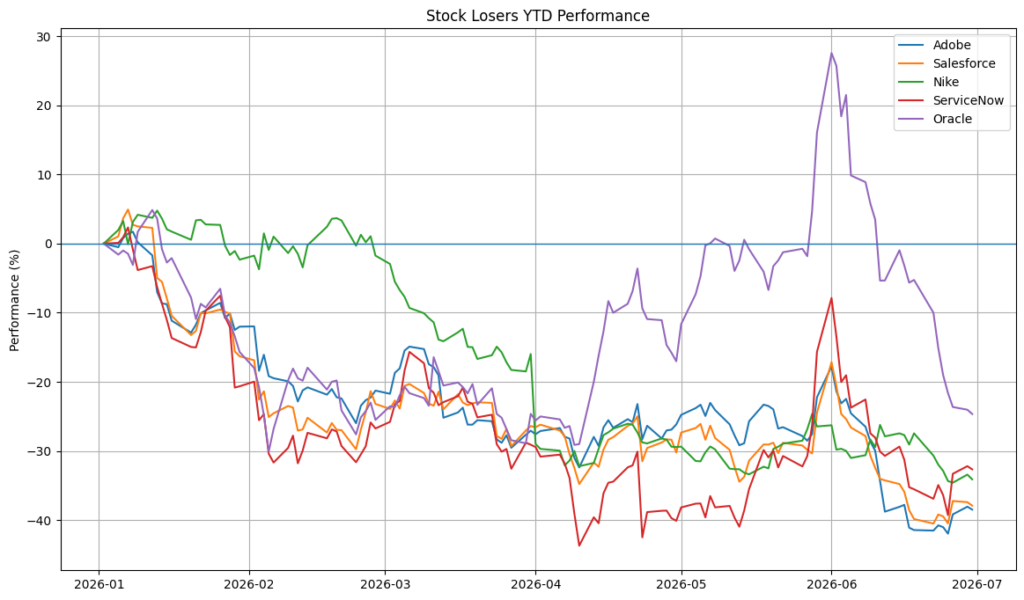
While AI hardware stocks surged, software, SaaS, and IT services sold off hard. Investors questioned whether AI spending would ever pay off, and valuations collapsed.
Salesforce fell 37.73% as SaaS valuations reset sharply, while Adobe dropped 38% on software multiple compression.
ServiceNow declined 32.2% amid broader enterprise software pressure, and Oracle slipped 24.5% as fears over AI disruption to legacy software models weighed on the stock. Outside tech, Nike fell 34.45% on persistent consumer weakness. ⁽⁴⁾
Earnings Strength, Market Skepticism
Corporate America delivered one of its strongest performances in years in Q1, with 97% of the S&P 500 showing earnings growth of 28.6% YoY, its strongest results since 2021.
Analysts only expected an earnings growth of 13.1%, but the stock market doubled it, with ten of eleven sectors in the S&P 500 posting gains. ⁽⁵⁾
Markets didn’t reward all of this equally. Companies beating estimates saw shares rise just 1.1% on average, while companies missing estimates fell 4.9%, far worse than the historical norm. With expectations already high, investors had little patience for disappointment.
That asymmetry showed up clearly in two corners of the market. Hyperscalers backed their AI spending with real results. Google Cloud grew 63% and AWS rose 28% in Q1, but even strong numbers weren’t always enough. Meta raised its capex guidance and still saw shares fall 6% after hours. ⁽⁶⁾
Software told the same story but in another way. ServiceNow grew Q1 subscription revenue by 22% and beat its own guidance, while Salesforce’s Agentforce, its AI agent platform built to automate business tasks inside its software ecosystem, showed strong early demand.
Agentforce ARR, or annual recurring revenue, rose 169% YoY to $800 million, meaning Salesforce was generating around $800 million in annualized recurring revenue from the product. Despite this, both stocks fell hard as markets repriced what that growth was worth amid fears that AI would eventually shrink software spending rather than grow it. ⁽⁷⁾
Central Banks Split Up
Major central banks did not move together. That was the defining policy story of the first half. Without a synchronized easing narrative, markets rewarded companies with real demand, not just cheap money.
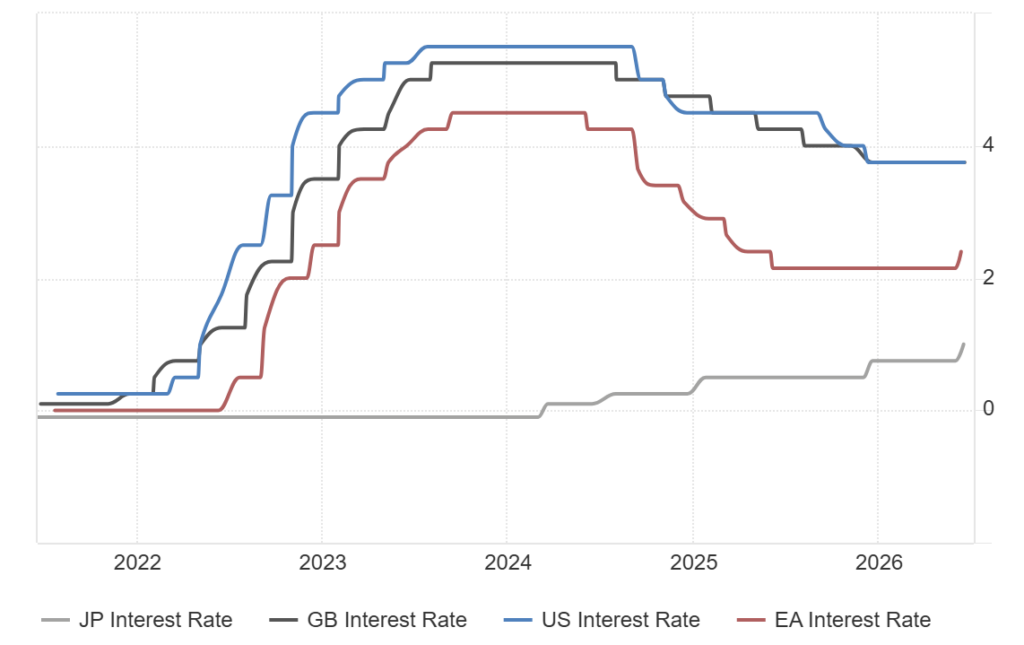
The Federal Reserve shifted from a market driven by rate-cut hopes to one bracing for hikes. Kevin Warsh was sworn in as Fed Chair on May 22, 2026, and at his first FOMC meeting on June 16-17, the FOMC held rates steady at 3.75%, but raised its year-end rate forecast from 3.4% to 3.8%.
Nine of eighteen officials signaled support for higher rates this year, a sharp reversal from earlier projections of a cut. Stocks sold off on the news, with the Dow and Nasdaq both falling around 1%, while short-term Treasury yields jumped.
The hawkish pivot came as inflation hit a three-year high of 4.2%, driven largely by energy costs tied to the Middle East conflict.
Warsh also changed the Fed’s statement, delivering shorter policy commentary and stepping back from forward guidance, a major shift that added its own layer of uncertainty for markets already adjusting to the AI-driven sector rotation.

The Bank of Japan also moved in the same direction, but it has its own reason for becoming hawkish. Last month, the BOJ hiked interest rates to 1%, reaching their highest level since 1995 as policymakers responded to ongoing yen weakness and higher inflation pressures from the Middle East conflict.
Unlike a Fed hike, a BOJ rate hike tends to strengthen the yen and can unwind the global carry trade, where investors borrow cheaply in yen to fund higher-yielding assets abroad.
Even so, the yen stayed weak and the AI-driven rally behind the Nikkei’s 38% surge continued largely undisturbed.
What to Watch in the Second Half
H1’s gains were narrow. A small group of hardware and infrastructure names carried the benchmarks.
If Q2 earnings confirm the AI capex cycle and geopolitical tensions keep easing, the rally can continue even without broad participation.
Europe has the potential to catch up if oil prices remain subdued and economic conditions improve. Japan remains a structural beneficiary of both the AI hardware cycle and BOJ normalization.
The risks are clear. A renewed oil spike, another leg up in rates, or a disappointment in AI hardware earnings would expose just how top-heavy H1 performance really was.