ar
ar
- The Bank of Japan hiked interest rates by 25 basis points to 1% as inflation and a weak yen continue to pressure the Japanese economy.
- Governor Ueda missed the meeting for medical treatment, and one board member dissented.
- Meanwhile, the Reserve Bank of Australia held steady on rates, but warned of further action if inflation remains high.
Global central banks kicked off a busy policy week, starting with two key decisions from the Bank of Japan (BOJ) and the Reserve Bank of Australia (RBA).
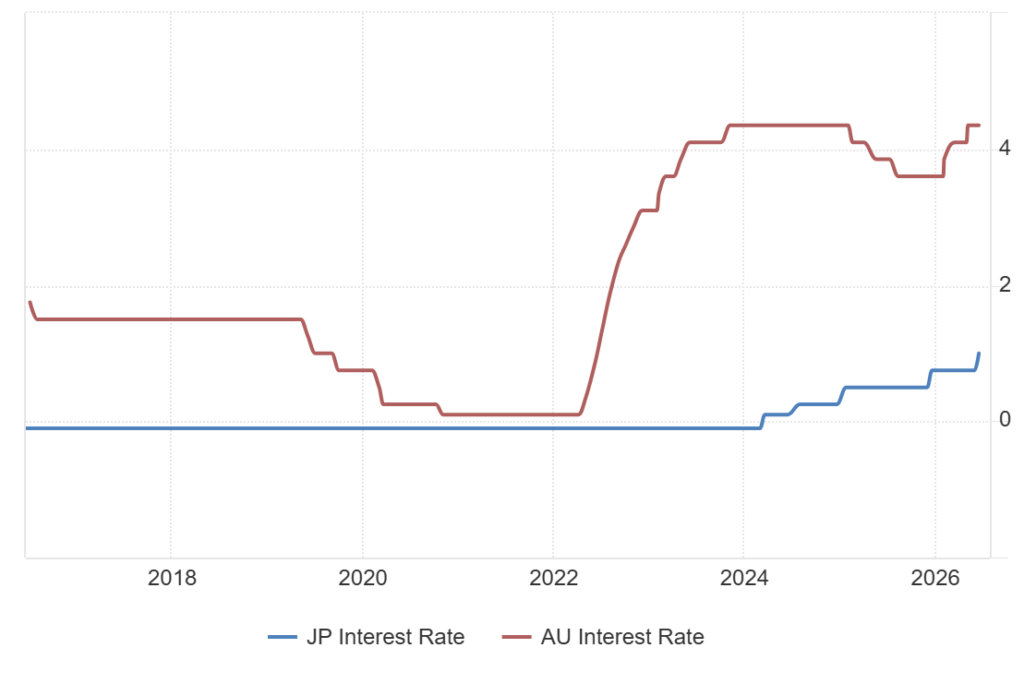
The BOJ raised interest rates to their highest level since 1995, while the RBA kept rates unchanged but warned that further hikes are on the table.
Both decisions were shaped by the same underlying forces: the Middle East conflict that sent energy prices higher, a peace deal that offered some relief, and stubborn inflation that refuses to fade quietly.
BOJ Raises Rates to Highest Level Since 1995
The Bank of Japan hiked interest rates by 25 basis points to 1% yesterday, reaching its highest level since 1995. It was a move widely expected by markets and marked the first rate change since December of last year.
The decision came without the presence of Governor Ueda, who was hospitalized two weeks ago and couldn’t attend the meeting.
Instead, Governor Uchida stepped in and acknowledged that the US-Iran peace deal had reduced the risk of a sharp economic deterioration. ⁽¹⁾
Even so, he warned that inflation risks remain very active.

The vote was 7 to 1 in favor of the rate hike. The lone dissenter was Toichiro Asada, who argued that downside risks to growth still outweighed inflation concerns.
Asada was the first board member selected by Japan’s dovish Prime Minister Sanae Takaichi, making his dissent a politically notable moment. ⁽²⁾
Inflation Broadening Across the Economy
The main concern for the BOJ is the pace at which the effects of higher oil prices are spreading across the economy.
Japan’s PPI jumped to 6.3% YoY in May, its fastest pace in over three years. The BOJ also stated that companies are passing these higher costs onto each other, which risks pushing up consumer prices. ⁽³⁾
It’s not just oil prices adding pressure, but also a weak yen. Japan’s currency remains weak near the 160 level against the dollar, a point that triggers concerns about a possible FX intervention.
Japan’s government had already spent an estimated 11.7 trillion yen on currency intervention operations in May, but the yen weakened again anyway. ⁽⁴⁾
Core CPI eased to 1.4% in April, with the decline driven by government subsidies on energy bills. But as those subsidies wear off and energy costs continue to filter through, analysts expect inflation to climb back above the BOJ’s 2% target later this year. ⁽⁵⁾
The BOJ also announced it would pause its bond-buying reduction program from April 2027 onwards, maintaining monthly purchases of around 2 trillion yen in Japanese government bonds. ⁽⁶⁾
RBA Holds but Warns It May Still Hike
The same day saw the Reserve Bank of Australia keep its Cash Rate steady at 4.35%, pausing for the first time this year after hiking rates three times since February.
The decision was unanimous and expected by markets.
However, Governor Bullock stated that the pause doesn’t indicate that the job is done. The RBA said in its statement that inflation was still too high and that it would not hesitate to raise rates further “if required.” ⁽⁷⁾
Bullock struck an optimistic tone on the Middle East peace deal, while keeping a cautious view on what comes next. She pointed out that even if the Strait of Hormuz reopens fully, the benefit to commodity prices and supply chains may take time to process, and the situation remains uncertain.
Australia’s inflation remains well above the RBA’s target range of 2%-3%, coming in at 4.2% in April. GDP only expanded 0.3% QoQ in Q1, coming in below expectations, while the unemployment rate climbed to a four-year high of 4.5%. ⁽⁸⁾
Financial markets are pricing in an RBA move in August at around 26%, indicating that markets believe the central bank will remain on standby before acting again. ⁽⁹⁾
A Busy Week for Global Central Banks
The BOJ and RBA decisions set the tone for a week packed with the Federal Reserve, the Swiss National Bank and the Bank of England still to come.
The Fed announces its decision today and is widely expected to hold rates steady. However, Fed officials have recently sounded more worried about inflation, and market pricing has shifted to reflect a growing possibility that the next Fed move could be a hike rather than a cut.
Across the board, other central banks are managing the same difficult balancing act. On one hand sits inflation partly imported through an energy shock. On the other sits economies slowing under the weight of higher rates, set against a geopolitical picture that is improving but still fragile.