ar
ar
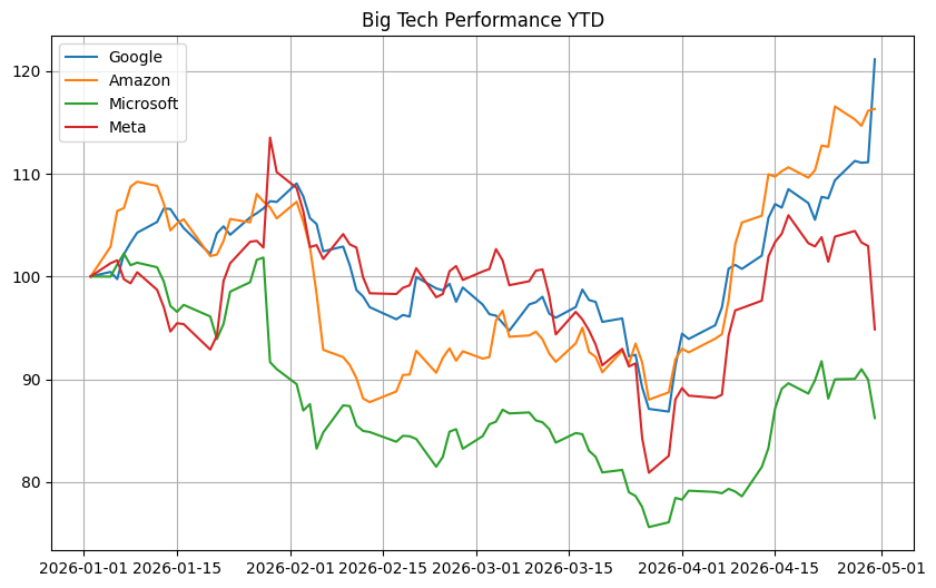
- Big tech reported strong earnings, with Google and Amazon emerging as winners due to their strong cloud segments driving growth.
- Despite beating earnings, Microsoft disappointed investors after losing rights to sell OpenAI products while Meta is being pressured by regulatory and legal issues over youth safety.
- Capital spending isn’t stopping in the sector, with all four companies raising their spending plans as they race to build AI infrastructure.
The first quarter of 2026 showed a clear message from tech giants, AI investments are no longer purely speculative, but are increasingly becoming visible revenue drivers.
Earnings from Alphabet, Amazon, Microsoft and Meta showed strong performance driven by cloud growth fueled by AI demand, alongside heavy spending.
Google Cloud Leads Growth with 63% Surge
Google emerged as the main winner among big tech, with Google Cloud revenue rising 63% to $20 billion in Q1, marking its best growth rate since the company began breaking out this segment back in 2020, easily surpassing estimates of 50% growth. ⁽¹⁾
CEO Pichai stated that this earnings call has reached a milestone, noting that enterprise AI solutions have become the main driver of growth for cloud operations for the first time. Sales of these products skyrocketed, highlighting strong adoption among customers.
The company also said it plans to sell TPU chips directly to customers, which are circuits designed to accelerate machine learning workloads. Operating income for the cloud unit tripled to $6.6 billion from $2.2 billion a year earlier. ⁽²⁾
Overall, total revenue rose 22% to $109.9 billion, beating estimates of $107.2 billion while earnings came in at $5.11 per share, smashing its forecast of $2.65 per share.
Amazon Maintains Cloud Leadership Position
Amazon also delivered strong performance in Q1, with its Amazon Web Services segment showing growth of 28% to $37.6 billion, surpassing analysts’ expectations of 25%. ⁽³⁾
While AWS trails Google’s growth rate, it remains the world’s largest cloud services provider by revenue and continues to expand its AI partnerships.
On the earnings front, Amazon reported earnings of $2.78 per share, higher than its forecast of $1.63 per share while revenue increased to $181.52 billion, also coming in higher than its forecast of $177.28 billion.
CEO Andy Jassy confirmed the company maintained its $200 billion capital expenditure target for 2026, reflecting continued investment in AI infrastructure, data centers, and cloud capacity. ⁽⁴⁾
The company has strengthened its AI position through its partnership with Anthropic, while OpenAI’s move away from Microsoft exclusivity could open the door for broader cloud partnerships across the sector.
Microsoft Faces Competitive Pressure Despite Solid Results
Next, Microsoft also beat earnings in its fiscal Q3 report, with EPS coming in at $4.27, surpassing its forecast of $4.06, while revenues also showed a strong figure of $82.89 billion.
Azure cloud revenue showed growth of 40%, with the company expecting Azure growth to be between 39% and 40% in Q4. ⁽⁵⁾
Despite the strong results, Microsoft remains pressured by competitors, especially when it no longer holds rights to resell OpenAI’s products on its cloud following a restructured partnership. ⁽⁶⁾
At the same time, the competitive landscape is evolving. As access to advanced AI models is becoming more widely available across platforms, Microsoft faces increasing pressure from rivals expanding their own AI offerings.
The company continues to scale its efforts in AI integration, adding millions of users to its Copilot segment. But investors are now focusing on the pace of adoption and monetization.
Microsoft just announced its CAPEX plans for this year of $190 billion, far exceeding the $150 billion figure that analysts expected. The increased spending highlights the rising costs associated with building and maintaining AI infrastructure. ⁽⁷⁾
Meta Increases Spending Amid Regulatory Headwinds
Just like Microsoft, spending isn’t stopping anytime soon. Meta just upgraded its forecast for CAPEX and is expected to spend between $125 billion and $145 billion, up from its previous range of $115 billion and $135 billion. ⁽⁸⁾
The increase reflects Meta’s continued investment in AI infrastructure as CEO Mark Zuckerberg is working to integrate AI throughout the company’s operations.
Meta also reported its Q1 earnings, with EPS coming in at $10.44, higher than its forecast of $6.6 while revenue came in at $56.31 billion, also beating its estimate of $55.45 billion. But that news got overshadowed by other factors.
Meta faces mounting pressure from teen social media bans globally and thousands of lawsuits accusing it of designing addictive platforms harmful to children. The company disclosed additional trials scheduled for this year that may result in material losses. ⁽⁹⁾
Meta is also preparing workforce reductions, with reports indicating around 10% of employees could be affected in May as the company reallocates resources toward AI infrastructure.
A Defining Cycle for the Tech Sector
Across the sector, capital spending continues to rise at an unprecedented pace.
The collective investment across Big Tech now approaches unprecedented levels as companies race to build the data center capacity required for AI workloads.
Investors are closely watching whether this massive spending will generate proportional returns as enterprise adoption of AI tools accelerates.