ar
ar
- The ECB is widely expected to hold rates at 2.25% on July 23, after both headline and core inflation eased again in June.
- Renewed Middle East tensions have pushed oil higher, the main risk to the outlook, though Brent remains below its earlier peaks and hasn’t yet forced the ECB’s hand.
- Lagarde is sticking to a meeting-by-meeting approach, keeping another hike on the table later this year if inflation or energy pressures persist.
The European Central Bank meets on Thursday, and most signs point to a pause. After raising rates in June for the first time in nearly three years, policymakers now face a familiar problem.
The conflict in the Middle East, which briefly cooled off after a short-lived ceasefire, has flared once again. Oil prices are back up, reviving some of the same pressures that pushed the ECB to act last month.
Still, most analysts expect the central bank to hold its deposit rate at 2.25% this week, leaving the door open for another move in September.
Why a Pause Looks Likely
Inflation for June was released ahead of the ECB’s meeting, which gives the central bank more justification for remaining on hold. Eurozone inflation eased from 3.2% in May to 2.8% in June, the first drop since prices started climbing at the start of the year. ⁽¹⁾
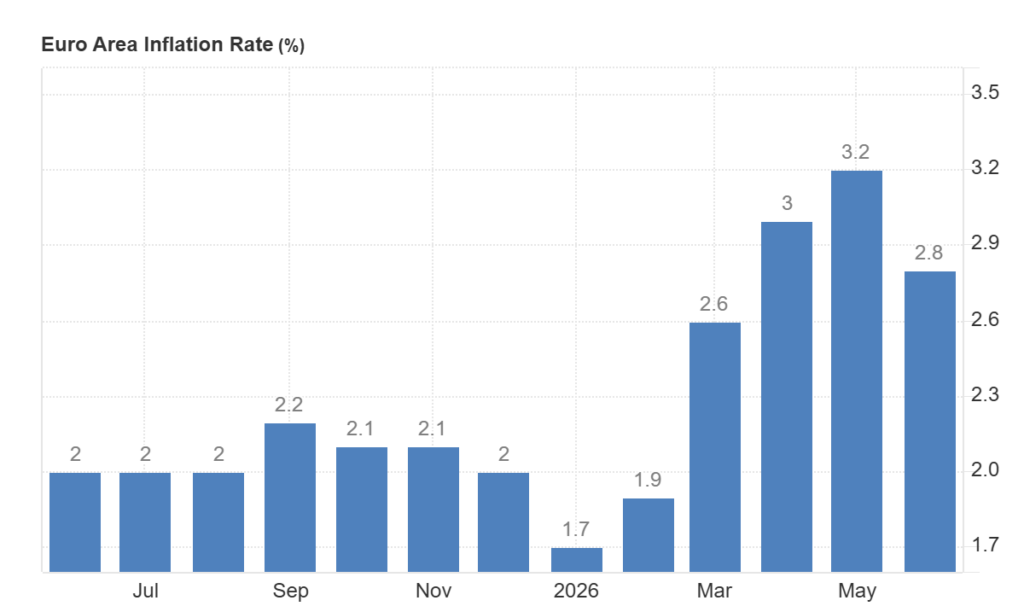
Core inflation also slowed, falling from 2.6% to 2.4%. Services inflation cooled too, and price growth declined across most EU member states. Germany’s inflation rate now sits at 2.3% and France at 1.8%. ⁽²⁾
Oil prices have rebounded but remain well below the peaks seen earlier this year when Brent crude reached $120 per barrel. Current prices are now closer to the milder scenarios the ECB outlined back in June, which gives officials less reason to rush into another hike right away. ⁽³⁾
The Ceasefire That Didn’t Last
The ceasefire agreement between the US and Iran had briefly calmed markets back in June. But it was short-lived after Iran struck commercial vessels and threatened to disrupt regional energy exports, leading to renewed sanctions and a tighter naval blockade from the US.
Greek central bank governor Yannis Stournaras noted that policymakers had hoped diplomacy would limit the economic fallout of the war. That hope has faded somewhat as the conflict resumed and uncertainty around shipping routes through the Strait of Hormuz returned. ⁽⁴⁾
What Businesses Are Expecting
A recent ECB survey of more than 5,000 firms suggests inflation pressures may be easing beneath the surface. Companies now expect selling prices to rise by 3.2% over the next year, down from 3.5% three months earlier. ⁽⁵⁾

Longer-term inflation expectations stayed mostly steady. Businesses see inflation running around 3% over the next one to three years, though the five-year outlook ticked up slightly to 3.1%. ⁽⁶⁾
This data will factor into the ECB’s thinking on Thursday, since wage growth is one of the key drivers policymakers watch to judge whether inflation pressures might be embedded in the economy. ⁽⁷⁾
Lagarde’s Position and What Comes Next
During the ECB’s Sintra Forum, President Christine Lagarde defended the June rate hike, stating that it was a necessary response to persistent inflationary pressures rather than a precautionary move.
She pointed out that the ECB’s own projections show inflation returning to its 2% target only by late 2027, and only with further tightening. Lagarde also declined to commit to any fixed policy path, saying decisions will continue to be made meeting by meeting, based on incoming data.
The ECB isn’t the only major central bank that hiked rates. The Reserve Bank of Australia raised interest rates back in May, while the Bank of Japan lifted its policy rate to a 31-year high of 1%.
For now, the message from Frankfurt is patience. Inflation is cooling, but with oil unpredictable and the war unresolved, the ECB would rather watch than move again.