ar
ar
This week, markets are watching the latest developments in the Middle East, US inflation prints, big bank earnings, Warsh’s testimony and the Bank of Canada’s rate decision. All of these events land in quick succession.
The key theme is around whether inflation pressure is easing or forcing policymakers to stay cautious. Here’s what to watch.
Calendar Events
- US CPI – Jul. 14
- China GDP – Jul. 15
- US PPI – Jul. 15
- Bank of Canada Interest Rate Decision – Jul. 15
- UK Monthly GDP – Jul. 16
- US Retail Sales – Jul. 16
- Eurozone Final CPI for June – Jul. 17
- US Prelim Consumer Sentiment – Jul. 17
Top Things to Watch
1.Hormuz Tensions Rise as Shipping Slows and Oil Climbs
Iran said over the weekend that vessels would require authorization to pass through the Strait of Hormuz. The US disputed the announcement and said an alternative route near Oman remained available.
Shipping activity nevertheless appeared to slow, with reports indicating that only six vessels crossed yesterday and that no LNG tankers entered during the weekend.
Tensions also increased following further US strikes on Iranian military targets. Iran said it responded by targeting US facilities in Kuwait and Bahrain.
The developments have added pressure to last month’s US-Iran agreement. Talks in Oman ended without an agreement, while President Trump said he viewed the ceasefire as over but remained open to further discussions.
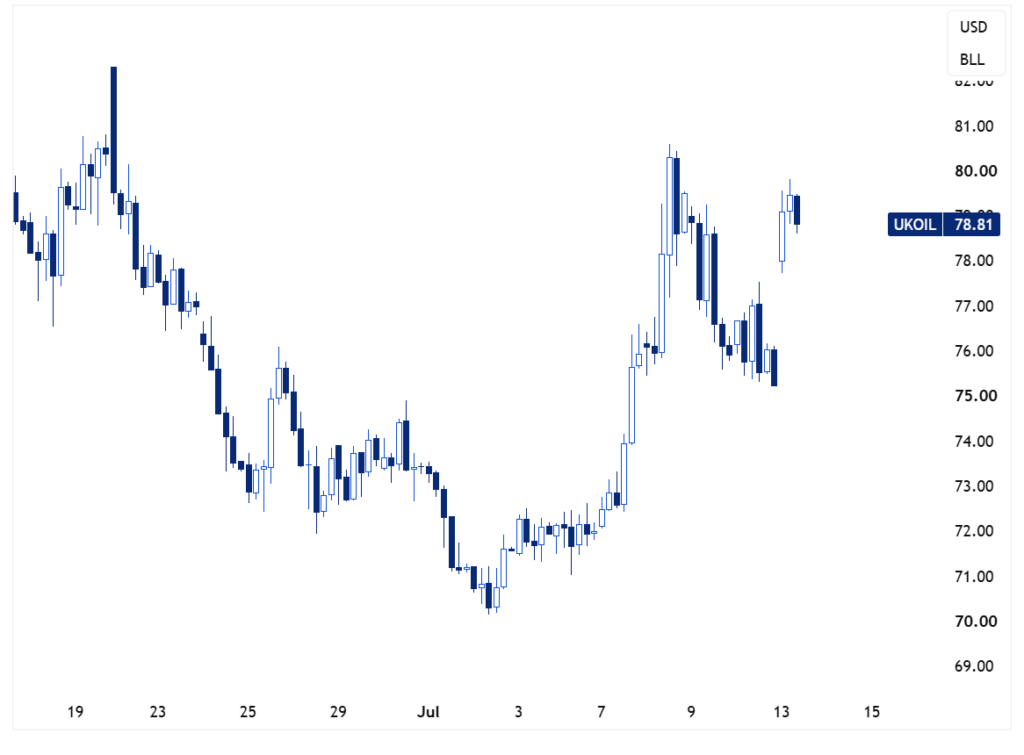
Brent crude rose around 4% toward $79 per barrel earlier today as markets assessed the risk of further disruption to regional energy flows.
2.US CPI and PPI Prints
June’s inflation data lands back-to-back next week, with CPI due on Tuesday and PPI on Wednesday. Both come two weeks ahead of the July 28-29 FOMC meeting, making them the Fed’s last major inflation reads before that decision.
May’s prints ran hot on both sides. CPI rose 4.2% YoY, with energy up 3.9% for the month, extending a run of oil-driven acceleration tied to the Middle East conflict.
PPI was even sharper, where prices climbed 6.5% YoY, the fastest pace since November 2022, with gasoline alone up 23.4% in May and PPI now accelerating for three straight months.
Even though CPI comes first, PPI still matters because it shows whether producer-level inflation pressure is building or easing. Another upside surprise would strengthen the case for tighter Fed policy, while a cooler print would give the Fed more room to stay patient.
3.Big Banks’ Earnings
Q2 earnings season begins this week, with JP Morgan, Bank of America, Citigroup and Goldman Sachs reporting their results on Tuesday, before the market opens, while Morgan Stanley reports on Wednesday. These names could set the tone for the broader earnings season.
Q1 gave a strong starting point. JP Morgan beat expectations across the board, with net income up 13% YoY and revenue climbing 10% to $50.5 billion, driven by surging trading and dealmaking activity.
Goldman Sachs was the standout among the major banks, performing strongly in Q1 and posting record equities trading revenue, which surged 27% on strength in prime financing. Citigroup also topped estimates on strong trading revenue, while Bank of America beat on the bottom line.
Executives across the group flagged that consumers were absorbing higher gas costs tied to the Middle East conflict, but described overall spending as resilient.
4.Warsh’s Testimony Before Congress and the Senate
Fed Chair Kevin Warsh delivers his first testimony to Congress as chair this week. He will appear before the House Financial Services Committee on Tuesday and the Senate Banking Committee on Wednesday, marking his first appearance before lawmakers since taking over in May.
His testimony comes just a week after minutes from his first FOMC meeting described a committee locked in what Warsh called “a good family fight” over rates. Having already withheld his own dot plot projection, this testimony may be the market’s best shot at reading his thinking.
His “AI productivity” thesis remains the key fault line. A stronger emphasis on productivity gains would give markets a dovish read, while a firmer focus on price stability would reinforce the higher-for-longer trade.
5.Netlfix and TSMC Earnings
Netflix and TSMC both report Q2 results Thursday, offering two very different reads on the market. Netflix is expected to post revenue of $12.57 billion, up 13.5% YoY, but this time it is its slowest growth in over a year.
Earnings are forecasted at $0.79 per share, while content costs peak this quarter and ad revenue tracks toward $3 billion for the year.
TSMC, by contrast, heads in with AI demand still running hot, expecting around $40 billion in revenue and $3.81 per American Depository Receipt in earnings, up from $2.47 a year ago, with CEO C.C. Wei describing chip demand as “extremely robust.”
Together, the results will show how consumer demand and the AI boom are holding up.
6.Bank of Canada Interest Rate Decision
The Bank of Canada heads into its Wednesday decision in a cautious but more inflation-sensitive position. After holding rates at 2.25% in June, policymakers are facing soft growth, but higher energy prices and renewed inflation pressure have made further cuts harder to justify.
Canada’s CPI rose to 3.2% YoY in May from 2.8% in April, driven largely by gasoline and transport costs. BoC surveys also showed weaker business sentiment, while price expectations remain exposed to oil, tariffs, and broader cost pressures.
With inflation running hot and growth running cold, the BoC has little room to move either way on Wednesday.