ar
ar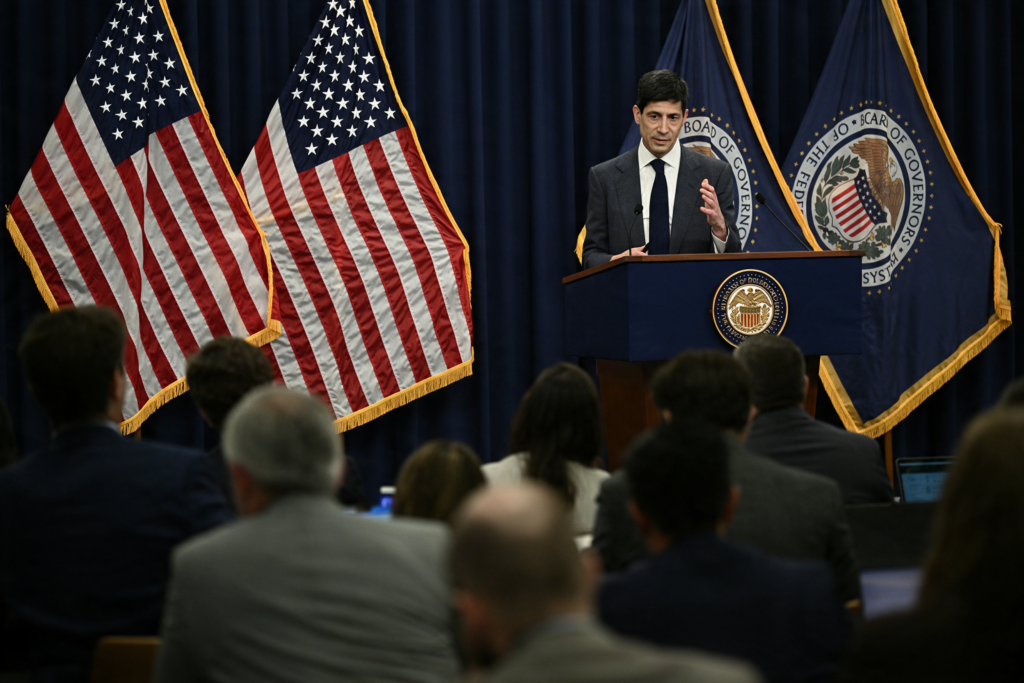
- The FOMC announces its decision tomorrow, with market pricing having moved decisively toward a hike over the past three weeks.
- The build in those odds started with Chair Warsh’s Jackson Hole speech in late August, not with last week’s inflation data.
- For GCC readers, one mechanism worth watching runs through the dirham’s dollar peg into local borrowing costs.
The Federal Open Market Committee starts its two-day meeting today, with the rate decision and updated projections due tomorrow. ⁽¹⁾
The starting point is a target range of 3.50%-3.75%, held since December 2025 and most recently maintained on 29 July in a 9-3 vote. ⁽¹⁾
Market pricing has shifted a long way since then. Ahead of Warsh’s Jackson Hole address on 28 August, CME FedWatch put the probability of a September hike at around 36%.
It moved above 50% after the speech, firmed on a stronger than expected August jobs report, and sat near 70% going into last week’s inflation release. ⁽²⁾ Following the CPI report on 11 September, that probability rose to 94%. ⁽²⁾
What the Inflation Data Showed
Headline CPI rose 0.4% in August, holding the annual rate at 3.4%. Both figures matched consensus.⁽³⁾ The surprise sat in core inflation, which excludes food and energy and came in at 0.3% monthly, a tenth of a point above forecast, ending three consecutive softer readings. ⁽³⁾ On an annual basis core eased to 2.4% from 2.5%. ⁽³⁾
Looking deeper at the composition, gasoline rose 3.9% in the month and 27.4% over twelve months, and BLS attributed more than a third of the headline increase to gasoline alone. ⁽³⁾
That sits outside the core measure. The core acceleration came from shelter, which rose 0.3% after two softer months, and from non-housing services, which posted their strongest monthly gain since January. ⁽³⁾
Energy remains the main driver for inflation. Oil prices have climbed above $100 per barrel amid renewed Middle East tensions, feeding directly into headline inflation and raising transportation and other business costs over time. ⁽³⁾

What the Market Is Pricing In
A hike would lift the target range to 3.75%-4.00%. ⁽²⁾ It would be the Committee’s first increase after holding through 2026. Almost all of the remaining probability sits with a hold. ⁽²⁾
The projections carry unusual weight this time. Chair Kevin Warsh declined to submit his own dot to the June Summary of Economic Projections, saying individual rate projections were not helpful to the current policy setting. ⁽⁴⁾
The June dot plot shifted from a median projection of one cut in March to a median projection consistent with one hike, with nine of eighteen participants expecting at least one increase in 2026. ⁽⁴⁾
With less explicit guidance coming from the Chair, markets have fewer official anchors for reading the path beyond this meeting.
How Markets Could React
High uncertainty surrounds the Fed meeting, as the decision could drive sharp volatility across Treasury bonds, currencies, stocks and gold. Even if the decision came in as expected, changes in the dot plot and Warsh’s comments could lead to rapid repricing as markets reassess whether the decision is a one-off adjustment or the beginning of a new tightening cycle.
The UAE Angle
Because the dirham is pegged to the US dollar, the Central Bank of the UAE has moved in lockstep with Fed decisions for decades. Its benchmark rate has sat at 3.65% since December 2025. ⁽⁵⁾
Whatever the FOMC decides tomorrow, CBUAE’s own rate typically adjusts within the same news cycle, feeding directly into mortgage rates, corporate lending costs, and short-term deposit yields across the UAE. ⁽⁵⁾
That transmission happens mechanically, regardless of what the decision is. The peg leaves little room for CBUAE to diverge from Washington’s decision, a mechanism explored further in Daman’s earlier look at the dirham’s dollar peg.