ar
ar
- US payrolls surged by 162,000 in August, sharply beating forecasts, while the unemployment rate held at 4.1%.
- The stronger labor market pushed Treasury yields higher and lifted the probability of a September Fed rate hike to around 60%.
- Inflation data will now determine the Fed’s decision as President Trump intensifies pressure on the central bank to cut rates.
The US labor market came back strong in August. Employers added far more jobs than economists expected, and traders have moved back to betting the Federal Reserve raises rates when it meets next week.
The timing is awkward for the White House. President Trump has spent months pushing the Fed to cut, and on Friday he threatened to stop trading with countries that run surpluses with the US unless it does.
A Stronger Than Expected Report
August’s Nonfarm Payrolls showed an increase of 162,000 jobs, more than triple the 53,000 gain that economists had estimated. The unemployment rate held steady at 4.1%. The jobs report was the best monthly gain since March this year, reversing summer’s slowdown in hiring. ⁽¹⁾
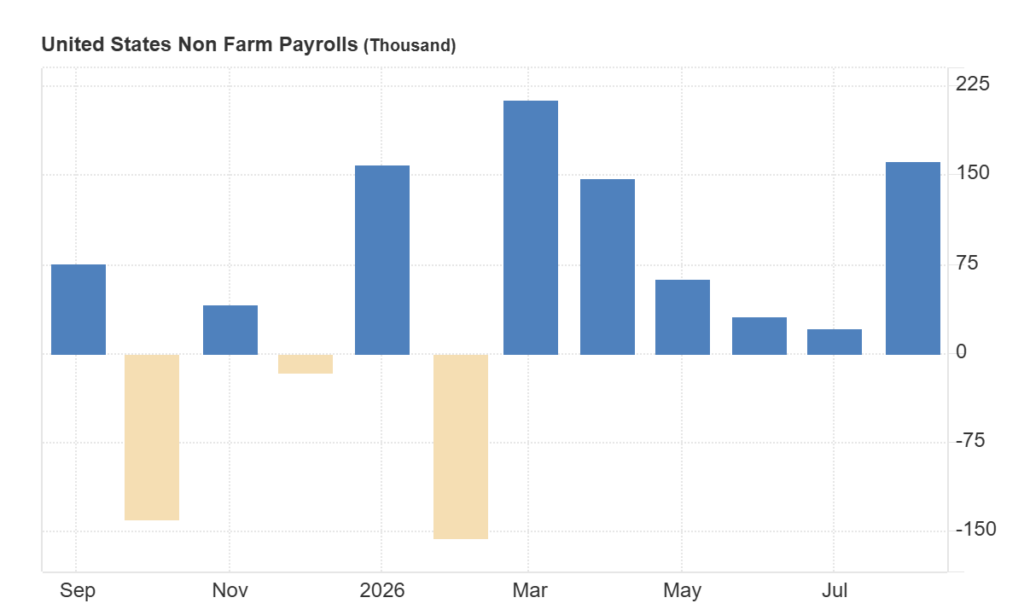
Prior months were revised higher as well. July’s job count swung from a loss of 23,000 to a gain of 21,000, while June was revised up to a gain of 31,000. Job growth was also broad-based this time, unlike in recent months. ⁽²⁾
Restaurants and bars led with 59,000 new positions, followed by gains in government education and manufacturing. Health care, usually the biggest driver of job growth, added a modest 13,000 positions, well below its recent monthly average. The information-related industries sector was the weak spot, losing 23,000 jobs. ⁽³⁾
Behind the Steady Unemployment Rate
The unemployment rate held steady, but the reason behind it was an optimistic one. More people entered the labor force during August, leading to a rise in the participation rate to 61.6%. That increase was driven largely by people moving straight from outside the workforce into jobs, rather than by discouraged workers giving up their search. ⁽⁴⁾
A broader measure of unemployment, which includes discouraged workers and those in part-time jobs for economic reasons, fell to 7.7%, its lowest level since June 2025.
Wage growth stayed in a range consistent with the Fed’s inflation goals. Average hourly earnings rose 0.3% for the month and 3.1% over the past year, slightly above forecasts but not seen as alarming. ⁽⁵⁾
Markets Price in Higher Odds of a Hike
The report quickly shifted expectations for the upcoming Fed decision. Treasury yields rose after the release, with the 2-year yield climbing 7.4 basis points to 4.42% due to its sensitivity to Fed policy. Gold dropped 1.60% while the US dollar held steady against major currencies.
Traders raised the probability of a quarter-point rate increase at the Fed’s September 15-16 meeting to about 59%, up from roughly 55% before the data came out. ⁽⁶⁾
The employment report alone makes it hard to justify keeping rates unchanged, though next week’s inflation data will likely carry more weight in the final decision.
Trump Escalates Pressure on the Fed
President Trump responded shortly after the report by renewing his call for lower rates, even as strong employment and above-target inflation strengthened the case for tighter policy. He urged the Fed’s leadership to “get smart” and argued that high rates put the US at an unfair disadvantage.
In an unusual move, Trump also threatened to cut off trade with nations that hold a trade surplus with the US, a group that includes more than 90 countries, unless the Fed lowers rates. It marked the first time he has tied a trade threat directly to Fed policy. This move could push the global economy toward a slowdown and raise recession risks at home. ⁽⁸⁾
Despite the pressure, Fed Chairman Kevin Warsh has not been targeted personally the way his predecessor Jerome Powell once was. Still, the mixed signals from Fed officials show the decision is far from settled.
Governor Christopher Waller has said he would support holding rates steady if inflation data continues to cool, while other officials have expressed similar wait-and-see views. ⁽⁷⁾
Next Up: Inflation
Attention now turns to this week’s inflation reports, with producer prices due on Thursday and consumer prices due on Friday.
Those numbers are expected to be the deciding factor for the Fed’s September meeting. Officials have said repeatedly that a hike would still depend on inflation data failing to show further improvement, even with the labor market running hot.