ar
ar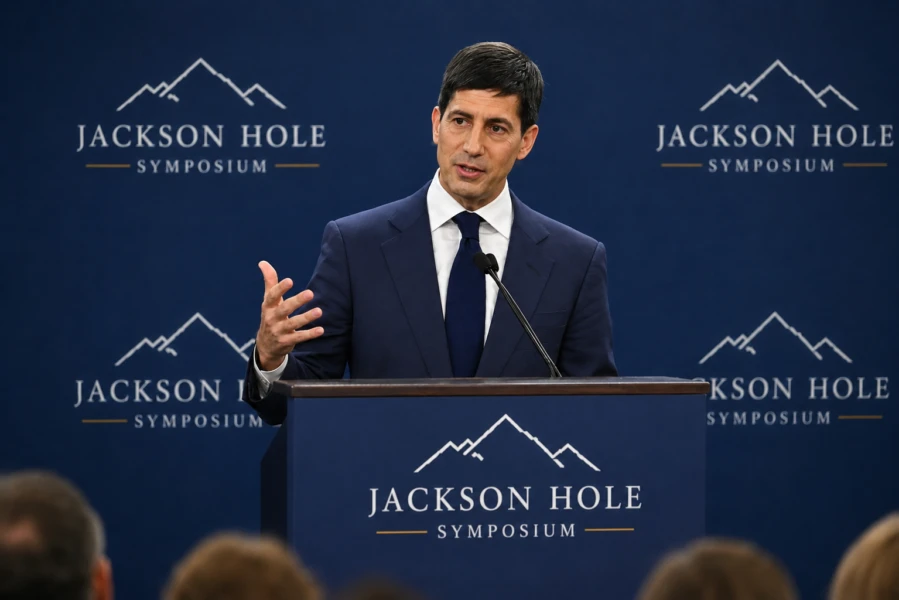
- Fed Chair Warsh warned in Jackson Hole that inflation remains too high and said the Fed has “work to do” if that doesn’t change.
- Markets repriced fast, lifting September hike odds from around 40% to nearly 60% and pushing the two-year Treasury yield to a one-month high.
- He refused to commit to a path, arguing that a resilient economy, stable labor market and loose credit conditions leave the Fed room to act without promising when.
Federal Reserve Chairman Kevin Warsh used his first Jackson Hole address last Friday to deliver a message markets had been waiting months to hear.
While speaking, Warsh acknowledged that inflation is stubbornly high and hinted that further rate hikes could be on the table if price pressures don’t ease.
Markets quickly got the message, with stocks moving lower and Treasury yields climbing as traders increased bets on a September rate hike.
A September Hike Returns to the Table
Warsh stopped short of committing to a certain path for interest rates, but his tone showed a shift from vague statements since he took office back in May.
He told the audience that recent progress on inflation has been modest and that softer readings during the summer do not prove that the trend is changing. ⁽¹⁾
The Fed needs confidence that inflation is heading toward its 2% goal “clearly and at sufficient speed.” Anything less, he said, means there is still work to do.
That language was enough to move markets. The CME Group’s FedWatch tool showed the probability of a September hike jumping to nearly 60%, up sharply from last week. ⁽²⁾
The policy-sensitive two-year Treasury yield climbed 12 basis points, touching its highest level since late July.
No Road Map, No Policy Promises
One of the clearest threads running through the speech was Warsh’s continued resistance to traditional Fed communication. He argued that forward guidance, the practice of previewing future policy moves, has “overstayed its welcome” and that markets should focus on economic data rather than anticipating the Fed’s next step.
He also declined to lay out a formal reaction function, telling the audience that policymakers’ knowledge simply does not extend far enough to promise a fixed rule for how they would respond to changing data. ⁽³⁾
Instead, Warsh described his approach as a discipline, stressing flexibility rather than fixed commitments. He wants a “quieter” central bank, one where investors stop treating every Fed statement as a trading signal. ⁽⁴⁾

Divisions Inside the Fed Deepen
Behind the speech lies a divided FOMC. Three policymakers already dissented at last month’s meeting in favor of raising rates, and others have shown signs they could follow.
The debate centers on whether inflation has stayed elevated because of temporary shocks, such as tariffs and tensions tied to the Middle East conflict, or because demand continues to outpace supply, giving businesses room to keep raising prices.
Warsh also pushed back on a common argument for patience that moderate wage growth signals inflation should cool naturally over time. He dismissed this idea directly, noting that wages have not been a reliable predictor of inflation for years. ⁽⁵⁾
Economy Holds Up, For Now
Despite the inflation warning, Warsh struck a fairly upbeat tone on growth. He pointed to resilient consumer and business spending, along with continued gains from artificial intelligence investment, as signs the economy remains on solid footing. ⁽⁶⁾
He acknowledged a slowdown in hiring but attributed it mainly to a flattening labor supply rather than weakening demand. ⁽⁷⁾
Importantly, Warsh said current borrowing costs are doing little to slow the economy. Credit and lending conditions, he noted, show few signs of restraint, a comment that could support the case for tightening further if inflation stays elevated. ⁽⁸⁾
Warsh’s remarks leave the Fed in a delicate spot heading into its September 15-16 meeting.