ar
ar
- Hiring slowed sharply in June, with the US adding just 57,000 jobs, well below forecasts.
- The unemployment rate still dipped to 4.2%, but that’s because fewer people were looking for work, not because more people got hired.
- With hiring cooling and wages steady, the Fed has little pressure to hike or cut rates anytime soon.
The US labor market appears to have lost steam heading into summer, based on the latest jobs report markets received yesterday.
Hiring cooled sharply, coming in well below what economists had expected, even as the unemployment rate ticked down.
That combination points to a more complicated story than the headline suggests, one where fewer people working doesn’t necessarily mean the job market is falling apart.
The report made the situation look more like a slowdown than a collapse, and the data now gives the Federal Reserve more room to stay patient on interest rates.
The Numbers Behind the Slowdown
June’s labor market report showed that the US economy only added 57,000 jobs, coming in far below its forecast of 110,000. ⁽¹⁾
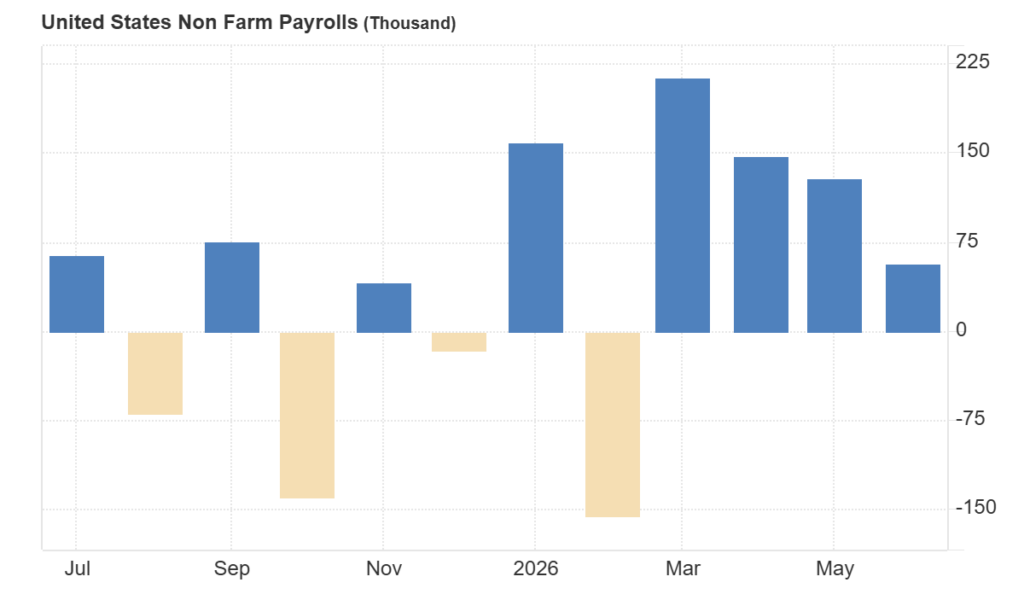
The household survey showed a much weaker labor market picture, with employment falling by 507,000 during the month.
At the same time, the labor force participation rate dropped to 61.5%, its lowest level since March 2021, suggesting that more people left the labor force rather than continuing to search for work. ⁽²⁾
That decline in participation helped explain why the unemployment rate still fell to 4.2% from 4.3% in May. With fewer people counted as part of the labor force, the unemployment rate can move lower even when the number of people actually employed is falling. ⁽³⁾
Where the Jobs Came From, and Where They Didn’t
Business services led the way in gains, creating 36,000 new jobs, while social assistance added 25,000, and healthcare showed an addition of 22,000, though that pace was slower than usual for the sector. Government jobs only came in at 8,000. ⁽⁴⁾

Leisure and hospitality was the main weak spot in the report, shedding 61,000 jobs. The sector had added 70,000 jobs in May, which was a strong gain for the industry. However, the Bureau of Labor Statistics pointed to slower than usual seasonal hiring as the main factor for job losses in the sector. ⁽⁵⁾
Some economists had hoped the World Cup would give hospitality a boost this summer, with Goldman Sachs estimating a possible 40,000-job lift. That didn’t materialize in this report. ⁽⁶⁾
Wage growth remained steady. Average hourly earnings rose 0.3% MoM and 3.5% YoY, both matching expectations and giving no sign that wage pressures are accelerating.
Markets React, Fed Stays on Hold
Stock indices ended mixed yesterday after the release of the report as traders scaled back bets on a September rate hike.
Treasury yields moved lower, with the 2-year yield down 3.5 basis points to 4.13%. Before the report, markets had priced in roughly a 50.7% chance of a September hike. That probability faded quickly once the weak payroll data hit the tape.
During his appearance at the ECB’s forum, Fed Chair Kevin Warsh described the labor market as “steady” in comments made just a day before the release, while keeping his focus on bringing inflation back to the Fed’s 2% target.
Inflation has stayed above that goal for five straight years, which is now at 4.2%, worsened recently by the Middle East conflict and lingering tariff effects.
Economists broadly agreed the report gives the Fed no reason to move on rates anytime soon. The labor market remains strong enough to hold the unemployment rate steady, without wage growth showing signs of overheating. ⁽⁷⁾
Markets expect the Fed to stay on hold during the summer. Following the jobs number, traders took a potential September hike off the table, though expectations still point to a potential hike in October. ⁽⁸⁾
The Bigger Picture
Despite the miss in jobs, most economists don’t see this as a turning point for the labor market.
The slowdown could be marked as a short-term pullback after three consecutive months of strong job gains, bringing payrolls in line with softer readings from other labor market surveys, including small business hiring plans. ⁽⁹⁾
With geopolitical tensions easing, economists could expect labor market risks to ease further, supporting a steady pace for hiring throughout the rest of 2026.