ar
ar
- The US labor market brought another month of job gains, with Nonfarm Payrolls coming better than expected in May, while the unemployment rate held steady.
- Wage growth stayed firm, keeping inflation concerns alive and possibly giving the Fed more reason to keep rates higher for longer.
The American labor market surprised economists and investors in May, adding far more jobs than expected.
The latest data from the Bureau of Labor Statistics showed the economy is standing on solid footing, even as the Fed holds interest rates steady and Middle East tensions weigh on global markets.
Payrolls Jump Well Past Forecasts
The US economy extended its gains in the labor market, adding 172,000 jobs in May to come in well above its forecast of 85,000.
The April figure was also revised upward to 179,000, a gain of 64,000 from the initial reading, while March was lifted to 214,000. The unemployment rate held steady at 4.3% for a third consecutive month. ⁽¹⁾
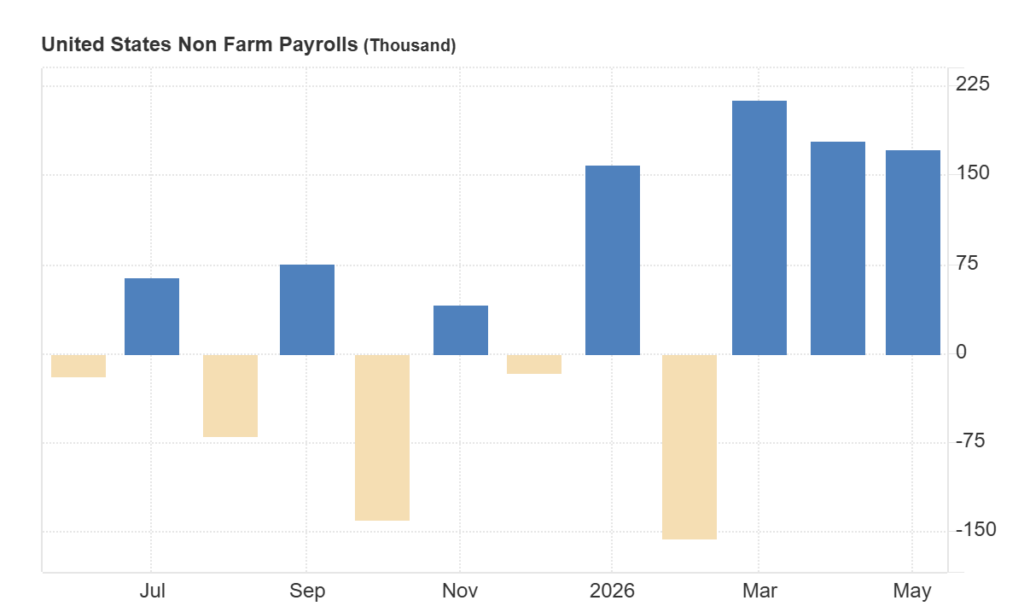
The numbers were stronger than markets were expecting, with estimates from various institutions ranging from 50,000 to 125,000, indicating how cautious forecasters are becoming due to subdued hiring.
The actual result fell well outside the top of that range, suggesting the labor market is more resilient than many assumed. ⁽²⁾
Hospitality Leads the Way, Wages Remain High
Leisure and hospitality led the way in job gains, adding 70,000 jobs in May, way above its monthly average of almost 14,000. Government jobs showed an additional 50,000 positions, while healthcare created 35,000 jobs. ⁽³⁾
Average hourly earnings rose 0.3% for the month and were up 3.4% compared to a year ago, both figures in line with Wall Street expectations. Wage growth at this level remains elevated enough to keep inflation concerns alive, even if it shows some moderation from earlier peaks. ⁽⁴⁾
A “Slow-Hire, Slow-Fire” Labor Market
Despite the strong print, economists are warning that the labor market might become subdued in the future, with businesses scaling back on hiring as uncertainty persists, mainly from tariffs and the Middle East conflict, which sent energy prices high.

Layoffs have been low, which in turn is helping to keep the unemployment rate stable. This dynamic has led economists to describe the current environment as a “slow-hire, slow-fire” equilibrium, one where neither significant job creation nor large-scale job losses dominate.
There are no clear signs yet that the Middle East conflict is directly affecting employment levels. ⁽⁵⁾
Fiscal Support and Corporate Profits
One reason businesses have been able to hold off on layoffs is that corporate profits have been supported by fiscal measures.
After the US Supreme Court struck down a set of tariffs earlier this year, some companies filed for tax and tariff refunds, which contributed to a $40.4 billion increase in corporate profits in the first quarter. Rising profits have reduced the pressure on firms to cut headcounts. ⁽⁶⁾
What This Means for the Fed
The strong jobs report could give the Federal Reserve more justification to keep interest rates unchanged. Fed officials have shifted their focus from labor market concerns to persistent inflationary pressures, which have ruled out rate cuts for this year and probably for next year.
Financial markets currently expect the Fed’s benchmark rate to remain at 3.75% well into 2027.
Rate Hike Risk is Back
Beyond pushing rate cuts out of the picture, May’s jobs report has brought back a major debate on whether the Fed’s next move could actually be a rate hike. Some economists are now flagging this as a credible risk, especially if inflation is well above the 2% target.
Treasury yields moved heavily on Friday, with the 2-year yield, which is the most sensitive to changes and expectations from the Fed, jumping 11 basis points to 4.16%, hitting its highest level since February 2025. The 10-year yield rose 6 basis points to 4.54%.
The sector hit the hardest was tech, as higher short-term interest rate increases placed more pressure on stocks that borrow heavily. Investors are now questioning whether all the spending on AI will actually pay off.
The Nasdaq 100 tumbled more than 4%, recording its worst day since April 2025, while the S&P 500 dropped more than 2%, its worst day since last October.
The macro picture may be shifting. With the labor market still strong and inflation sticky, the Fed has removed its options for rate cuts, while the latest jobs report was strong enough to bring rate-hike risks back into focus.