ar

- Japan’s economy was flat in Q3 as weaker household spending and a drag from trade offset stronger business investment.
- Higher import costs and uneven wage gains are squeezing consumers, leaving the BOJ balancing weak demand against persistent inflation pressures.
Japan’s economic recovery has lost its momentum in Q3 as household spending weakened alongside a rise in imports which weighed on growth. Companies however, continued to invest, but higher living costs kept consumers cautious despite rising wages.
The Bank of Japan now faces a tough challenge. The central bank is still willing to hike rates but demand remains fragile, while a weak yen is still contributing to import inflation.
GDP Flattens as Household Spending Weakens
Japan’s GDP in Q3 came in flat, following a 0.4% growth in Q2 and missing expectations against a 0.1% expansion. The reading ended three consecutive quarters of growth. ⁽¹⁾
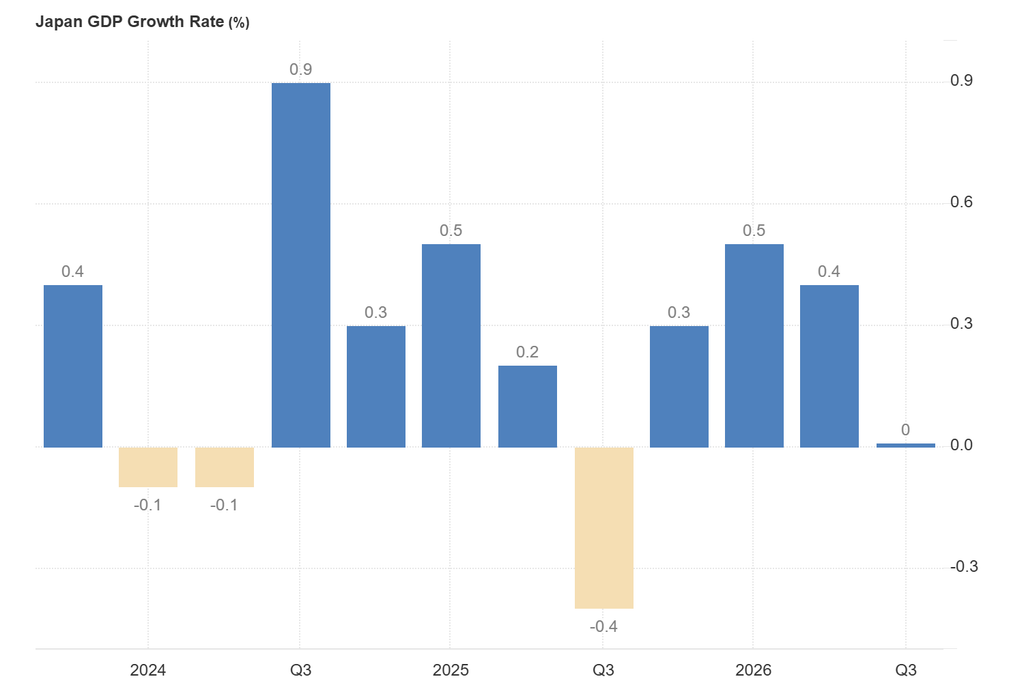
Private consumption declined 0.3%, extending its weakness for a second consecutive quarter. Consumption accounts for more than half of Japan’s output, so now softer household demand weighed on the economy. ⁽¹⁾ ⁽²⁾
Persistent inflation and recent natural disasters contributed to the decline in economic activity. Government consumption also edged lower. ⁽¹⁾
Business investment rose 1.6% after falling 0.4% in Q2, as companies spent more on labor-saving technology and AI projects despite weak household demand. It was a bright spot, but not the only one. The Cabinet Office also reported that domestic demand rose 0.6% and public demand rose 1.8%, while changes in public inventories added about 0.5 percentage points to GDP growth. ⁽²⁾
Trade Delivers the Largest Drag on Growth
Japan, which relies heavily on exports, saw them fall 0.2%, the first drop in a year, while imports rose 2.5%. Both these movements subtracted 0.6 percentage points from quarterly growth. Their impact on growth is weighted by the size of exports and imports relative to Japan’s GDP. ⁽³⁾
The rise in imports was mainly from energy purchases as Japan bought more oil and used more supplies amid Middle East disruptions. So the drag on growth comes partly from restocking energy and partly from weaker exports. ⁽²⁾
Rising Wages Have Yet to Lift Spending
Weak consumer spending comes despite an improvement in wages, with Japan’s nominal wages rising 4.6% YoY in September, while inflation-adjusted wages climbed 2.2%. Households are already pressured by the weak yen, as import prices rose 19.2% annually in the currencies that are used to settle transactions, compared with 24.8% in yen terms. ⁽³⁾ ⁽⁴⁾
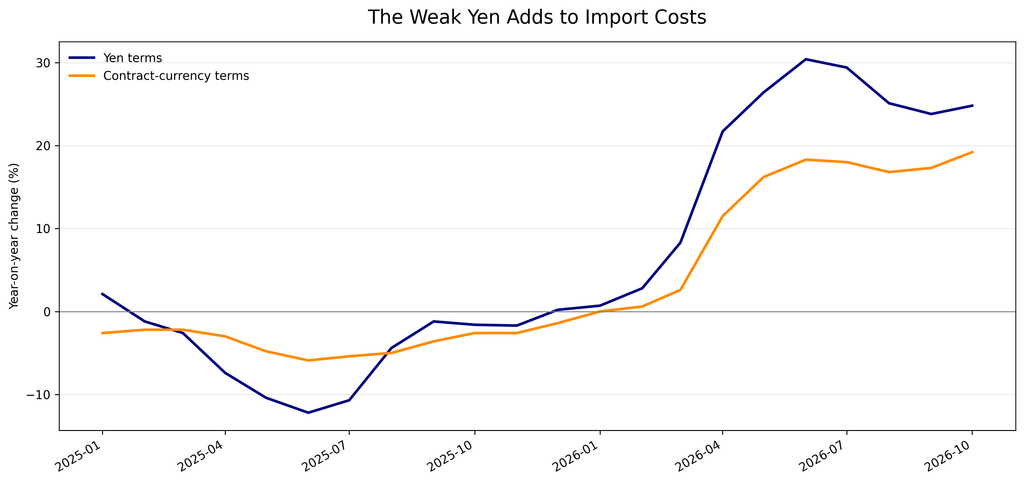
Both lines show how import prices changed compared with the same month a year earlier. Readings below zero during much of 2025 mean imports were becoming cheaper. The sharp rise in both lines in 2026 shows that international price pressures increased, while the higher blue line shows how the weaker yen amplified those costs for Japanese buyers.
In June, import prices rose 30.4% in yen terms, compared with 18.3% in contract-currency terms. By October, the gap had narrowed to 24.8% versus 19.2%, indicating a smaller exchange-rate effect on annual price growth. The blue line’s decline from its peak shows that prices were rising more slowly, with yen-based import costs still almost a quarter higher than a year earlier.
Average employee pay is gaining purchasing power, but that improvement has yet to create a convincing recovery in consumption. Global prices were already high, and sharp swings in currency markets made those purchases more expensive for Japanese buyers.
Businesses have two choices, either absorb those higher import costs through lower margins, or pass these costs onto their customers.
When those increases reach food, electricity and transportation, households could have less income available for other purchases. The Bank of Japan indicated that higher import prices and a weak yen as factors slowing consumption in its October outlook. ⁽⁵⁾
This is a household level concern. The BOJ has found that regular full time wages have failed to keep up with the build-up of inflation. However, bonus payments have helped boost overall households’ income. ⁽⁵⁾
In addition, pension payments have fallen in value over several years meaning that older households are becoming more cautious with their spending. Therefore, higher average wage levels are misleading. ⁽⁵⁾
Weak Demand Complicates the BOJ’s Next Decision
This can complicate the BOJ’s next decision, because further rate hikes would raise borrowing costs while consumption remains weak. However, policymakers are also concerned that keeping interest rates low could continue weaken the yen and increase import inflation.
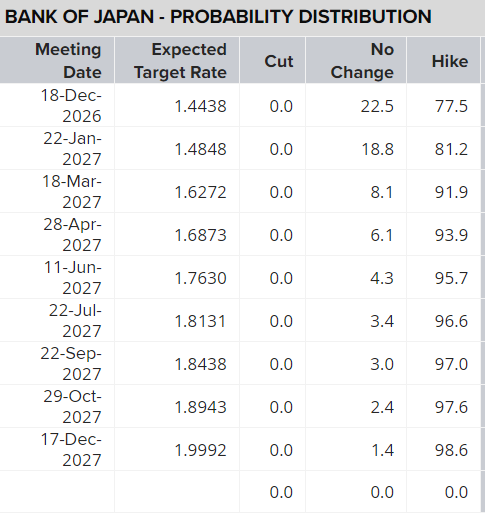
BOJ board member Hajime Takata stated that further rate hikes were needed to contain the bleeding in the yen. With Japan’s policy rate sitting at 1.25%, his remarks kept the possibility of another hike on the table despite weak economic activity. ⁽⁶⁾