ar

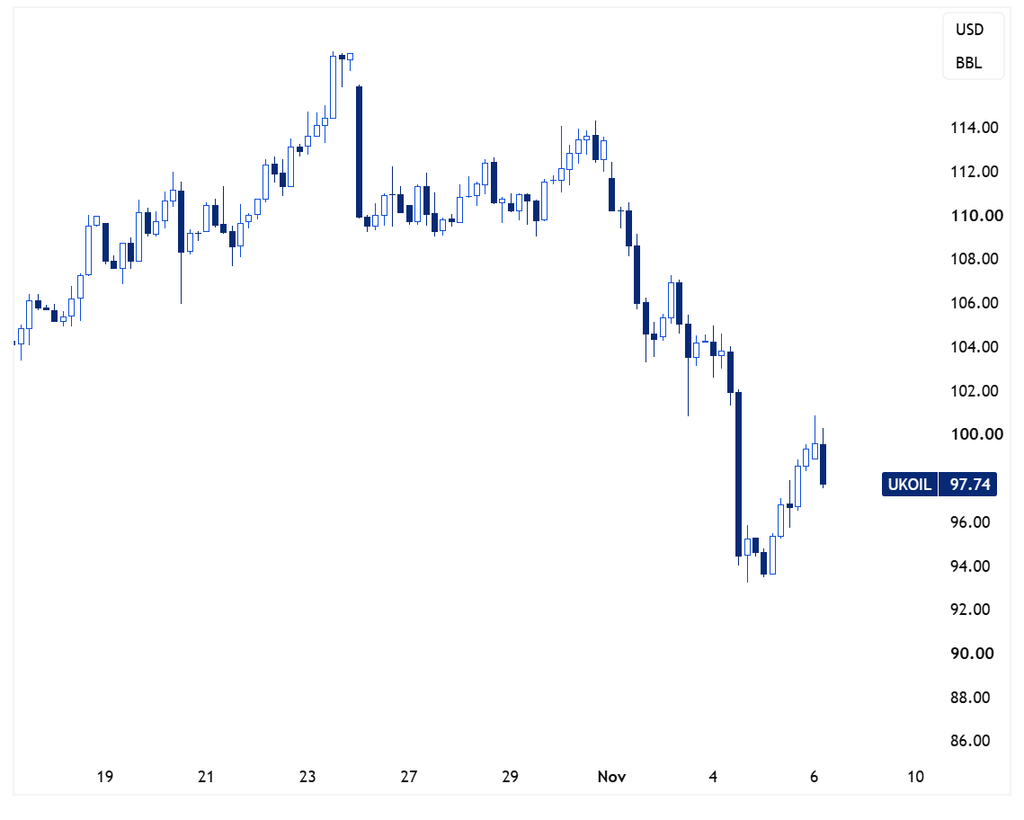
- Brent plunged after the US midterms raised hopes for a deal with Iran. It recovered some of those losses as tanker attacks renewed concerns about Gulf oil supplies.
- Recovering Gulf exports helped widen the global oil surplus in October. A fresh shipping disruption could wipe out that surplus and push the market into a deficit.
- Oil prices sank after the US midterms as traders saw a better chance of a deal with Iran. Then attacks on tankers in the Gulf brought supply fears back into focus.
Brent has recovered some of its losses, but whether the rebound lasts may depend on how much oil keeps moving through the Strait of Hormuz.
Why the Vote Mattered for Oil
Brent fell 8.7% on Wednesday to settle at $94.62, its lowest close since August 31, after Democrats won big in the US midterms.
Vice President JD Vance blamed the Iran war for Republicans’ losses, and President Trump acknowledged that the conflict had hurt the party. Trump had already stated that the US had no immediate plans to strike Iran. With Democrats set to take control of both chambers of Congress, traders saw political pressure on Trump to pursue a deal.
Trump still defended his decision to attack Iran, saying he would make the same choice again.
Iran wants the US to lift its blockade of Iranian ports and waive sanctions on Iranian oil sales as part of a deal to reopen the Strait of Hormuz. Tehran had sent a nuclear proposal through Qatar. ⁽¹⁾
Brent recovered some of its losses after the UK Maritime Trade Operations reported that two unidentified projectiles had struck a tanker north of Qatar.
More Oil is Reaching Buyers
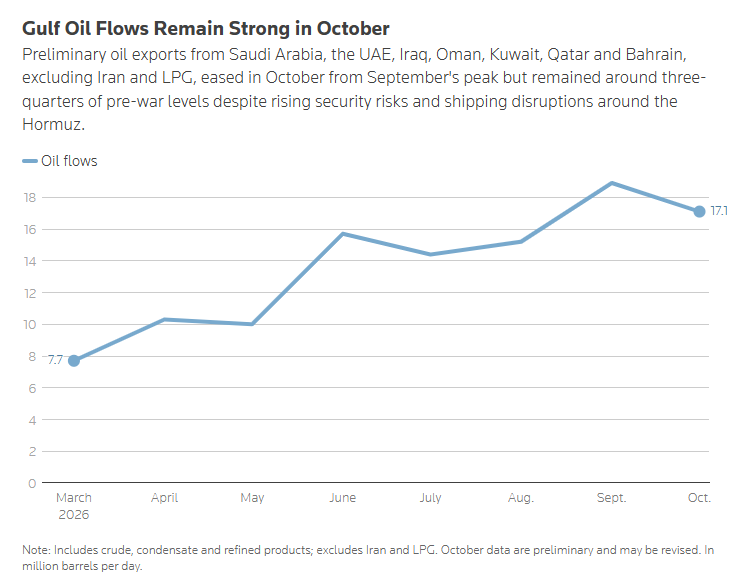
Middle East oil exports have more than doubled from 9.8 million barrels a day in March to around 20.7 million according to JP Morgan. The figure still remains below pre-war levels but the recovery has been enough to change the global balance. ⁽²⁾
Alongside higher production elsewhere and weaker demand, a rebound in Gulf supply widened the bank’s estimated global surplus to 1.4 million barrels a day in October, up from September’s 1.1 million. ⁽³⁾
Ship tracking shows a slightly different picture. Vortexa counts Gulf exports at 17.1 million barrels a day in October, down from 18.9 million in September. JP Morgan tracks broader Middle East oil exports, while Vortexa’s figures cover Gulf shipments of crude, condensate and refined products, excluding liquefied petroleum gas. ⁽⁴⁾
The October dip came as tanker attacks rose, which shows how quickly flows can fall.
Seven OPEC+ producers kept December output targets steady and will meet again on November 29.
Buyers are also paying less for fast delivery. The price gap between the two nearest Brent futures contracts fell from more than $5 a barrel in mid-October to less than $2.50, according to MUFG.
How Much Disruption Would Erase the Oil Surplus?
Using October’s estimated surplus as a starting point, suppose a fresh disruption cuts global oil supply by 1.8 million barrels a day after accounting for any cargoes that can be rerouted. If demand and production elsewhere hold steady, the market would face a 400,000-barrel-a-day shortfall.
Over two weeks, global inventories would fall by 5.6 million barrels instead of rising by 19.6 million.
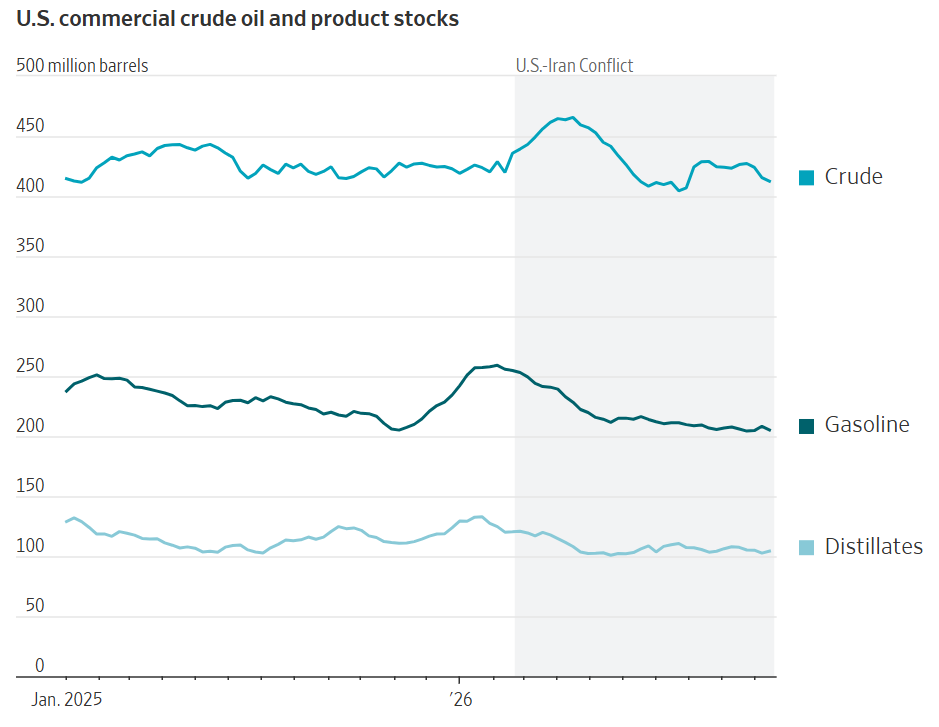
US stocks show why the starting point matters. Commercial crude inventories fell by 865,000 barrels to 409.8 million in the week ending October 30, which is 4% below the five-year seasonal average, according to the EIA.
Distillate stocks, which include diesel and heating oil, were 13% below their five-year seasonal average. Separately, the US Strategic Petroleum Reserve stood at 282.2 million barrels, its lowest level since October 1982. ⁽⁵⁾
Brent has dropped 15% from $118 as hopes for a deal with Iran eased fears of further disruption. If talks halt again or attacks delay more shipments and production, some of that drop could reverse. A rebound alongside a wider premium for earlier delivery could show that traders are growing more concerned about short-term supply.