ar
- Gold and silver remained pressured as a stronger dollar and expectations of tighter US monetary policy weakened their defensive appeal.
- Silver faces additional pressure from weaker industrial demand, while its projected annual supply deficit has failed to prevent further selling.
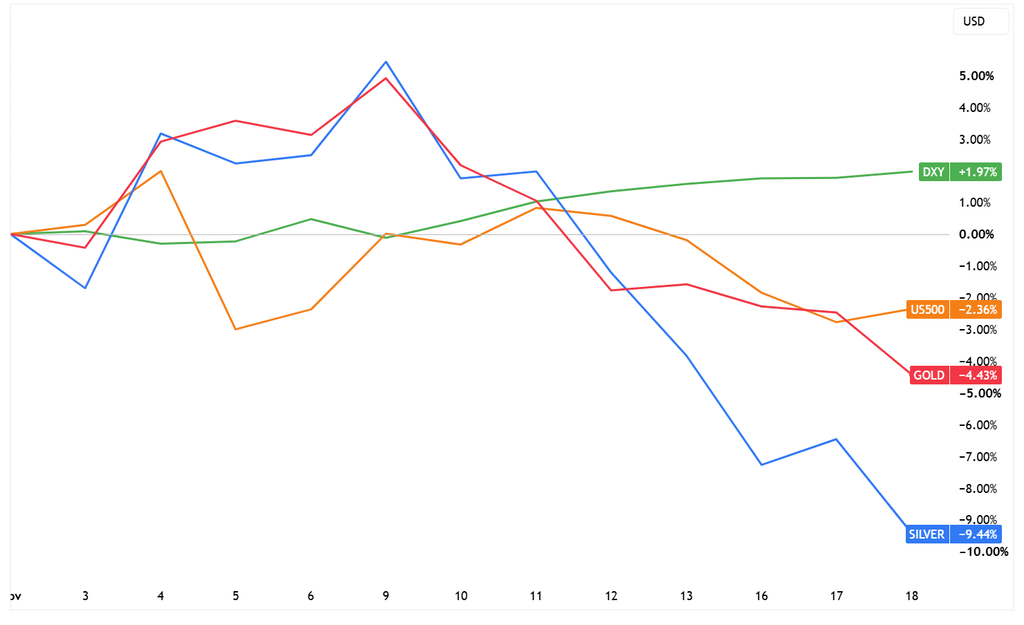
Gold and silver are struggling to provide protection from the latest market turbulence. This week’s selling highlighted how demand for cash and competition from interest-paying assets can outweigh the buying associated with uncertainty.
Gold went below $3,800 an ounce, its lowest since September 2025. Meanwhile, silver was down 3.30% to $45.66, trading at one-year lows.
Cash Needs Weaken Haven Protection
Recent pressure on precious metals reflects higher US interest-rate expectations and, according to market analysts, investors’ need for liquidity. These conditions have weakened bullion’s short-term defensive performance. ⁽¹⁾
During an equity selloff, investors may sell precious metals to raise cash even when they continue to value their longer-term diversification benefits.
The World Gold Council’s latest ETF commentary discussed this possibility, noting that October’s technology-stock turbulence may have encouraged some investors to use gold holdings as a source of liquidity. ⁽²⁾
Fed Hike Bets and Dollar Strength Weigh on Metals
Expectations for a higher Fed funds rate are moving against precious metals. The US dollar index recently climbed to April 2025 highs on hawkish comments from Federal Reserve officials which led traders to price in a 96% chance of a rate hike in December. ⁽³⁾
The rising US dollar also adds another challenge to precious metals by making them more expensive for investors buying in foreign currencies. These factors can weaken the safe-haven status for these metals even if financial markets remain volatile.
Tuesday brought a fresh reminder of the policy risk. St. Louis Fed President Alberto Musalem said: “The economy will likely require several interest rate increases before the spring of 2027 to achieve price stability in a timely manner”. He argued that the current 3.75%–4.00% policy range could be as much as one percentage point below the level needed to return inflation to target. ⁽⁴⁾
New York Fed President John Williams also supported further rate increases on Tuesday, but pushed back against the need for more aggressive action. His comments highlight that support for additional tightening does not necessarily imply support for larger individual increases. ⁽⁵⁾
Persistent inflationary pressures can encourage investors to seek purchasing-power protection while also strengthening expectations of monetary policy tightening.
US Treasury data show that the US 10-year TIPS (Treasury Inflation Protected Securities) rose from 2.63% to 2.92% in 10 days. That 29-basis point increase has raised the return available from an alternative asset to gold.
Silver Faces Weaker Demand Despite Supply Deficit
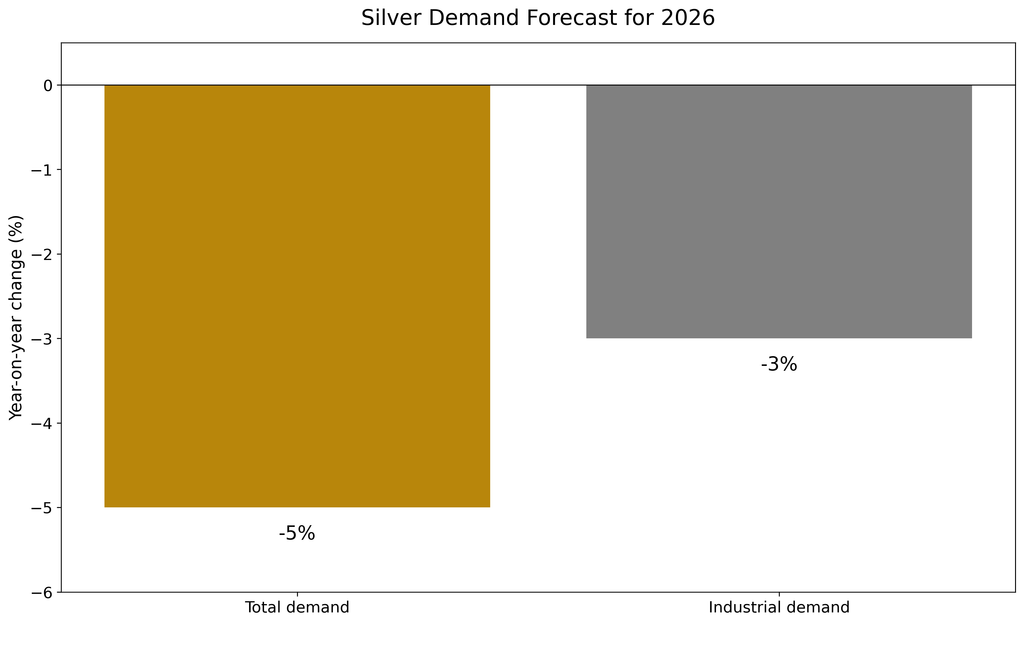
Silver also faces the same pressure alongside a weaker demand outlook. The Silver Institute released an update last week forecasting total demand to fall 5% in 2026 and industrial consumption to decline 3% to 640 million ounces. ⁽⁶⁾
Solar installations have also disappointed expectations, especially in China, while manufacturers have sped up their efforts to reduce their usage of silver and seek alternative materials.
Industrial consumption represents approximately 59% of projected total demand. That exposure leaves silver sensitive to economic activity as well as investment sentiment. As BlackRock put it in its 10 November assessment: “Silver has historically been more volatile and cyclical than gold.” ⁽⁷⁾
The 35-million-ounce deficit is not particularly encouraging in the short term. However, the Silver Institute noted that “The narrower shortfall and metal released through ETP selling have helped ease physical market tightness.”
The deficit can be met by drawing on existing stocks, allowing prices to fall even when demand exceeds newly available supply.
Gold’s Haven Role Depends on the Shock
Gold’s strategic diversification role remains relevant, but it has provided limited protection during the recent selloff. Silver’s larger industrial exposure makes it less reliable as a safe haven.
In the current regime, persistent inflation has strengthened expectations for further tightening from the Fed, lifting Treasury yields and pressuring precious metals. A weakness in growth can lead to a different outcome, especially if yields decline and encourage investors to buy silver and gold.
The Fed’s October meeting minutes is due today, which will provide the next policy direction. Stronger evidence of renewed haven demand would be gold holding its value through another equity decline while the dollar and yields remain elevated. That would suggest demand for protection is overcoming the financial pressures currently weighing on the metal.