

 ar
- The Federal Reserve voted to hold its key interest rate steady at 3.5%-3.75%, citing higher-than-expected inflation and uncertainty from the ongoing war with Iran.
- The closely watched “dot plot” pointed to only one rate cut this year and another in 2027, down from earlier expectations of two cuts before the conflict began.
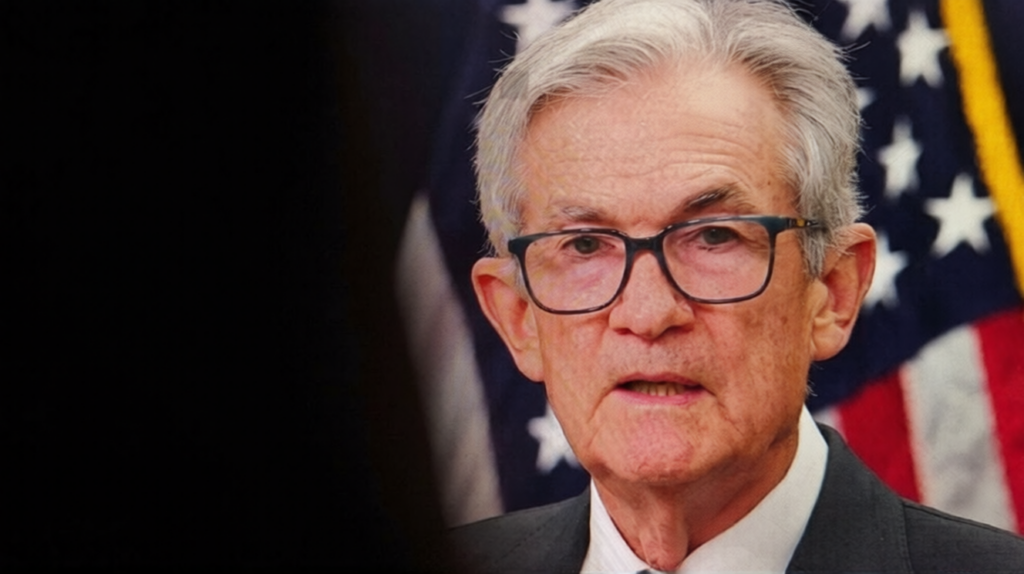
- Fed Chair Jerome Powell said it is “too soon to know” the war’s full economic impact, despite surging oil prices threatening to keep inflation above the Fed’s 2% target.
The Federal Reserve is caught between stubborn inflation, a shaky job market, and an ongoing war in the Middle East. For now, it is choosing to wait.
The Fed Holds Steady
The FOMC voted 11–1 to hold interest rates steady at 3.75%, broadly in line with expectations. The post-meeting statement reflected only modest changes, with officials acknowledging firmer growth and higher inflation than previously anticipated, while keeping their overall policy direction unchanged.
Rate Cuts Still Expected, But Fewer of Them
Despite rising uncertainty, Fed officials still expect rate cuts, though fewer than previously projected. The dot plot now signals one rate cut this year and another in 2027. However, the key takeaway is that the timing of these cuts remains uncertain. ⁽¹⁾
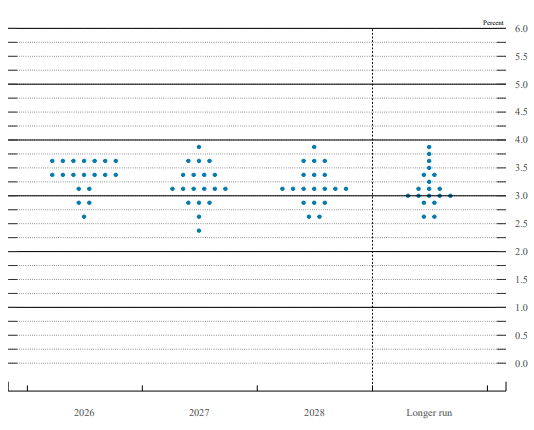
Of the 19 committee members, seven now expect rates to remain unchanged throughout the year, up from six in December, suggesting that confidence in the rate cut outlook is beginning to weaken.
The long-term outlook points to rates settling around 3.1%, with most of the easing happening gradually over the next two years. ⁽²⁾
The War Factor
One of the key challenges facing the Fed is the ongoing conflicts in the Middle East. Disruptions to oil flows through the Strait of Hormuz have driven oil prices up by around 40% since late February. This surge is adding upward pressure on inflation, further complicating the Fed’s policy path.
“The implications of developments in the Middle East for the US economy are uncertain,” the Fed said in its statement.
Fed Chair Jerome Powell echoed this cautious stance during his press conference. He said it was “too soon to know” the full impact of the war and pointed to a recent rise in short-term inflation expectations as a direct result of the spike in oil prices. ⁽³⁾
Before the conflict began, markets had expected two rate cuts this year, with a small chance of a third. Those hopes have now faded. Most investors are now pricing in just one cut, at best, in 2026. ⁽⁴⁾
Growth Up, Inflation Up Too
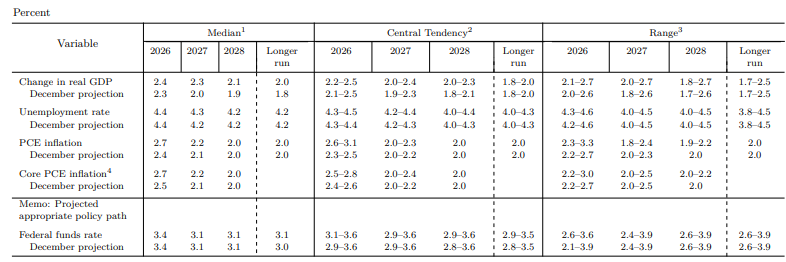
In the Fed’s summary of economic projections statement, Fed officials raised their growth forecast slightly. They now expect the US economy to grow by 2.4% this year, up from their December estimate, and 2.3% in 2027.
At the same time, the inflation outlook was revised higher. The PCE index, the Fed’s preferred inflation gauge, is now projected at 2.7% for this year, remaining above the 2% target.
Officials believe inflation will fall back toward that target in the years ahead, once the effects of the war and trade tariffs begin to fade. The unemployment rate is still expected to end the year at 4.4%, even as recent job reports have come in weaker than expected.
Political Pressure on the Fed
Alongside its existing challenges, the Fed is now also facing political pressure, as President Trump continues to publicly urge Powell and his colleagues to lower interest rates.
Earlier this week, Trump criticized Powell for not calling a special meeting to cut rates, even as inflation remains elevated and the war’s economic impact remains uncertain.
Adding to the tension, Powell may be nearing the end of his time as Fed chair. His term runs until May, and Trump has nominated former Fed Governor Kevin Warsh as his replacement. Warsh is known to favor lower rates, though he has not made any recent public statements clarifying his current views. ⁽⁵⁾
The situation has escalated into a legal and political standoff, as Powell fights a subpoena tied to a Fed renovation probe, dismissed by a judge but now under appeal, while Senate opposition threatens to delay Warsh’s confirmation, potentially keeping Powell in his role beyond May.
Powell stated that he has no intention of leaving the FOMC until the investigation is done.
Dollar Surges, Riskier Assets Fall
As soon as the Fed turned hawkish, financial markets reacted rapidly. The US dollar index surged 0.7% while risk-on currencies suffered major losses, particularly toward the end of Powell’s press conference.
US 2-year yields rose 9.1 basis points to 3.762%, while the 10-year yield rose 5.9 basis points to 4.261%. The Dow Jones fell more than 700 points, reaching a new low for 2026, while the S&P 500 closed 1.4% lower alongside the Nasdaq’s 1.5% drop.
Gold was already under heavy pressure, with the precious metal closing the session 4.5% lower, while oil prices remained elevated amid the ongoing conflict in the Middle East.


