ar
ar
The Japanese yen and Swiss franc are traditionally considered safe-haven currencies, yet both have been under intense pressure this year.
The yen is now trading above 159 per dollar despite repeated intervention, while the rise in USD/CHF from its March low shows that the franc has also weakened against the dollar.
A key force behind both moves is the wide interest-rate differential that favors higher-yielding currencies. However, Japan and Switzerland face very different policy challenges.
Japan wants a stronger yen to contain rising import costs, while Switzerland is trying to prevent excessive franc appreciation from damaging exporters and pushing inflation lower.
Rising JGB Yields Support the Yen
The yen recovered from its 40-year low near 164 following the recent US-Japan intervention in the FX market.
Despite this recovery, the yen remains more than 1% weaker against the dollar this year and around 7.78% lower over the past 12 months. Its recent move could also be viewed as a partial correction rather than a confirmed reversal of the broader trend.
The yen received additional support after the market-implied probability of a Federal Reserve rate hike in September fell to around 31%, from 52% a week earlier. ⁽¹⁾
Changes in rate expectations matter because currencies tend to react to expectations around monetary policy and bond yields. The US 2-year Treasury yield has declined to around 4.19%, while Japan’s 2-year yield has risen to around 1.69%, showing a yield differential of 250 basis points.
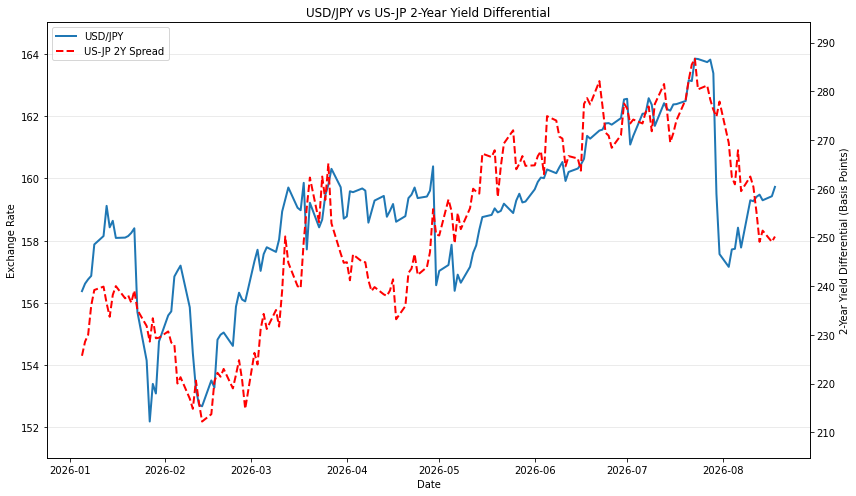
The spread still favors the dollar. Investors can borrow relatively low-yielding yen and invest in higher-yielding US assets, keeping the yen carry trade attractive.
However, the gap is beginning to narrow. Japan’s two-year yield has risen by approximately 25 basis points over the past month as markets price in another Bank of Japan rate increase. The 10-year Japanese government bond yield has also reached 2.93%, its highest level since 1996.
The BOJ raised its policy rate to 1% in June and left it unchanged in July. Markets are now increasingly pricing in another increase to 1.25% at the September meeting. A hike, combined with a sustained decline in US yields, would narrow the rate gap further and provide the yen with more durable support. ⁽²⁾
Intervention Alone Has Not Been Enough
The recent coordinated intervention initially pushed USD/JPY from nearly 164 to approximately 155.20. However, the pair has since returned towards 159, giving back a large part of that move.
The operations slowed the yen’s decline and forced traders to reduce short-yen positions, but they did not remove its underlying yield disadvantage.
A lasting yen recovery would probably require several BOJ rate increases, a sustained decline in US yields or a combination of both.
Weak Domestic Demand Complicates the BOJ’s Decision
Japan’s economy expanded by 0.3% QoQ in Q2, below expectations of 0.5%. On an annualized basis, GDP grew by 1.1%, missing the 2% forecast and slowing from a revised 1.9% in the previous quarter. ⁽³⁾

Private consumption slipped 0.02%, marking its first decline in eight quarters, while capital expenditure fell 1.2% against expectations of a 0.4% increase.
Domestic demand weakened, subtracting 0.2 percentage points from quarterly GDP growth, while net external demand added 0.5 percentage points. The boost mainly reflected a 1.5% fall in imports, partly caused by temporary disruptions to crude-oil shipments through the Strait of Hormuz, rather than strong exports, which rose just 0.5%. ⁽⁴⁾
Exports remained strong, supported by US demand for Japanese hybrid vehicles and global investment in artificial intelligence. But that positive contribution came from net exports, not exports alone. ⁽⁵⁾
Despite the weak GDP report, financial markets continue to expect a BOJ hike in September. Rising fuel costs and yen weakness are increasing import prices and household living expenses, creating a difficult policy trade-off.
Higher rates could support the currency and control inflation, but tighter financial conditions could place further pressure on already-fragile domestic demand.
The Franc has Weakened from its March Highs
The Swiss franc has been on a downward spiral since March, especially against the AUD, GBP and USD.
Since the Middle East conflict began, safe-haven demand faded for the franc, causing USD/CHF to rise from 0.767 in March to 0.81, representing an increase of nearly 6%.
The franc’s safe-haven status has not disappeared yet. However, it has been outweighed by the fading of the initial geopolitical shock, large yield differentials and the Swiss National Bank’s opposition to excessive appreciation.
Switzerland’s Yield Disadvantage is Even Larger
The Swiss 2-year yield is trading around 0.10%, compared with the US 2-year Treasury yield of 4.19%. The US–Swiss yield differential is therefore about 408 basis points, substantially wider than the US–Japan spread.
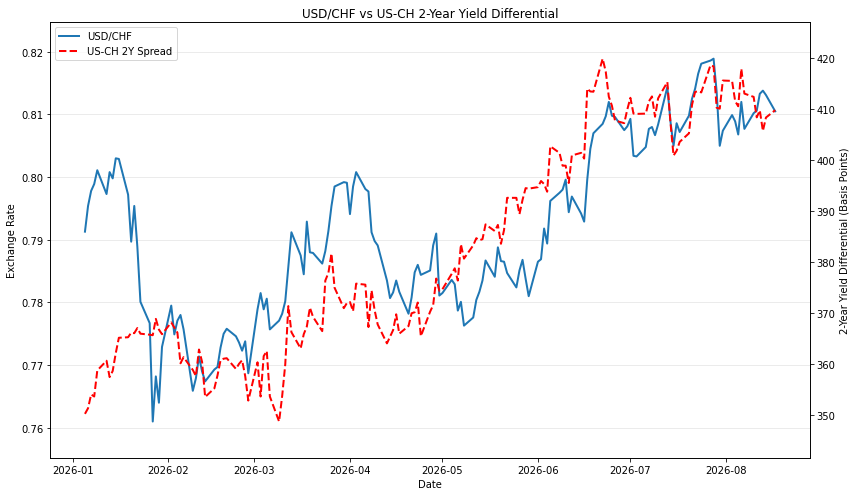
Swiss inflation also eased to 0.4% in July, from 0.5% in June, giving the SNB little reason to raise its 0% policy rate. ⁽⁶⁾
The Swiss economy expanded by 1.5% QoQ in Q2, marking its fastest quarterly pace since 2021. However, part of that expansion may have reflected chemicals and pharmaceutical exporters bringing shipments forward before new US tariffs took effect, making the pace of growth unlikely to continue. ⁽⁷⁾
Unlike Japan, Switzerland is not actively seeking a stronger currency. The SNB has warned that rapid and excessive franc appreciation could damage exporters, reduce import prices and push inflation towards zero or below.
The central bank has therefore maintained an increased willingness to intervene in the foreign exchange market if the franc appreciates too quickly.
Similar Pressure, Different Policy Paths
The key difference is the likely direction of the two yield gaps. Japan’s disadvantage could narrow if the BOJ raises rates while US yields decline, giving the yen a clearer path towards a sustained recovery.
Switzerland’s rate gap is likely to remain much wider because low inflation gives the SNB little reason to tighten policy. As a result, lasting yen strength increasingly depends on monetary-policy convergence, while renewed franc gains may depend more heavily on another surge in global risk aversion.