ar
ar
Markets face a packed week ahead, with major rate decisions from the Fed, Bank of England and Bank of Japan, alongside earnings from Microsoft, Meta, Apple and Amazon.
Here’s what to watch.
Calendar Events
- US Durable Goods – Jul. 27
- Australia CPI – Jul. 29
- Federal Reserve Interest Rate Decision – Jul. 29
- Eurozone Flash Q2 GDP – Jul. 30
- Bank of England Interest Rate Decision – Jul. 30
- US Advance Q2 GDP – Jul. 30
- US PCE Index – Jul. 30
- Bank of Japan Interest Rate Decision – Jul. 31
- Eurozone Flash CPI – Jul. 31
- Canada Monthly GDP – Jul. 31
Top Things to Watch
Federal Reserve Interest Rate Decision
The FOMC meets on July 28–29, and for the first time this cycle, a hike is a real possibility. Markets see roughly a one-in-three chance of a rate increase.
June’s dot plot turned hawkish, with the median projection showing rates ending the year at 3.8%, above where they currently stand. However, this meeting will not have new forecasts for the economy, so there will be no updated dot plot to confirm whether that view still holds.
Adding to the uncertainty, Warsh has removed forward guidance from Fed communications, leaving the statement and press conference to carry the full weight of its policy signaling.
Several officials, including Governors Lisa Cook and Christopher Waller, have highlighted that inflation remains well above target and expressed openness to reconsidering policy if it does not cool.
Big Tech Earnings
Big Tech earnings dominate the week, with Microsoft, Meta, Apple and Amazon set to test whether strong demand can justify rising AI spending and protect margins.
Microsoft and Meta report on Wednesday alongside the Fed decision. Azure growth will be weighed against Microsoft’s heavier AI investment, while Meta faces growing scrutiny over whether its infrastructure push is beginning to squeeze profitability.
Apple and Amazon follow on Thursday. Apple’s focus will be on iPhone demand and services growth, while Amazon could benefit from Prime Day and continued AWS acceleration.
Other major reports include Coca-Cola and Boeing on Tuesday. Coca-Cola enters with strong momentum and an easier volume comparison, while Boeing will look to turn higher production and strong deliveries into narrower losses.
Chevron closes the week on Friday, with oil prices, upstream output, refining margins and free cash flow likely to drive the market reaction.
Bank of England Interest Rate Decision
The Bank of England’s next decision comes on Thursday, July 30, alongside a new Monetary Policy Report. The BOE has held rates at 3.75% since cutting them in December 2025, but the vote split has become increasingly hawkish, moving from one vote in favor of a hike in April to two in June. Megan Greene joined Huw Pill in pushing for a move to 4.00%.
The case for remaining on hold rests on cooling inflation. UK CPI fell to 2.6% in June from 2.8% in May, while services inflation eased slightly to 3.6% from 3.7%. However, the energy backdrop has become less supportive, with Brent climbing back above $100 amid renewed Middle East tensions.
The case for a hike rests on services inflation remaining elevated, the renewed surge in energy prices and the risk that higher inflation feeds into 2027 wage settlements, slowing wage disinflation and keeping price pressures embedded.
Bank of Japan Interest Rate Decision
The Bank of Japan’s next meeting concludes the week on Friday, following June’s 25-basis-point hike, which lifted the policy rate to a 31-year high of 1.00%. The decision passed by a 7–1 vote, with Governor Ueda absent. The BOJ has explicitly signaled that more hikes are coming.
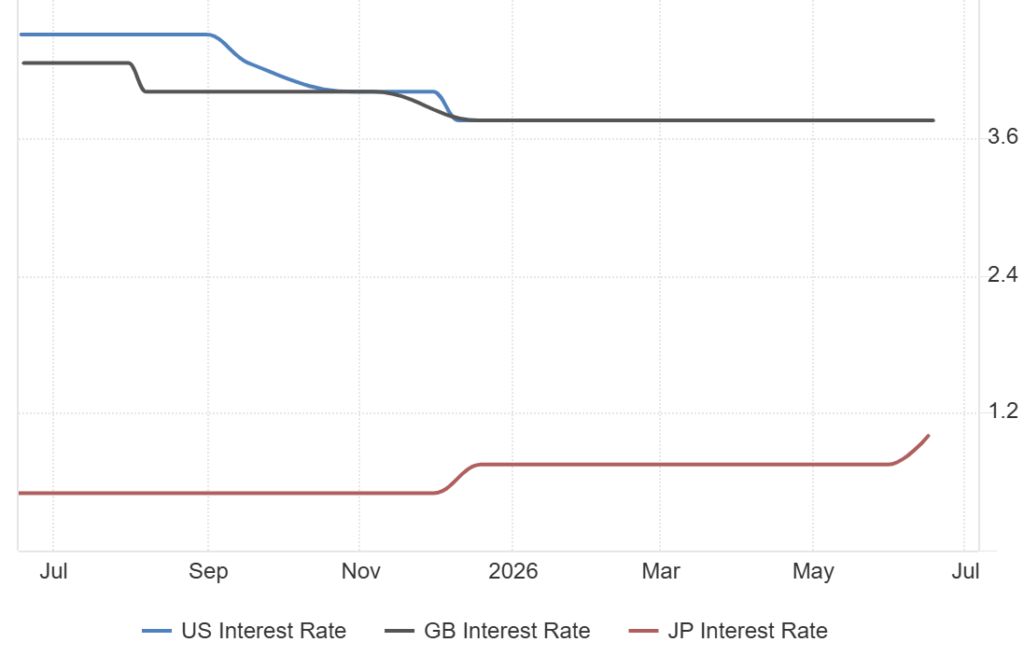
The yen remains the key driver. A roughly $73.5 billion intervention effort in May failed to hold the line, and USD/JPY moved back toward 160 in June, with Goldman Sachs subsequently revising its 12-month forecast to a weaker 165.
A soft yen keeps imported inflation elevated, adding pressure on the BOJ to continue normalizing policy even as it watches for spillovers from the Middle East that could weigh on growth.
Most economists expect the BOJ to hold this time. However, with policymakers maintaining a tightening bias, any hawkish language could add fresh pressure to an already fragile yen.