ar
ar
- A currency carry trade means borrowing in a low-interest currency and investing the funds in a higher-yielding one, profiting from the rate gap between them.
- The strategy is a clear example of how rate differentials can affect currency markets.
- It carries a well-known risk. When the rate gap narrows or risk appetite drops, unwinding carry trades can move markets fast, as seen in August 2024.
Interest rate decisions can influence where investors borrow and where they invest, as these choices connect currencies with other financial assets, allowing a change in borrowing conditions or market confidence to spread across markets.
Understanding how currency carry trades are built and unwound helps explain why currencies can move sharply when interest-rate expectations or investors’ appetite for risk change.
How Currency Carry Trade Works
In its simplest form, a carry trade involves borrowing in a currency with a low interest rate, converting the funds into another currency, and investing in an asset offering a higher yield.
The currency used to borrow is called the funding currency or selling it. The currency purchased is the investment currency.
This selling pressure tends to weaken the funding currency and strengthen the target one, at least while the trade is being built up across the market. However, the investor must eventually convert the proceeds back into the funding currency to repay the loan. That makes the exchange rate a central part of the trade’s outcome.
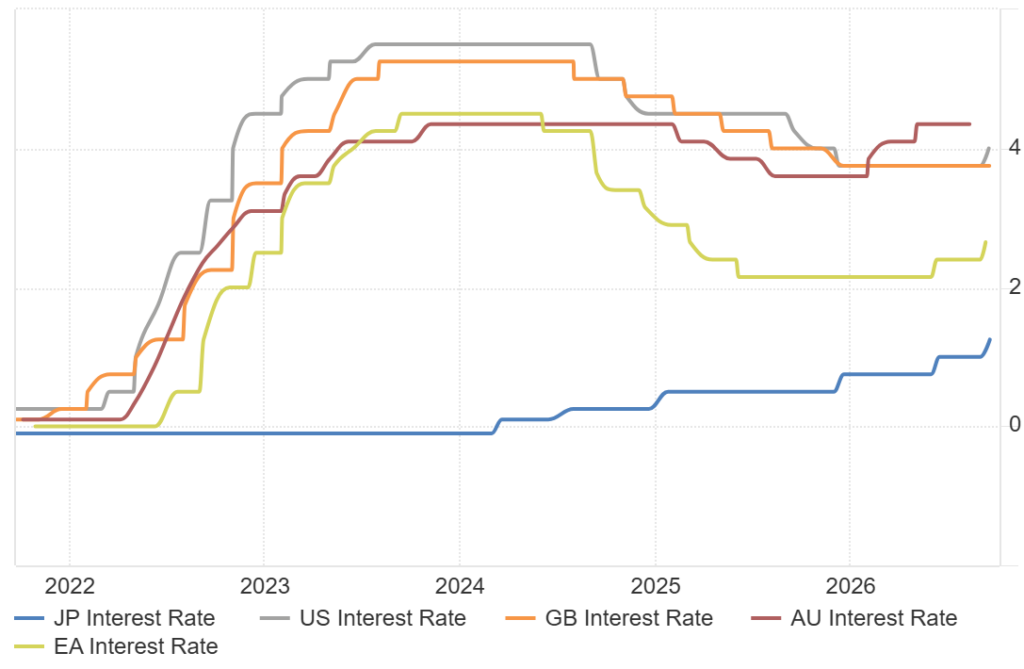
For example, an investor could borrow yen and use it to buy Australian dollar assets. As of September 2026, Australia’s policy rate is 4.35% and Japan’s is 1.25%, a gap of 3.10 percentage points. This makes the trade appealing, but the gap is not a guaranteed return: borrowing costs, the investment’s yield and changes in AUD/JPY determine the result.
Japan’s prolonged period of low interest rates helped make the yen a widely used funding currency. Borrowing in yen allowed investors to finance positions in currencies offering higher yields.
These flows are one influence on exchange rates. Economic developments, trade flows and changes in risk appetite can reinforce or outweigh them.
Why the Interest Rate Gap Matters
The interest rate differential is the engine behind every carry trade. It exists because central banks set policy rates differently based on their own inflation and growth conditions. One economy might need higher interest rates to counter inflation, while the other keeps interest rates at low levels in order to support economic activity.
A wider rate gap can make a carry trade attractive, provided the additional profits is enough to compensate for the risks. Monetary policy expectations also matter, where investors may reassess a position before either central bank consider changes to monetary policy if they expect the gap to narrow further.
Central bank policy rates provide a useful starting point, but the actual carry depends on the investor’s borrowing rate and the yield available on the chosen investment.
When Carry Trades Unwind: August 2024 Example
A carry trade can lose money despite a wide interest rate gap.
In the earlier example, if the Australian dollar declines against the yen, the exchange rate loss could wipe out the income earned from the investment.
Interest income accumulates overtime, while exchange-rate losses can occur within hours. Leverage, which increases the size of a position relative to the investor’s own capital, magnifies the impact of those losses.
On July 31, 2024, the Bank of Japan raised its policy rate to around 0.25%, its highest level since 2008, increasing the cost of yen funding.
On August 2, a weak US employment data increased concerns about the US economy and increased expectations of aggressive Federal Reserve rate cuts. Together, changing policy expectations and rising volatility put pressure on yen-funded carry trades as the yen appreciated.
On August 5, Japan’s Nikkei 225 plunged 12.4%, marking its largest single day decline since 1987. The sell-off reflected several forces, including US growth concerns and the stronger yen.
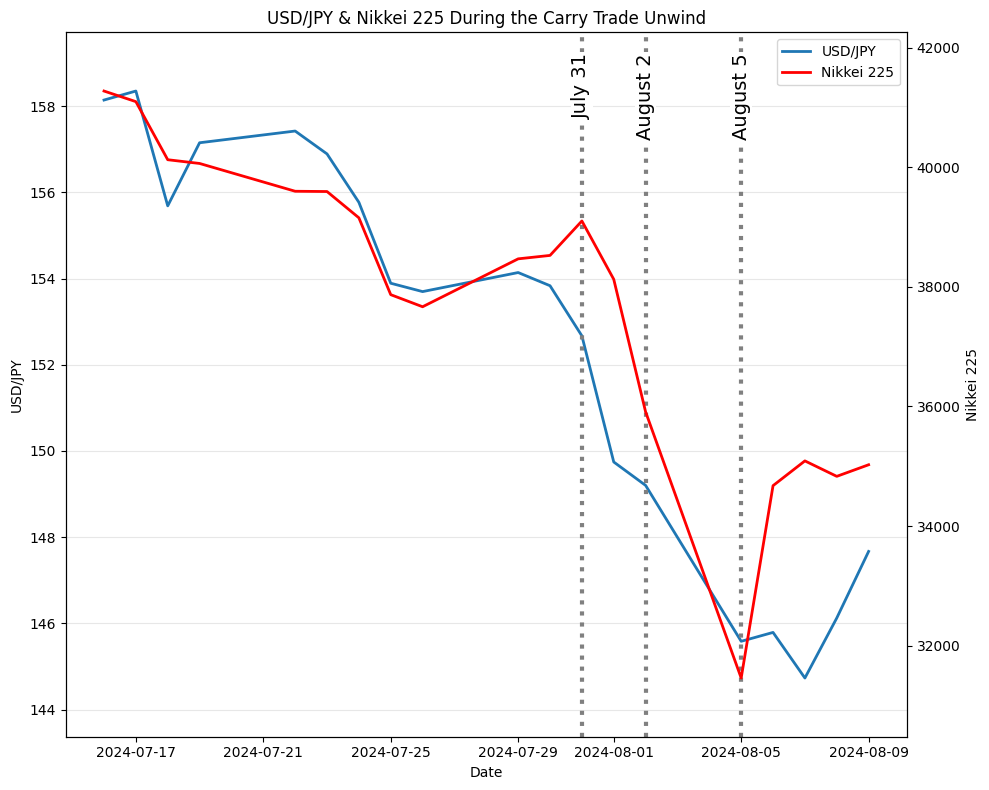
Research published by the Bank for International Settlements found that unwinding leveraged positions amplified the initial market reaction. The episode illustrates how economic news, changing interest-rate expectations and forced selling can combine to intensify market moves.⁽¹⁾
Carry Trades Can Also Strengthen the Funding Currency
The same mechanism that weakens a funding currency while a carry trade builds works in reverse when it unwinds. As traders buy back the funding currency to close their positions, demand for it rises sharply.
This is why the yen surged against the dollar in August 2024 even though the change in Japan’s economic outlook was modest. The Bank of Japan’s hike was small, but the unwinding of crowded positions made the move far larger than the news alone would justify.
For FX markets more broadly, this is a useful reminder that a currency’s short-term direction can be driven by unwinding trades rather than by the underlying economy.
Takeaways
A currency carry trade is the straightforward idea of borrowing cheap, investing where yields are higher, and collecting the difference. What makes it worth tracking is what happens when it stops working.
Three things define the mechanism:
- The trade builds slowly, driven by the interest rate differential between two currencies.
- It can unwind quickly, often triggered by a rate surprise or a broader risk-off shift.
- When it unwinds, the effects move beyond FX into equities and other asset classes.