ar
ar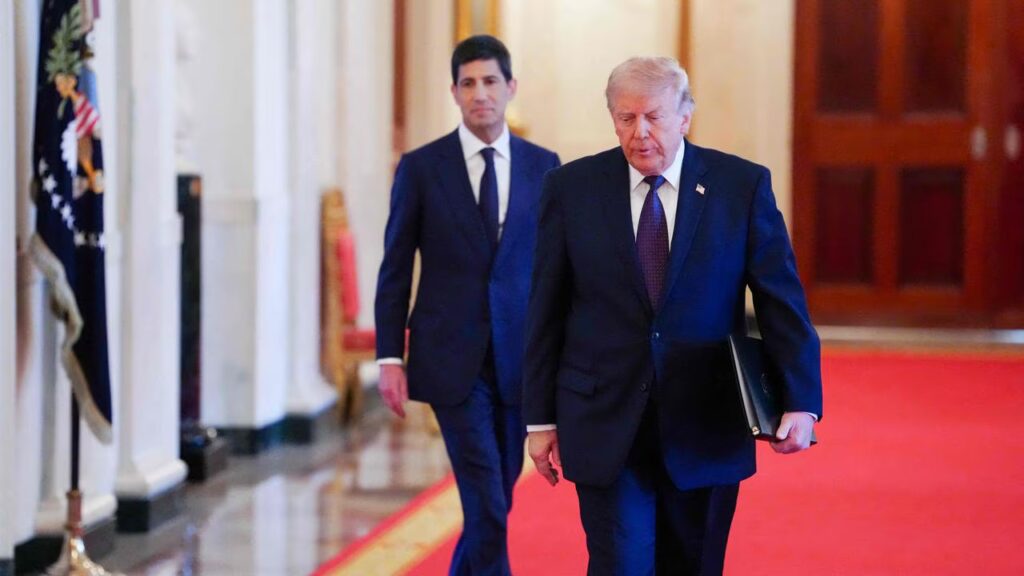
- New Fed Chair Kevin Warsh officially takes office as higher oil prices and rising inflation complicate the case for rate cuts.
- Warsh now faces an immediate policy dilemma, where Trump wants lower rates, but inflation pressure may force the Fed to stay cautious or even turn more hawkish.
- His first major test will come at the June policy meeting, where markets will look for signs of whether the Fed is still leaning toward cuts or preparing for tighter policy.
Kevin Warsh was officially sworn in as Chair of the Federal Reserve on Friday, taking over at one of the most difficult moments for US monetary policy in recent years.
Oil prices have eased from their recent highs but remain elevated, inflation pressure is building again, and consumer confidence inside the US is weakening.
That leaves Warsh facing an immediate policy dilemma, where markets and the White House want lower rates, but the economic backdrop may leave the Fed with little room to ease.
A White House Ceremony with Political Undertones
Warsh took the oath of office at the White House in a ceremony attended by Treasury Secretary Scott Bessent and former Secretary of State Condoleezza Rice. Supreme Court Justice Clarence Thomas administered the oath as President Trump looked on. ⁽¹⁾

Trump praised Warsh as a “great head of the Fed” and promised that he would have full independence.
However, he also used the moment to repeat his view that “growth does not mean inflation,” making clear that he still expects interest rates to come down.
The president also criticized former Fed Chair Jerome Powell, whose cautious approach to rate cuts had repeatedly frustrated the White House. ⁽²⁾
The setting underlined the political pressure Warsh may face from day one. While the Fed is designed to operate independently, the new chair is taking office under a president who has been anything but private about the direction he wants monetary policy to take.
The Challenge Ahead
Warsh now inherits an economy impacted by one shock after another. Oil prices have seen high volatility in the last three months as the Middle East conflict drives inflation higher. Import tariffs have also been a headache for the Fed, while the AI boom adds short-term pressure on demand and prices. Consumer sentiment has also fallen to record lows. ⁽³⁾
In his first remarks as Fed Chair, Warsh pledged to lead a “reform-oriented Federal Reserve” while maintaining high standards of integrity and performance.
He also reaffirmed the Fed’s dual mandate of price stability and maximum employment, saying that pursuing those goals carefully could support lower inflation, stronger growth and higher real wages. ⁽⁴⁾
Hawkish Voices Are Getting Louder
The debate over Fed policy is intensifying rapidly. Fed Governor Christopher Waller, who was also considered for the chairmanship, took a more hawkish tone on Friday by calling for the Fed to move away from its recent easing bias and acknowledge that rate hikes may still be possible. ⁽⁵⁾
Waller argued that inflation has broadened across the economy and warned that “a rate cut is no more likely in the future than a rate increase.” His comments quickly pushed markets to price in a higher chance of a rate hike as soon as October. ⁽⁶⁾
Why did markets take note? Because it shows Warsh may not be taking over a Fed that is ready to cut.
Instead, he may inherit a divided committee where several policymakers believe the inflation threat is still strong enough to justify keeping policy restrictive, or worst-case scenario, even tightening further.
Trump’s Rate-Cut Hopes Meet Economic Reality
Trump chose Warsh to deliver the lower interest rates he has demanded for over a year. But the conditions that would support cuts seem to have moved out of reach.
Warsh’s first major test comes at the Fed’s June 16-17 meeting, where he must decide whether to signal support for higher rates or align with Trump’s political agenda.
His decision will reveal whether he can maintain Fed independence while navigating intense presidential pressure.