ar
ar
- Oil prices were lifted after renewed hostilities between the US and Iran, with President Trump announcing a mission to escort trapped vessels through the Strait of Hormuz, and Iran reportedly striking tankers following its warning to the US.
- Elevated prices continue to threaten global growth, with central bankers remaining pressured to keep interest rates high, while OPEC+ increased its output, hoping to provide relief to energy markets.
- Markets were driven by risk-off sentiment, with the US dollar rising on safe-haven demand while stocks and other riskier assets declined.
Oil prices jumped as traders reacted to President Trump’s announcement of military operations in the Strait of Hormuz aimed at helping vessels leave the Gulf safely.
The move comes as tensions re-escalated between the US and Iran and continue to disrupt energy flows through the strait, threatening global supply chains and pushing oil prices to levels that could increase global growth risks.
Prices Climb on Rescue Operation Announcement
Brent crude oil jumped 7% on Monday while WTI rose almost 8%, with both benchmarks trading above $110 per barrel.
These gains were the result of Trump’s ‘Project Freedom’, an operation to rescue vessels trapped in the strait since the conflict began.
The Strait of Hormuz, which represents most of the world’s oil and gas flows, has become increasingly difficult for ships to navigate through. Recent maritime incidents near Fujairah in the UAE have added concerns over vessel safety and insurance risks in the region. ⁽¹⁾
Iran’s military warned US forces not to enter the strait, threatening to “respond harshly” to any perceived threat.
OPEC+ Output Increase Unlikely to Ease Pressure
Traders were also assessing OPEC+’s latest decision to increase production by 188,000 barrels per day for June, marking the group’s third consecutive monthly increase. ⁽²⁾
However, the additional supply may offer only limited relief if the conflict continues to restrict Gulf exports. With access through the strait still uncertain, markets are more focused on physical supply risks than headline production targets.
Markets Drop as Inflation Fears Return
US stock indices dropped from their new record highs yesterday, with the S&P 500 declining 0.4%, while the Nasdaq fell 0.2%. The decline was driven by renewed inflationary fears from elevated oil prices.
However, not all stocks dropped. Energy shares such as Exxon Mobil and Chevron ended higher yesterday on higher oil prices.
Moving on to FX, the US dollar rebounded as safe-haven demand increased, while the yen remained steady after a suspected intervention by the Japanese government that occurred last week. Gold extended its declines on surging US Treasury yields, with expectations that central banks could keep interest rates higher for longer.
The Reserve Bank of Australia hiked its cash rate today to 4.35% to tame inflation. The RBA has raised its inflation forecasts and downgraded its outlook for economic growth, causing the Aussie dollar to drop after the announcement. ⁽³⁾
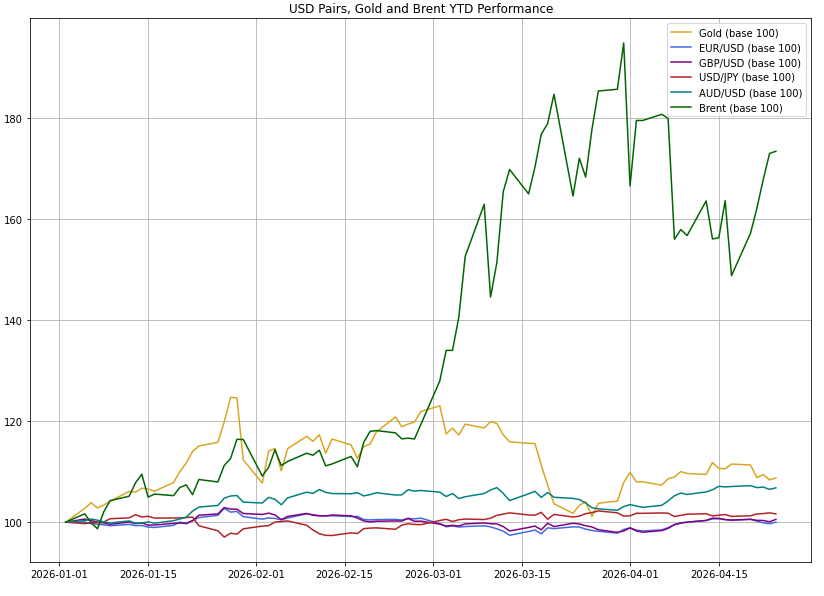
The chart above shows the YTD performance of major USD pairs, gold and Brent on a base-100 scale, making it easier to compare percentage changes rather than their actual prices.
The recent rise in oil prices has renewed concerns about the potential impact on global growth. Some analysts have warned that if Brent were to move towards $125 per barrel and remain there for a sustained period, recession risks could increase. ⁽⁴⁾
For now, Brent remains above $110 per barrel, keeping markets focused on the economic impact of higher energy costs. Without a clear path towards de-escalation, investors are likely to remain sensitive to headlines around supply risks, inflation pressure and diplomatic developments.
President Trump has continued to prioritize a nuclear deal with Iran, but talks remain uncertain, with Iran reportedly seeking to delay negotiations until the conflict ends and the US blockade is lifted.