ar
ar
The idea of a perpetual contract (perp) has been around for decades, but it’s only in the cryptocurrency era that it has developed into a trading instrument.
Traders may be familiar with the concept, but may find themselves asking important questions when it comes to the crypto market, including:
- What is a perpetual contract in crypto, and how does it work?
- How do perps differ from standard futures contracts in crypto?
- Which tools do traders use to manage perp exposure?
These are all relevant questions, the answers to which can help traders in a market where perps have become a dominant crypto trading instrument. Centralized perpetual exchanges (Perp CEXes) processed $85.3 trillion in trading volume in 2025 alone, according to Coin Gecko, a cryptocurrency news and research platform.
This article explains what a perpetual contract in crypto actually is, how funding rates work, how perps differ from futures and options, and where the real risks sit.
Contents list
- What is a Perpetual Contract in Crypto?
- How Funding Rates Keep Perps Tied to Spot
- How Perpetuals Differ from Futures and Options
- Leverage, Margin, and Liquidation Explained
- How Traders Manage Exposure: Key Tools
1. What is a Perpetual Contract in Crypto?
A perpetual contract is a type of crypto derivative that has two functions. First, it tracks the price of the underlying asset, or crypto coin, in question. The two most popular are Bitcoin and Ether.
Second, the contract allows the trader to take a leveraged position on the direction of price movement, without ever actually owning the asset. It has no expiration or settlement dates – the position can, in principle, stay open indefinitely.
This is where perps get their name, and it’s what makes them unusual. Unlike a traditional futures contract, perpetual contracts (or perpetual swaps) have no expiration date on which open trades must be settled. Instead, it uses the funding rate to stay tethered to the spot market.
Perpetual Contracts vs the Spot Market
The contrast between perps and spot trading can help us understand how perps work.
When a trader buys a coin in the spot market, they own it outright. The coin sits in their wallet and rises or falls in value according to its market price.
In perpetual trading, the trader never holds the coin. Instead, they have a contract that tracks its price, which they can open as a long (and gain if the price rises) or short position (gain if the price falls). This gives them two-way exposure, which spot ownership cannot provide.
This idea has existed, largely as a concept, since the early 1990s. Economist Robert Shiller proposed “perpetual futures” then as a way to build liquid markets for hard-to-settle assets such as real estate. This involved a contract that never expired and was settled instead of delivered.
In 2016, the first perpetual swap appeared on the BitMEX exchange, which added the funding-rate mechanism that keeps it anchored to spot. With this move, BitMEX turned Shiller’s decades-old concept into one of the most heavily traded instruments in the market.
With perps established as a defining instrument of crypto derivatives, it is worth understanding the mechanics that hold them together and how they compare to other derivatives.
How Perps Compare to Other Crypto Derivatives
Traders who have dealt in crypto futures contracts and options will be familiar with the concept of perps as they sit alongside them within the broader family of crypto derivatives.
Yet perps stand apart because they lack a crucial element that those other contracts have: futures and options carry expiry dates, while perpetuals have none. Instead, they rely on the funding rate to stay anchored to spot.
These also hold principles that differ from longer-term approaches, like how to invest in the stock market, where ownership and time horizon work differently.
A perp is a leveraged position by design, and traders often post margin to control this larger amount of exposure – we will look into how this works further down.
The instrument’s growing reach shows in who’s adopting it. As regulated perpetual futures begin reaching new markets, Kraken’s global head of derivatives, John Palmer, observed in a Crypto News interview that the first movers tend to be “the ones that are more sophisticated in nature”. In other words, traders who are already connected to exchanges and running positions of their own.
With perps established as a defining instrument of crypto derivatives, the mechanics that hold them together are worth understanding, starting with the perpetual futures funding rate.
2. How Funding Rates Keep Perps Tied to Spot
As mentioned, perpetuals have no expiry to force the contract’s price back in line with the underlying asset, so they need another mechanism to anchor them. This is where the funding rate comes in.
Mark Price, Index Price, and Spot Price
These three prices all serve different purposes, and we can explain them as follows.
- Spot price – what the asset trades for on the open market.
- Index price – An aggregate of spot prices collected from several top exchanges to be used as a reference.
- Mark price – The value that exchanges use to calculate unrealized gains, losses, and liquidations. This comes from the index price to avoid a single venue’s volatility, causing unfair liquidations.
These distinctions are important because they make the gap between the perp’s trading price and the index clear, which is what the funding mechanism responds to.
How the Funding Mechanism Works
The funding rate is a small payment exchanged directly between traders that works off the gap between the perpetual’s trading price and the index price. It replaces the expiry-driven convergence that keeps a dated futures contract anchored to the spot price.
The direction of payment depends on which way the contract is trading. When the perpetual trades above the index, the rate is positive and long positions pay shorts; when it trades below, the rate flips and shorts pay longs.
A positive rate makes holding a long position more expensive, discouraging further buying, while a negative rate rewards going long. The effect is a self-correcting tether, providing the constant nudge toward equilibrium that an expiry date is designed for.
“Perpetual contracts ‘settle’ every 8 hours,” say Qihong Ruan and Artem Streltsov, writing for Cornell College of Business. “In general, the higher the deviation, the higher the fees”
In theory, these fees give incentives for traders to keep the prices at the spot and perpetual markets close.
It’s also the feature that sets perpetuals apart from the contracts they’re built on, and the clearest place to start comparing them.
3. How Perpetuals Differ from Dated Futures and Options
Perpetuals borrow their structure from traditional derivatives but change one defining feature. Setting them beside the two instruments they’re most often compared to — dated futures and options — is the clearest way to see what’s actually different.
Perpetuals vs Dated Futures: Expiry and Settlement
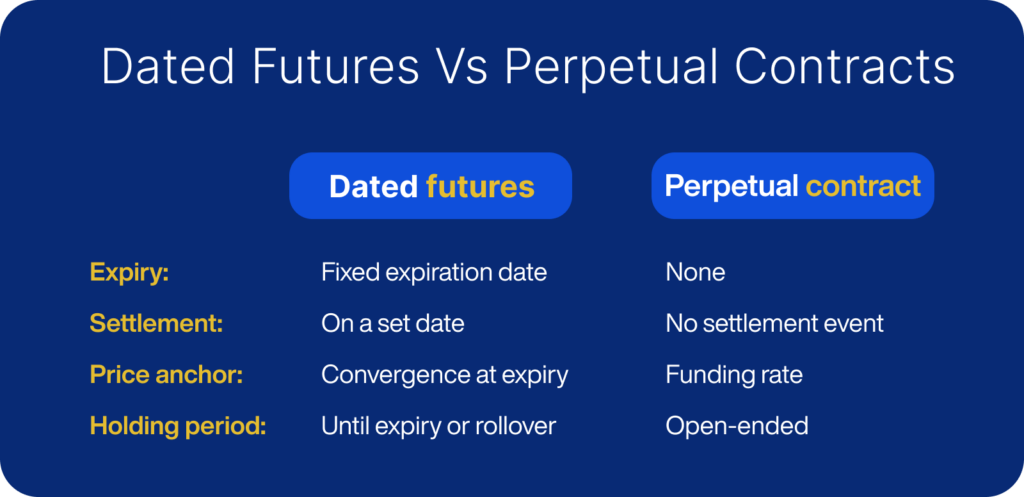
Traditional futures contracts work on one important principle – they commit both sides to settle on a fixed date. The contract closes on that settlement date, and any obligation is met.
Perpetuals remove this date so that there is nothing to settle or roll over. The position is not forced to close at any time.
Price Convergence and the Role of Staying
A deeper difference lies in how each of these instruments stays tied to the underlying asset.
A dated futures contract pulls prices together naturally. As expiry nears, the price and spot converge because settlement happens at spot value.
A perp does not have this built-in convergence. Instead, the funding rate steps in to continuously realign the contract with spot.
Funding thus operates at the core of a perpetual contract. Without it, nothing would pull the perpetual’s price back toward spot.
Perps vs Options: Linear Exposure vs Premiums
Options bring another structure to the table. Here, traders pay a premium for the right (not the obligation) to trade at a set price before a set date. The value is influenced by strike prices and time decay, so the pay-off is non-linear.
In contrast, a perpetual offers linear exposure. Gains and losses track the underlying’s price move directly – traders do not pay a premium, and there’s no expiry eroding the value. The cost of holding is the funding rate, not time decay.
Many traders view these two mechanisms as competitors, but they’re simply different tools. One gives direct directional exposure, the other allows you to measure risk around defined outcomes.
Perps vs CFDs
Traders with experience of CFD trading strategies will find the core idea of a perpetual familiar: both give leveraged exposure to an asset’s price without the need to own it. Yet there are certain important differences.
A CFD is typically traded via a broker, who acts as the counterparty. Yet instead of a funding rate, an open CFD position will accrue an overnight financing charge to hold it.
On a crypto exchange, a perp is traded against other participants, with the funding rate exchanged between traders instead of being paid to a broker.
4. Leverage, Margin, and Liquidation, and How They Contribute to Risk
A perpetual contract is a leveraged position, and leverage cuts both ways by widening gains and losses equally.
This makes it all the more important to understand the mechanics behind it, like with all leveraged products.
Initial Margin vs Maintenance Margin
The very nature of leverage is controlling a large position with a smaller amount of capital, and there are two margin requirements that govern it.
- The initial margin – the deposit that traders need to open a position
- The maintenance margin – the minimum equity that must stay in the account to keep the position open.
The trade stays alive as long as the account’s equity sits above the position’s maintenance margin. If it falls below this, the position risks being liquidated.
Collateral and Stablecoins
The collateral is the deposited capital (or initial margin) backing the position.
On crypto platforms, the collateral can be held in a stablecoin such as USDT or USDC, which helps keep the margin balance stable in dollar terms instead of fluctuating like a typical crypto asset.
It’s also possible to see contracts that are margined in the underlying coin itself, which behaves differently according to price movements.
How a Liquidation Price is Reached
The liquidation price is simply the point at which the equity behind the leveraged position
drops below the maintenance margin, and the exchange automatically closes the position to prevent more losses.
This price depends on the amount of leverage. The higher the leverage ratio, the closer the liquidation price is to the entry price, so a smaller adverse move can trigger it. This central risk is something that traders frequently ignore and incur unnecessary losses.
“Most traders obsess over leverage and ignore liquidation risk,” says Deepak Shukla, founder and CEO of Pearl Lemon Crypto, a crypto investment service. “In my experience, surviving the market matters more than maximizing gains.”
Every leveraged trader eventually faces this dilemma at some point: how to stay in the market long enough to hold a winning position. This is where a trader’s toolkit helps.
5. How Traders Manage Exposure: Key Tools
Perpetual contracts in crypto are leveraged instruments that offer a greater level of exposure. Experienced traders know how to keep this in check and call on several tools to help them, including using AI in trading to improve trading efficiency.
Stop-Loss Orders and Market Orders
A market order is a well-known trading instrument that executes a trade immediately at the best available price, opening or closing a position in that exact moment.
A stop-loss order, meanwhile, triggers a market order once the price hits a set level and caps how far a losing trade can run before it closes.
Both these mechanics work well with fast-moving positions.
Hedging with Perpetuals
Hedging can also help with perpetuals because it helps traders offset downside risk by opening an opposing short to the spot position that they hold. This uses the contract as a counterweight rather than a directional band.
Where Perpetuals are Traded
Liquidity depth, execution speed, and available leverage are all crucial factors in executing perpetual contracts, and the same criteria apply across asset classes, whether comparing crypto marketplaces or the best forex trading platforms.
Many of the best online trading platforms provide these conditions to give traders tighter, faster, and more reliable access to the markets.
For this reason, experienced traders invest time researching the platforms themselves, so that the real cost and quality of execution, rather than just the headline offer, informs their decision.
If you’re looking to trade forex and CFDs on futures and crypto, then you’ll need a solid trading platform. Open an account with Daman Markets to explore all these markets in one place.
FAQs
How long can you keep a perpetual contract open?
A perpetual contract has no expiry or settlement date, so, in principle, you could keep it open indefinitely. However, the funding rate and margin are two limiting factors. If equity falls below the maintenance margin, the position is liquidated.
What is the funding rate in a perpetual contract?
The funding rate is a small payment exchanged directly between traders. When the contract trades above the index price, longs pay shorts. When it trades below, short positions pay longs. This keeps the perpetual’s price tethered to spot, and replaces the convergence that a dated futures contract relies on.
How do perpetual contracts differ from futures and options?
Dated futures expire and settle on a fixed date; perpetuals never do, relying on funding instead. Options charge a premium for the right to trade at a set price, with a non-linear payoff. A perpetual offers linear exposure — gains and losses track the underlying’s price directly.
What is liquidation in perpetual trading?
Liquidation is a form of risk management and is the point at which the equity backing a leveraged position falls below the maintenance margin, prompting the exchange to close it automatically to prevent further loss. The higher the leverage, the closer the liquidation price sits to the entry price, so a smaller adverse move can trigger it.