ar
ar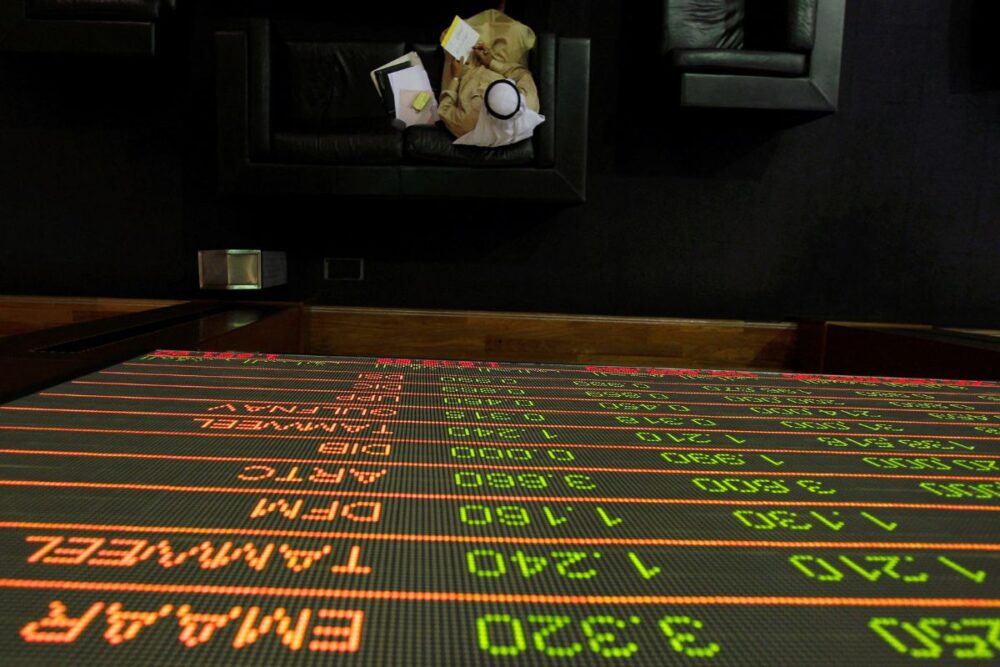
For anyone trying to work out how to invest in the UAE stock market, it’s easy to come across online guides that jump straight to telling you to open an account, fund it, and start buying shares.
The problem is that many of these guides skip the most important step: understanding how the UAE market actually works.
Investing in stocks in the United Arab Emirates comes with several practical challenges, including:
- Meeting access requirements, such as obtaining a National Investor Number (NIN) and working with locally approved brokerage firms.
- Understanding the differences between the DFM, ADX, and Nasdaq Dubai in terms of liquidity, listings, and investor participation.
- Applying diversification principles in a market where a small number of large-cap companies can dominate index performance.
Investors who can understand and overcome these challenges are better positioned to make informed investment decisions based on their time horizon, financial goals, and risk tolerance.
With that in mind, this guide breaks down how to invest in the UAE stock market in 2026, what makes it different from Western exchanges, and what to consider before committing your hard-earned capital.
We’ll cover:
- Understanding the UAE’s three stock exchanges
- The key requirements before buying stocks in Dubai or Abu Dhabi
- Understanding the UAE market structure
- Liquidity, regulation, and UAE market participation
- Is it worth investing in the UAE stock market?
- How to invest in the UAE stock market online
- Trade safely and flexibly in the UAE with Daman Markets
Are you ready to put these insights into practice? Open a live or demo account with Daman Markets today and trade regulated stock CFDs with tools designed to help you respond quickly to market movements.
Understanding the UAE’s Three Stock Exchanges
Newcomers to investing in the UAE will find that there are three main stock exchanges: the Dubai Financial Market (DFM), the Abu Dhabi Securities Exchange (ADX), and Nasdaq Dubai.
Each one follows UAE regulations, but they also have several important differences in liquidity levels and investor participation that traders should be aware of.
The Abu Dhabi Securities Exchange (ADX)
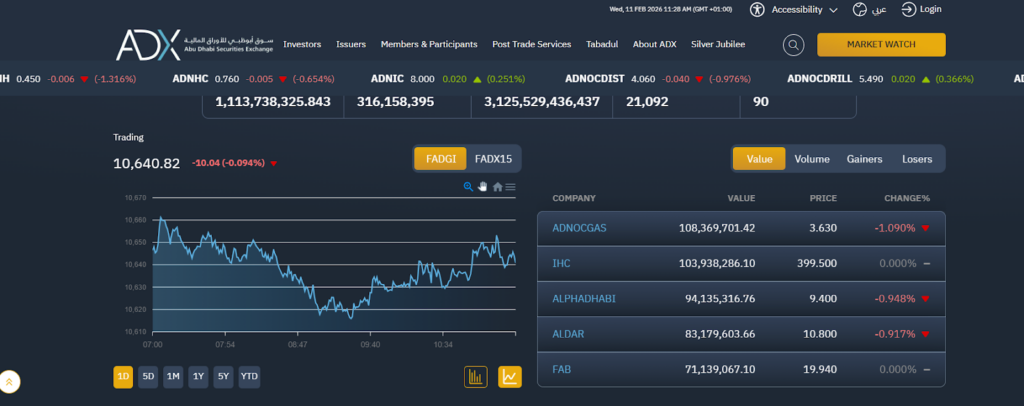
The ADX is the largest of the three exchanges by capitalisation, standing at around AED 3.1 trillion (about $850 billion) at the end of 2025. ADX trading takes place between 10:00 AM and 3:00 PM local time, from Monday to Friday.
It houses larger listings, including energy, banking, and government-linked entities, and boasts deep liquidity in selected entities thanks to several high-profile Initial Public Offerings (IPOs) in recent years.
Some key ADX stocks at the moment include:
- International Holding Company
- TAQA (Abu Dhabi National Energy Company)
- ADNOC Gas
- First Abu Dhabi Bank
- Abu Dhabi Commercial Bank
The Abu Dhabi Securities Exchange (ADX)
The Dubai Financial Market (DFM)
The DFM is home to UAE-based PJSC (publicly listed) companies across the real estate, banking, and transport sectors, with more than 170 listed securities.
Some of the most popular stocks on the DFM include:
- Emaar Properties
- Emirates NBD
- Dubai Islamic Bank
- Salik Company
- Air Arabia
In the past, the DFM has experienced strong retail participation and, like the ADX, is active during local trading hours.
The Dubai Financial Market (DFM)

Nasdaq Dubai
The Nasdaq Dubai is the smallest of the three exchanges, but it focuses more on international listings and investment products, including global equities, stocks, bonds, and REITs.
Regulated by the Dubai Financial Services Authority, the Nasdaq has the DFM as its largest shareholder, owning two-thirds of the exchange, with Borse Dubai holding the rest.
Notable names on the Nasdaq Dubai include:
- DP World PLC
- Emirates REIT (CEIC)
- ENBD REIT (CEIC)
Note: It’s also possible for UAE-based investors to trade on the New York Stock Exchange (NYSE), the world’s largest, with a market cap of around AED 95.5 trillion ($26 trillion) and over 2,400 listed securities. Certain regulated trading platforms, like Daman Markets, provide access and let traders gain exposure to global equities through derivative products.
It’s also worth understanding settlement timelines. Buying stocks in the UAE and choosing to sell shares later doesn’t always follow the same rhythm as Western markets. While trades on US stock exchanges settle one business day after the trade date (T+1), they take two business days (T+2) in the UAE, so knowing how transactions settle can prevent surprises.
Once investors know these key differences, they should then look at what they need to access them and start investing. The next section will cover this important step.
The Key Requirements Before Buying Stocks in Dubai or Abu Dhabi
Working out how to invest in the Dubai stock market or Abu Dhabi Securities Exchange is straightforward, but there are several important steps you need to follow.
The first obstacle is getting hold of the National Investor Number (NIN), also known as an investor number. Acting as your entry pass to trading equities, you can get this directly from the exchange you are using.
The next step is to open a trading account with one of the locally approved brokerage firms. Look out for a Securities and Commodities Authority (SCA) certificate here, as this is the most respected regulator. You will also need to do the following:
- Provide ID documents (original passport, Emirates ID, or any government-issued ID for non-UAE residents)
- Give proof of address (often including a P.O. Box), using a utility bill
- Complete compliance checks under the UAE financial services rules.
Finally, investors should be aware of any applicable fees (including brokerage commissions and exchange transaction fees) before they start trading. They might not appear that important, but they can eat into investment returns, so they deserve attention from the outset.
Understanding the UAE Market Structure
The first step in getting to know a new market is to look at its structure.
Many Western indices are diversified across hundreds of companies, which can dilute the impact of any single stock on the overall market capitalisation.
The UAE market, on the other hand, is very top-heavy with government-linked entities and large-cap banking and real estate firms. This plays a big role when you build (and diversify) your investment portfolio there.
“Investors must understand that UAE markets are structurally top-heavy because government-related entities dominate the major indices,” says Jon Morgan, Co-founder of Venture Smarter, a financial strategy consultancy. “In my experience guiding clients, the top 10 listed companies frequently constitute over 70% of an index’s total market capitalization.”
The nature of the market means investors often end up with portfolios heavily biased toward banking and real estate stocks, without making a conscious effort to do that.
Diversification strategies are a possible solution, but many of these usually focus on exposure to stocks outside the UAE, so they don’t apply to diversifying within the UAE.
“Many large-cap stocks (in the UAE) also have a limited free float, sometimes below 25%,” Morgan points out. “This concentrates trading power among a smaller pool of institutional players and can amplify volatility during economic announcements.”
While not necessarily a flaw, this concentration can play a key role in your investment strategy from the start. For example, you may struggle to enter or exit positions quickly at desired prices, which makes short-term investing or trading difficult.
Liquidity, Regulation, and UAE Market Participation
The UAE stock market is not only structured differently, but it’s also subject to different regulations and participation levels.
It runs within a framework overseen by the Securities and Commodities Authority (SCA), making it a safe ecosystem to invest in, but that framework directly affects who participates.
In practice, this affects how activity flows through the market rather than how it is structured. Certain listings attract sustained institutional interest, while others see lighter turnover. This participation mix can shape day-to-day price movements and trading rhythm.
For investors used to broader global markets, familiarity with these participation patterns helps place price movements in context rather than reacting to them in isolation.
Is it Worth Investing in the UAE Stock Market?
The UAE stock market has many appealing features for investors.
The United Arab Emirates is well located at the crux of several major global trade routes. It has a robust regional economy that boasts strong IPO growth in recent years, including across key sectors like energy, logistics, banking, and real estate.
As an emerging market, the UAE has, at times in the past, delivered stronger returns than more mature developed indices. For example, in 2025, the MSCI United Arab Emirates Index had a 26.72% return, which is higher than the 17.9% return of the S&P 500 Index. This performance also showed how regional momentum and sector concentration has historically created periods of significant upside.
For active traders, this sector mix can also intersect with gold and crude oil trading strategies, especially when regional macroeconomic shifts ripple through energy-linked equities. This creates fertile ground for those seeking genuine investment opportunities away from traditional Western markets.
Yet, there are downsides. The UAE market is more concentrated than many global indices, which means a small number of companies can have a big effect on performance. Liquidity can also easily shift between listings and contributes to high market volatility that hits specific sectors during economic shifts.
Two factors are particularly important to consider:
- The sector tilt created by UAE exposure, particularly toward energy, banking, and real estate, as well as broader emerging-market dynamics.
- The level of risk tolerance needed in a market with higher concentration and shifting liquidity.
The UAE market can play a meaningful role in a broader investment strategy, but it’s crucial to know what drives it, instead of assuming it behaves like larger global markets.
How to Invest in the UAE Stock Market Online
For those exploring how to invest in the UAE stock market online, the good news is that it’s simple to get started.
Once you have cleared the first hurdle of selecting a broker and getting your investor number (NIN), the rest normally happens via a trading platform. Many of these are stocked with useful features that will help you get your feet under the table, including:
- User-friendly dashboards
- Mobile app access
- Real-time AED pricing
- A smooth gateway to stock trading
Yet, while these features are fairly common, some platforms perform much better than others in key areas.
Depending on the platform, you may experience lag when you attempt a trade, which is an obvious problem if you are trying to catch a certain price. There’s also the threat of unclear terms and fees that hide behind small print.
These issues further muddy the waters for newcomer traders who are already trying to work out how UAE trading works.
The best UAE trading platforms should go out of their way to make newcomers comfortable, with tutorials, high-quality content, and a strong licence helping to smooth their concerns.
Get the foundation right, and the rest of your investment journey becomes far more deliberate and much less risky.
Trade Safely and Flexibly in the UAE with Daman Markets
As a market trader looking to explore a new territory, it’s easy to think that direct share ownership is the only route into the UAE stock market.
Yet a wave of modern UAE trading platforms is proving that this isn’t the case. Daman Markets is one of them.
Instead of worrying about execution delays or unclear pricing, Daman provides fast, transparent access to UAE and global markets through regulated stock CFDs. That means traders can go long or short as conditions change, without holding the underlying shares. They can also use these derivatives for everything from day trading gold to trading crude oil futures.
Daman Markets works in tandem with MetaTrader 5, so traders can structure and refine their market moves with the latest charting tools and real-time pricing. They can access multiple asset classes within a single trading account, while fees and trading conditions are clearly outlined, helping them avoid the small-print surprises that sometimes come with new platforms.
Daman Markets is regulated by the Securities and Commodities Authority (SCA), which safeguards every transaction and provides a safe, structured environment for traders.
The UAE market rewards those who understand its structure, and Daman Markets is built for traders ready to engage it with confidence.
New to the UAE stock market? Sign up today with Daman Markets to trade with precision, speed, and trusted local support.
Disclaimer: This content is for informational purposes only and does not constitute investment advice, a recommendation, or a solicitation. Trading involves risk, and outcomes are not guaranteed. Investors should assess their own circumstances before participating.