

 ar
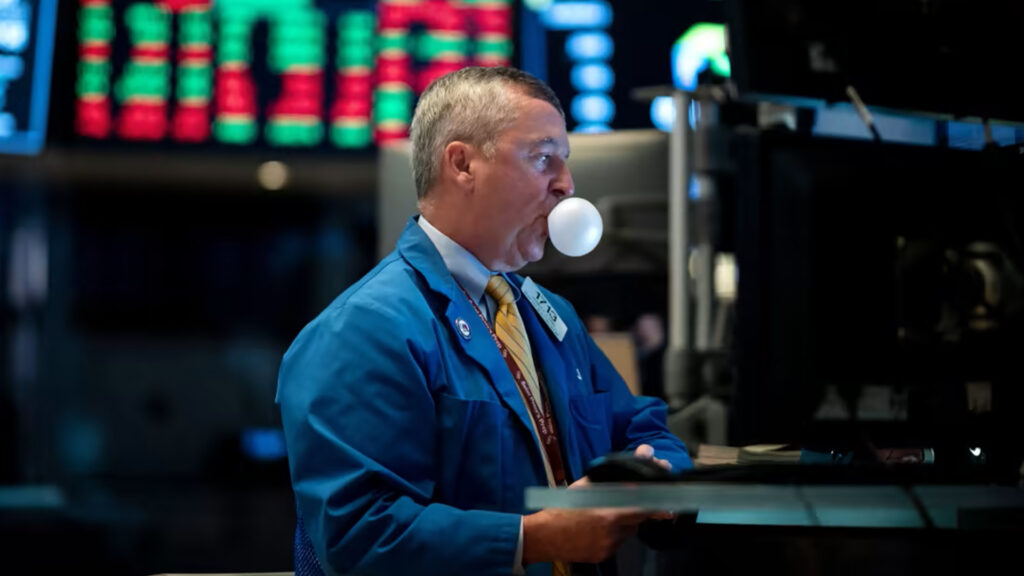
- Stock markets around the world are hitting record highs as AI hype drives huge investments in big tech.
- Some analysts warn that high-valued stocks could lead to a market correction like the dot-com bubble.
- Other commentators argue that AI growth nowadays is driven by profits and investments rather than speculation.
Stock markets globally have surged to record highs in the face of an artificial intelligence boom, with investors injecting billions into big tech firms leading the next wave in innovation.
Beneath the optimism, concerns are emerging from financial institutions, warning that this AI boom is simply another bubble that could just be about to burst.
With highly valued stocks, soaring expectations and concentrated gains among a few tech giants, warnings suggest that tech stocks may be heading towards a correction similar to that of the dot-com bubble in the early 2000s.
Global Economic Warnings
International Monetary Fund (IMF) Chief Kristalina Georgieva said in a statement that she had warned investors to buckle up for uncertainty towards the AI boom ahead of the IMF’s annual meetings in Washington.
She also noted that the global economy is expected to slow down at a slower pace, as market shocks could test resilience. As gold trades above $4,000, it signals growing investor concerns amid uncertainty. Georgieva highlighted that US tariffs and fast-rising stock valuations fueled by AI are signs for caution. ⁽¹⁾
The Bank of England warned on Wednesday that the risk of a market correction has increased, noting that valuations appear stretched, particularly for artificial intelligence-focused tech firms. Federal Reserve Chair Jerome Powell also warned of fairly high-valued stocks, though he didn’t explicitly refer to technology firms. ⁽²⁾
JP Morgan CEO Jamie Dimon is also of the opinion that a sharp market correction is due in the next six months to two years, due to geopolitical tensions and fiscal policy challenges. ⁽³⁾
AI has been one of the main drivers of stock market returns this year, supporting gains in big tech firms. ⁽⁴⁾
AI Valuations: Stretched but Not Extreme
Goldman Sachs stated that tech valuations are high but not at dot-com bubble levels. The forward PE ratio for the S&P 500 is 23, indicating that investors are paying $23 for every $1 of expected return. From a technical standpoint, this would suggest the index is trading at a higher price than the fair one. ⁽⁵⁾
Apple, Microsoft, Nvidia and Tesla are among the Magnificent Seven stocks viewed as trading at elevated valuations, a sign of AI-fueled optimism and future growth.
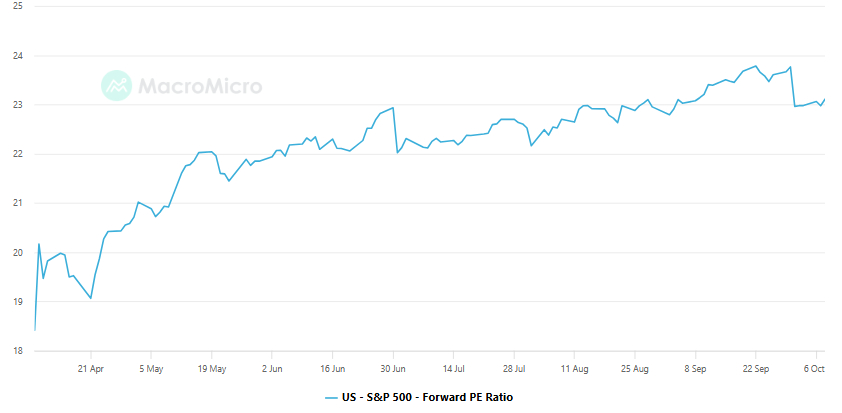
Source: MacroMicro, S&P 500 Forward PE Ratio Chart on a 6-Month Timeframe
Magnificent Seven stocks have a combined market cap of $20.8 trillion, which accounts for 36.3% of the S&P 500.
Unlike the dot-com bubble in 2000, stocks at the time were trading with lower profits at higher prices. Compared to today’s tech stocks, AI leaders have resilient earnings and strong financial performance.
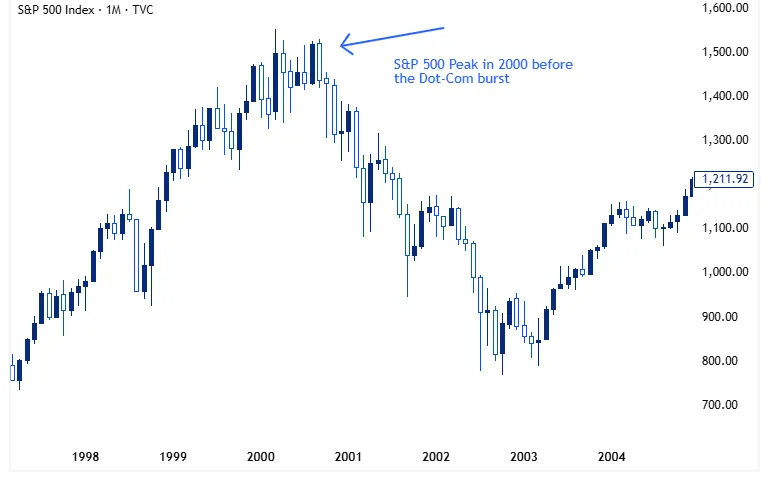
Source: TradingView, S&P 500 Chart
AI’s Growing Influence and Risks
AI stock prices have risen on higher performance expectations rather than results, which could be a major concern. Companies are investing billions in AI to improve work efficiency, but AI still cannot handle complex tasks as expected.
Weak tech earnings could cause tech stocks to enter a market correction, as the AI hype is mostly focused on big tech rather than the overall industry.
OpenAI CEO Sam Altman said that investors may be overexcited about the AI hype, but he still believes it innovates technology. Nvidia CEO Jensen Huang stated that the global AI race has been competitive, especially against Chinese models like Huawei, Deepseek and Alibaba. ⁽⁶⁾
Higher valuations and tech partnerships, such as OpenAI’s valuation of $500 billion and partnerships with Nvidia, AMD and Oracle show the intense market enthusiasm for AI.
A Different Kind of Bubble?
Many believe that today’s wave of innovation is not the same as the dot-com era, with stronger profits and real business results supporting higher valuations. Unlike the dot-com era, big tech is delivering solid earnings, suggest the rally may be able to stand its ground.
Still, others warn that stock prices have risen faster than company earnings, as excitement around AI continues to drive markets higher. With valuations stretched and gains concentrated in a few major firms, some analysts suggest that a slowdown in AI adoption or profits could spark a correction.
But one of the tricky things about bubbles is that they’re hard to spot while you’re in one. So whether this period marks a sustainable tech revolution or another bubble waiting to burst will likely depend on how well innovation continues to translate into lasting value and growth.


