ar
ar
When uncertainty hits the global economy and financial markets experience massive downturns, one asset becomes a topic of discussion: gold.
Gold’s historical function as a safe-haven asset was once again pronounced in 2025 when Trump’s tariffs introduced a new wave of uncertainty into the global economy.
While the S&P 500 Index was down 17.6% between February 19 (its previous high) and April 8, gold was up 3.6% over the same period. By the end of the year, the S&P 500 Index was up 16.39%, according to Macrotrends, an economic intelligence platform, and gold was up by 64.58%, according to Sprott, an asset management company. Beyond the price return, gold made 53 new all-time highs in 2025 and crossed the $5,000 mark in January 2026.
This tendency of gold to hedge portfolios against uncertainty and market downturn is one reason why it is popular among certain investors in the UAE.
However, UAE investors often face a tough decision: how to invest in gold in the UAE, given the numerous options available (physical gold, gold ETFs, digital gold accounts, gold mining stocks, and gold CFDs).
In this article, we will consider each of these gold investment options, weighing their pros and cons and the type of investors they are appropriate for. We’ll cover:
- Is gold a good investment in the UAE? Why investors consider it
- How to invest in gold in the UAE: An overview of 5 investment assets
Looking to trade gold CFDs in the UAE? Daman Markets offers regulated access to gold CFDs and other leveraged instruments.
1. Is Gold a Good Investment in the UAE? Why Investors Consider It
Before evaluating the different options for gold investment in the UAE, let’s spend some time understanding why some investors like to add it to their portfolios.
Gold as a safe-haven asset
As said above, gold tends to provide a hedge when there is economic uncertainty and market downturns.
We have used the aftereffects of Trump’s tariffs as an example of how this works. But a better way to illustrate this point is to consider how gold has performed during economic recessions (when traditional equity markets suffer) compared to the S&P 500 Index.
To do this, the London Bullion Market Association (LBMA) divided recession periods into four different phases:
- Phase 1: The run-up to the recession
- Phase 2: The unofficial recession (recession has broken out, but GDP figures have not been released yet)
- Phase 3: Official recession (GDP figures are out)
- Phase 4: The last quarter of the recession
The chart below shows how the S&P 500 Index compares to gold (in USD and in EUR) during the seven recessions between 1970 and 2018:
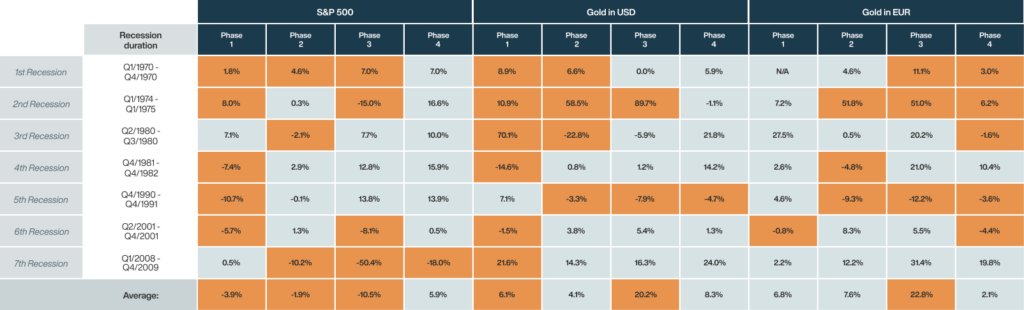
On average, the S&P 500 Index produced negative returns in Phases 1, 2, and 3, only posting positive returns in Phase 4. In contrast, gold produced positive returns in all phases.
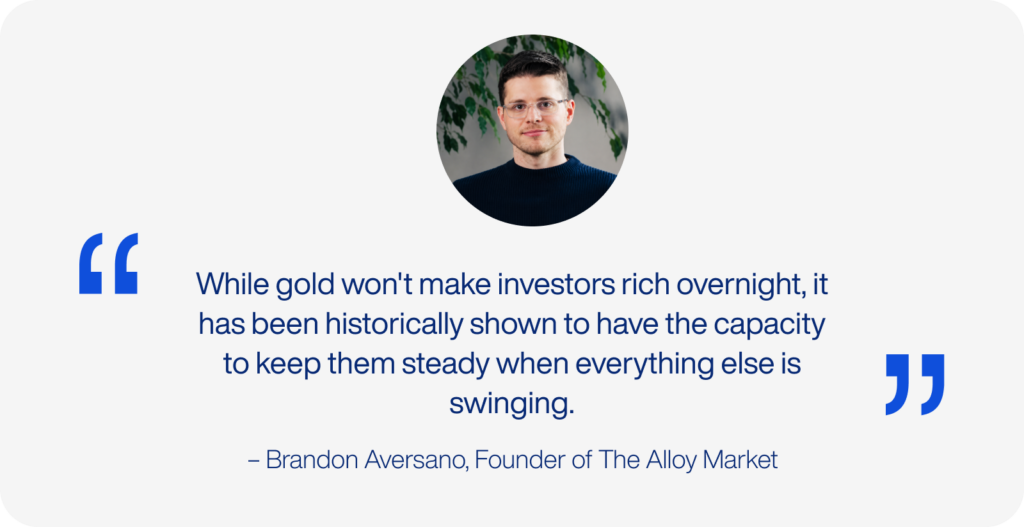
“For a portfolio, gold can act like an anchor,” according to Brandon Aversano, the founder of The Alloy Market, a precious metals marketplace. “While it won’t make investors rich overnight, it has been historically shown to have the capacity to keep them steady when everything else is swinging.”
Gold as a Portfolio Diversifier
Some investors also like gold because it has historically helped to diversify traditional portfolios.
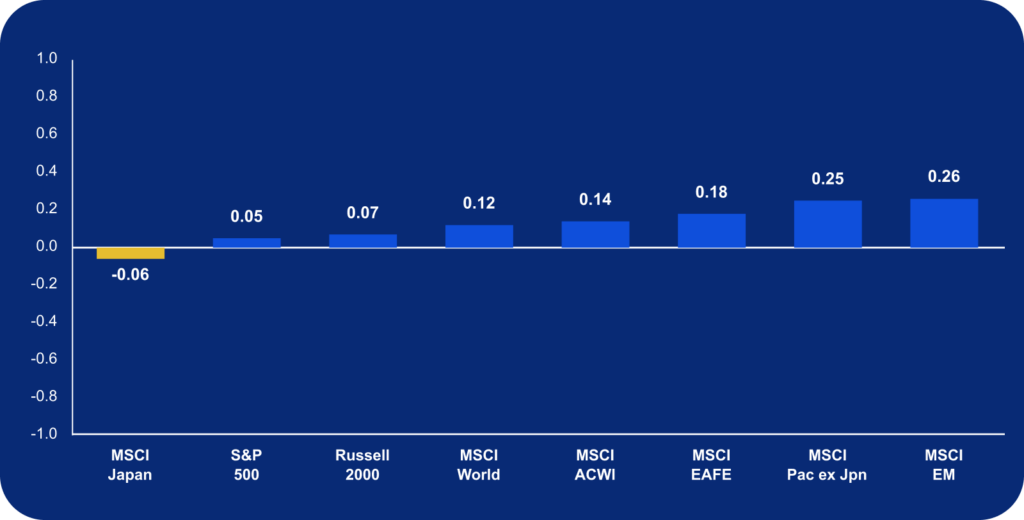
As the chart below shows, gold has historically low correlations to various equity markets.
Gold’s Correlation to Equity Markets Over the Past 30 Years
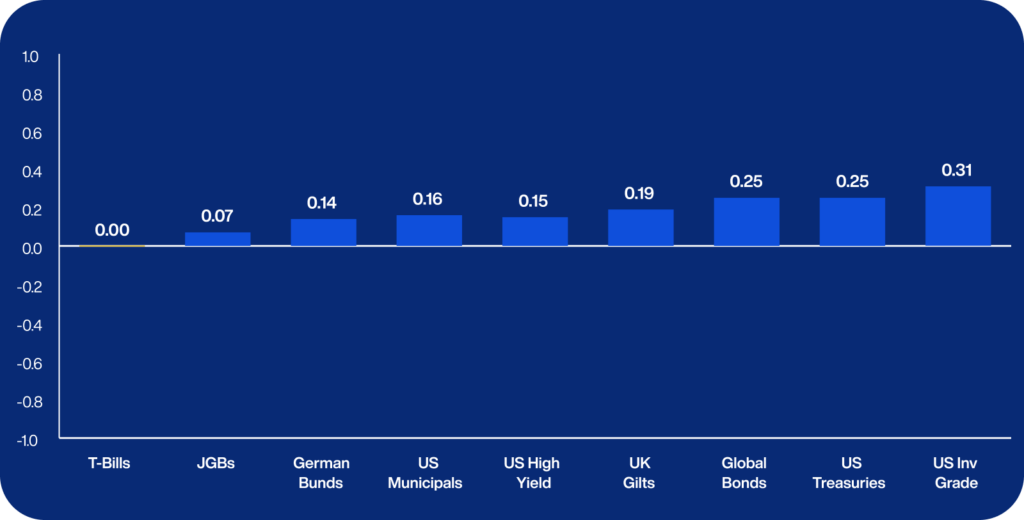
Gold also showed low correlation to fixed-income assets during the same period:
Gold’s Correlation to Fixed-Income Securities Over the Past 30 Years
Finally, a study by Macrobond found that, in 11 of the 16 years examined, portfolios with a 20% allocation to gold (60/20/20) outperformed a traditional 60/40 portfolio.
Annual Performance of a 60/20/20 Portfolio vs a 60/40 Portfolio
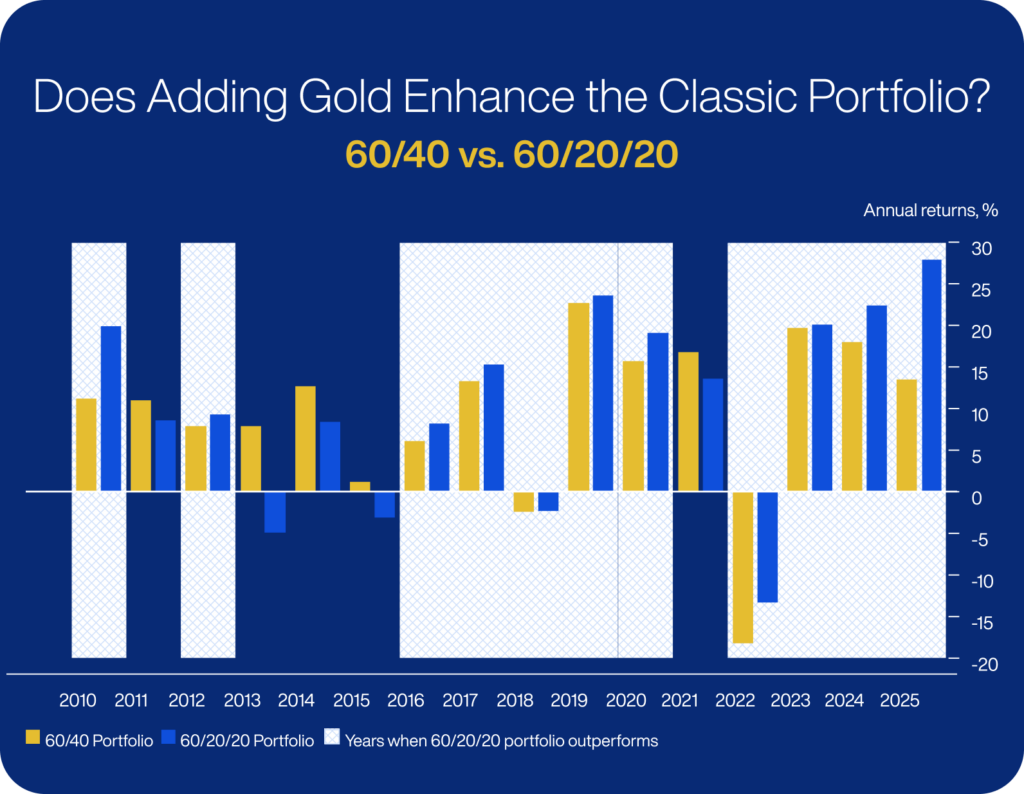
These historical results are specific to the study period and do not guarantee future performance.
Gold as a Store of Value
An asset is a store of value when it can keep its worth over time and preserve wealth.
A look at gold’s historical performance shows that it has tended to serve as a store of value over decades.
As the chart below shows, it has outperformed other asset classes over a 10-, 20-, and 30- year time horizon.
Gold’s Average Return Over Long Investing Horizons, Compared to Other Asset Classes
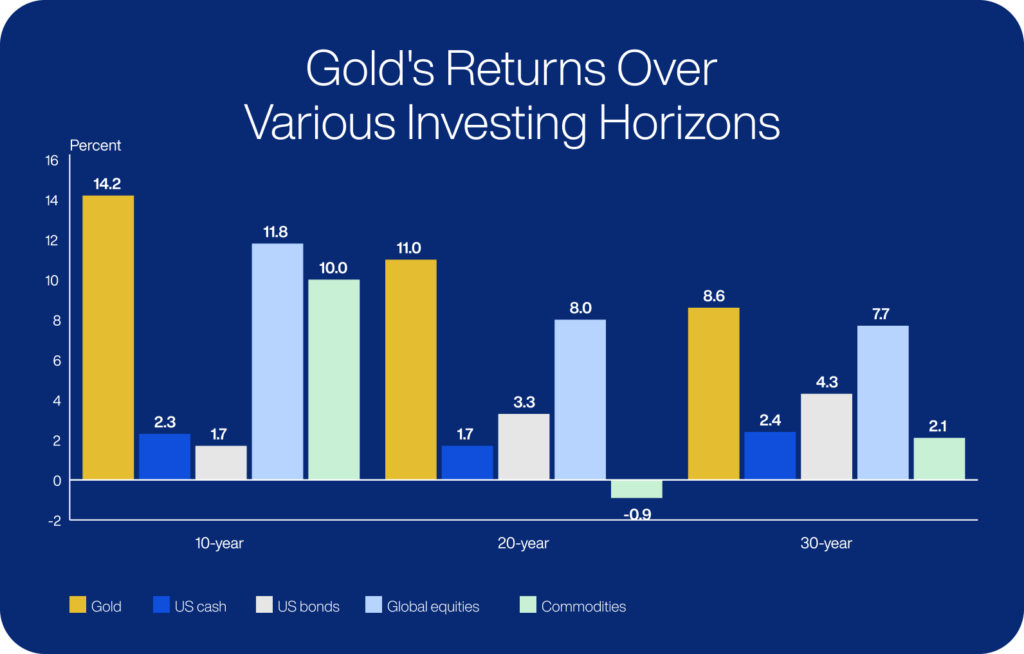
For this reason, many investors also use gold to hedge against inflation. However, while gold performed this role well in the inflation of the 1970s, it has not convincingly repeated that performance ever since, including during the 2021/2022 inflation that followed COVID-19.
Some Downsides of Gold Investment
However, some investors have raised certain concerns about gold investment that need to be mentioned.
First, unlike stocks that pay dividends or bonds that pay interest, gold produces no cash flow. The only way investors make money from gold is through capital appreciation.
For this reason, Warren Buffett, arguably the greatest investor of our time, calls it an unproductive asset.
Second, though gold can provide stability during economic downturns and uncertainty, it is a volatile asset itself, driven by factors like interest rates, geopolitical tensions, inflation, the US dollar, and the actions of the Federal Reserve and other central banks (including the Central Bank of the UAE), among others.
As an example of volatility, gold has already surged past $5,000 and fallen below $4,000 in just the first six months of 2026.
As the chart below shows, the volatility of gold and the S&P 500 Index is usually close.
Gold vs S&P 500 Index: 3-Year Annualized Volatility
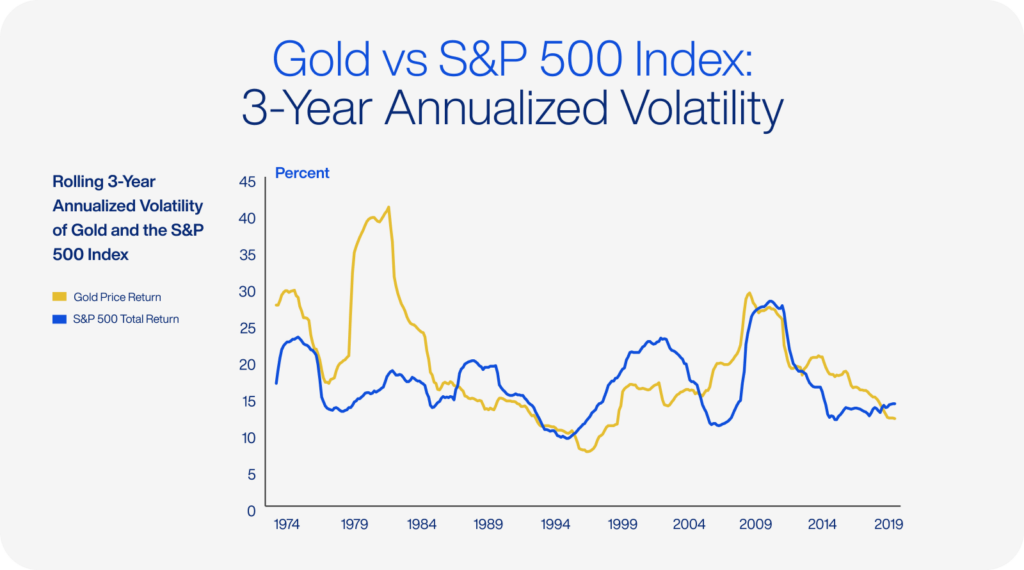
Thus, though gold is not as volatile as other precious metals, investors with lower risk tolerance are still concerned about its volatility level.
Third, many investors are worried that investing too much in gold can result in missing out on the compounding returns of equities during bull markets (good times). This is because, over long periods, equities have tended to historically outperform gold.
For example, as the chart below shows, stocks outperformed gold in the 40 years between 1985 and 2025:
Gold vs S&P 500 Index vs NASDAQ: Growth of $10,000 Between 1985 and 2025
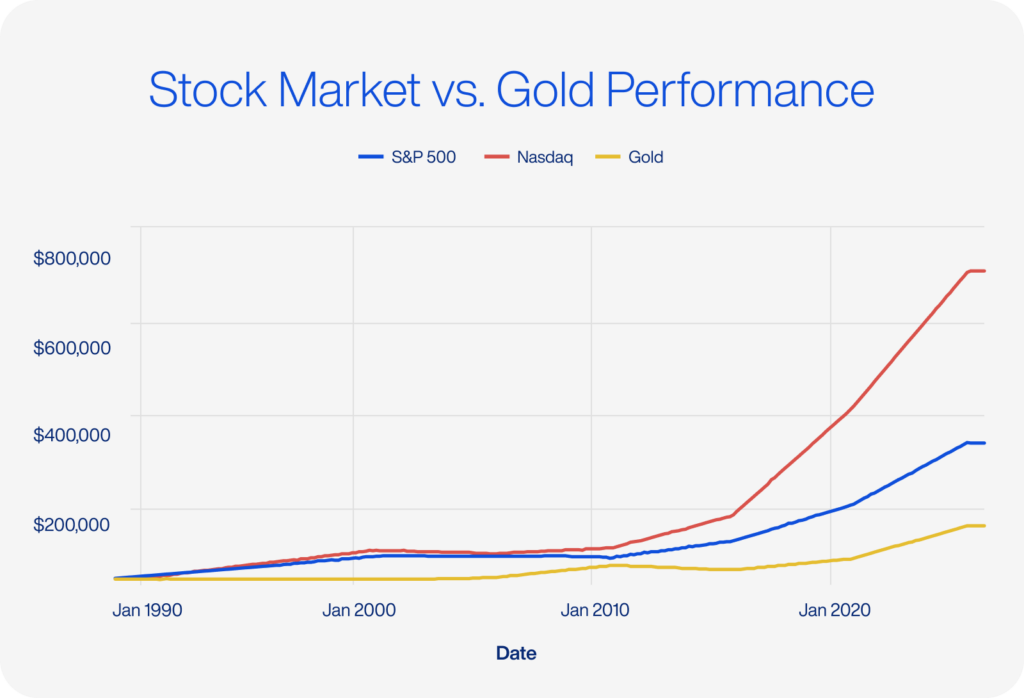
Despite these concerns, gold remains popular in the portfolios of many investors.
2. How to invest in gold in the UAE: An overview of five investment assets
For investors interested in gold investment in the UAE, below are the five popular options that many investors have explored:
1. Physical Gold (Gold Bullion)
Overview
Physical gold can come in the form of gold bars or coins.
Gold coins are nationally minted and are usually in small sizes, which makes them liquid. On the other hand, gold bars are bigger, which makes them less liquid than gold coins. They can weigh from one ounce to many kilograms.
To be traded on gold markets, gold bullion must be at least 99.5% pure. Those with up to 99.9% purity are referred to as investment-grade gold.
Pros of Physical Gold
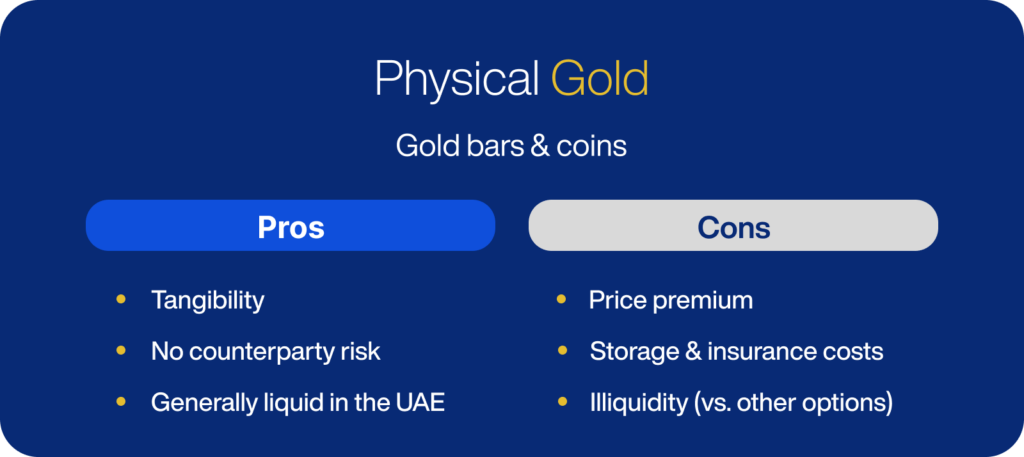
- Tangibility: Investors who prefer tangible assets to financial assets tend to value physical gold that they can hold and store for themselves.
- No counterparty risk: Buyers of physical gold own what they buy without having to depend on another party’s promise or performance, as is common with financial assets.
- Generally liquid in the UAE: Though real assets are usually illiquid, the UAE has a gold market with many participants, making it generally liquid.
Cons of Physical Gold
- Price premium: Buying physical gold comes at a price premium when compared to the spot price of gold. This premium (also called making charges) pays for the cost of producing, packaging, and transporting physical gold.
- Storage and insurance costs: Safe storage of physical gold costs money. Furthermore, since gold is valuable, owners often have to pay to insure it.
“Most people start with physical gold, coins, bars, or jewelry from the souks,” according to Aversano. “It feels real and safe, but storage and resale spreads eat into returns.”
- Illiquidity: Though the UAE gold market is generally liquid, buying physical gold remains illiquid when compared to other options.
How to Buy Gold in Dubai
Physical gold investors usually buy gold through the following means:
- Bullion trading houses: Dubai Gold Souk, located in Old Dubai, is the most popular of these trading houses. Gold and Diamond Park, located on Sheikh Zayed Road, is another option. There are also gold trading houses in Abu Dhabi. The most popular are the Madinat Zayed Gold Centre and Hamdan Street.
- Independent bullion retailers: Many bullion retailers also have offices outside of these trading houses. Most of them also have websites where investors can create online orders.
- Gold jewelry stores: Some jewelry stores also sell gold bars and coins.
2. Gold Exchange-Traded Funds (ETFs) or Exchange-Traded Commodities (ETCs)
Overview
Gold ETFs or ETCs refer to investment funds that track gold prices by holding physical gold on behalf of investors.
A share in the ETF represents ownership of the underlying physical gold. So, instead of directly owning physical gold, investors own shares of the ETF, with each share tracking the price of gold.
These shares can be easily traded on stock exchanges just like any stock. Also, when an investor sells a given number of shares, they receive the equivalent in fiat currency (USD, for example) instead of in gold coins or bars.
Put simply, gold ETFs or ETCs are a way to gain exposure to the price movement of gold without owning and storing physical gold.
Pros of Gold ETFs or ETCs
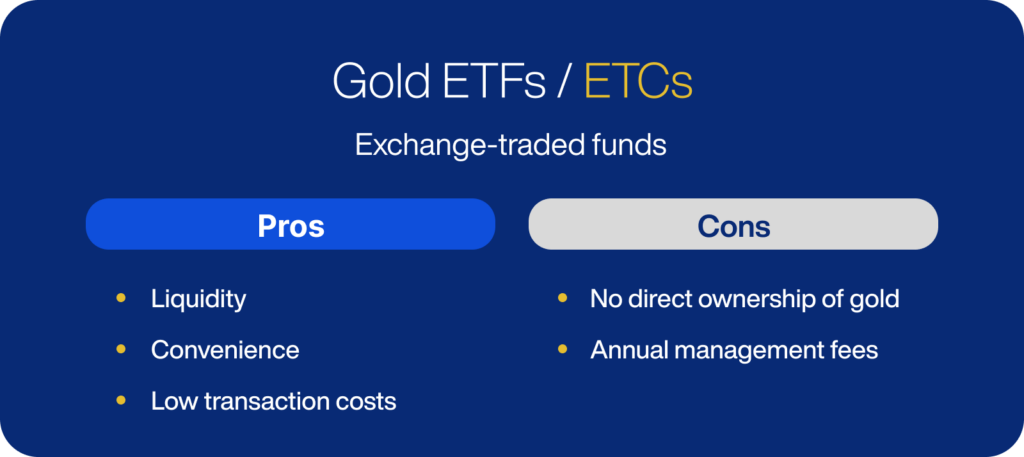
- Liquidity: ETFs can be traded on stock exchanges during trading hours.
- Convenience: Investors can gain exposure to gold’s price without having to handle physical gold.
- Low transaction costs: The price of gold ETFs trends closely with the price of spot gold. Also, transaction costs associated with physical gold are absent.
Cons of gold ETFs pr ETCs
- No direct ownership of gold: Investors who value tangibility may not fancy gold ETFs.
“Gold ETFs are simple and liquid,” according to Aversano. “You skip storage, but you never actually hold anything.”
- Annual management fees: Gold ETFs charge annual management fees, which can be higher than those of stock ETFs.
How to Invest in Gold ETFs in the UAE
SPDR Gold Shares (GLD), iShares Gold Trust (IAU), and SPDR Gold MiniShares Trust (GLDM) are the most popular gold ETFs.
Many investment platforms offering access to US stocks and ETFs have them on offer. Some also identify Shariah-compliant ETFs that are appropriate for investors who follow Islamic investment principles.
3. Digital Gold Accounts or Gold Savings Accounts
Overview
Digital gold accounts allow investors to own physical gold without handling physical delivery and storage (which is handled by the financial institution providing the account).
The main difference between digital gold accounts and gold ETFs or ETCs is that investors own a share of the physical gold rather than the ETF.
For example, if Investor A purchases $1,000 worth of SPDR Gold Shares (GLD), they will own 2.7 shares of GLD (at the current price per share). They do not directly own the physical gold held by the ETF, though a share of the ETF will correspond to a given value of the precious metal.
On the other hand, if Investor B invests $1,000 in a digital gold account, they will own 0.24 troy ounces at the current gold spot price per troy ounce (ignoring fees).
The implication here is that while owners of digital gold accounts can redeem their investment in physical gold or cash, gold ETF owners can only redeem their shares in cash.
Most digital gold accounts allow fractional ownership. As we saw in the example above, investors can own a fraction of gold and continue to add more money to their account.
Some banks or fintechs prefer to call their products a gold savings account.
Digital gold accounts and gold savings accounts are practically the same thing. The only difference is that those who use the former description tend to encourage automatic monthly contributions, goal-based saving, and consistent accumulation of gold over time.
However, you can do all these with platforms that call their products digital gold accounts as well, which makes it a mere difference of emphasis rather than in product structure.
Pros of Digital Gold Accounts
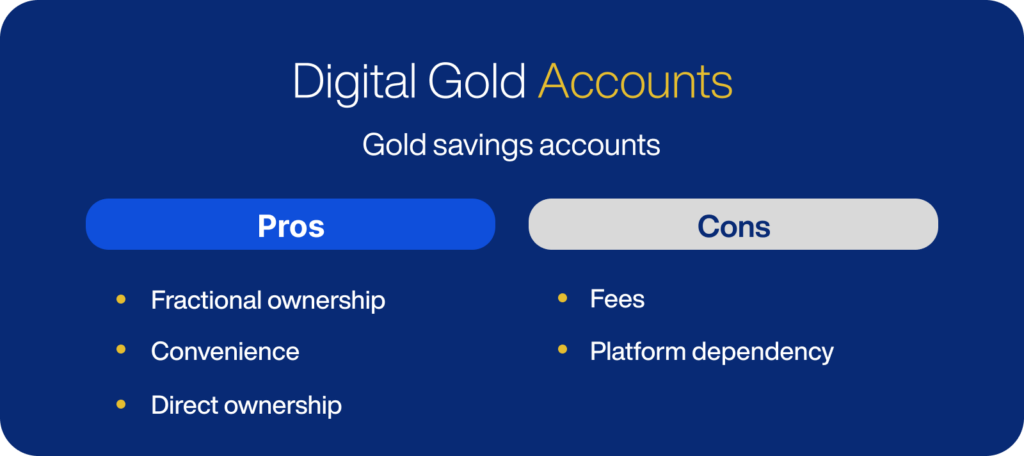
- Fractional ownership: Gold account owners do not have to own a troy ounce of gold (represented as 1XAU) to get started. Many banks allow an initial investment as low as 0.05XAU.
- Convenience: The financial institution handles delivery and storage.
- Direct ownership: Unlike gold ETFs, digital gold accounts provide direct ownership of gold.
Cons of Digital Gold Accounts
- Fees: Various transaction and account management fees may apply.
- Platform dependency: Purchase and sale transactions take place between the investor and the platform. This is different from gold ETFs, where investors can buy from and sell to each other.
How to Buy Digital Gold in Dubai
Many banks in the UAE offer digital gold investment accounts. Examples include Emirates NBD, Mashreq, and Liv Bank.
4. Gold mining stocks
Overview
Gold mining stocks are stocks of companies that engage in the production, distribution, and trading of physical gold.
Since these companies derive a significant part of their revenue from gold, there is a correlation between their stock prices and gold’s price. Thus, investing in them is usually seen as an indirect way to gain exposure to gold, especially for investors who know how to invest in the stock market.
Instead of investing in individual gold mining stocks, some investors prefer to buy gold mining ETFs, which are baskets of multiple gold mining stocks. Gold mining ETFs are different from gold ETFs or ETCs because while the former’s underlying assets are gold mining stocks, the latter’s are physical gold held in a vault.
Pros of gold mining stocks
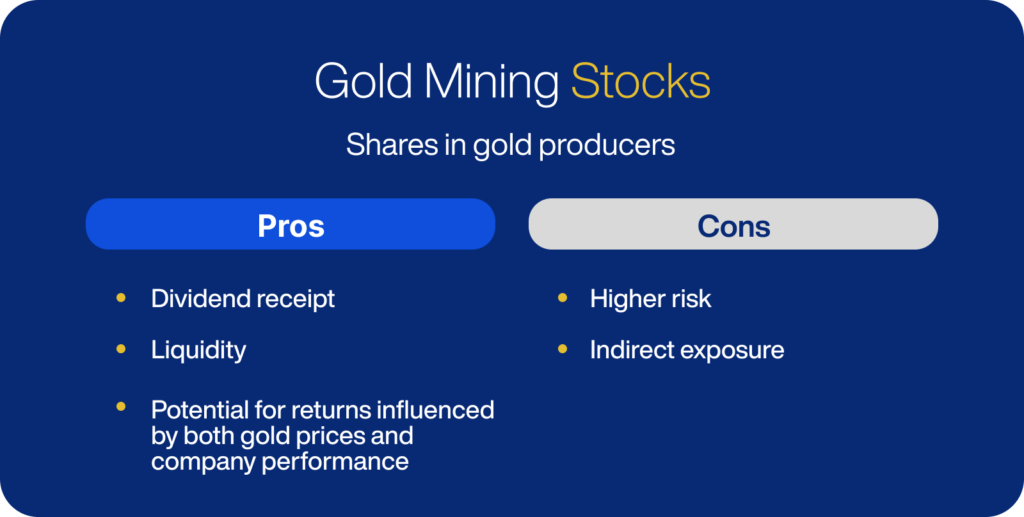
- Dividend receipt: Some gold mining stocks pay dividends, which gives investors an additional way to make money from their gold investment in the UAE.
- Liquidity: Shares of gold mining companies can be easily traded on stock exchanges.
- Potential for returns influenced by both gold prices and company performance: A gold mining company’s stock price can increase due to other reasons that have nothing to do with gold’s price: management quality, investment activities, operational efficiency, etc.
Cons of gold mining stocks
- Higher risk: Just as investors can gain when other factors drive prices up, they can also lose when those same factors drive them down.
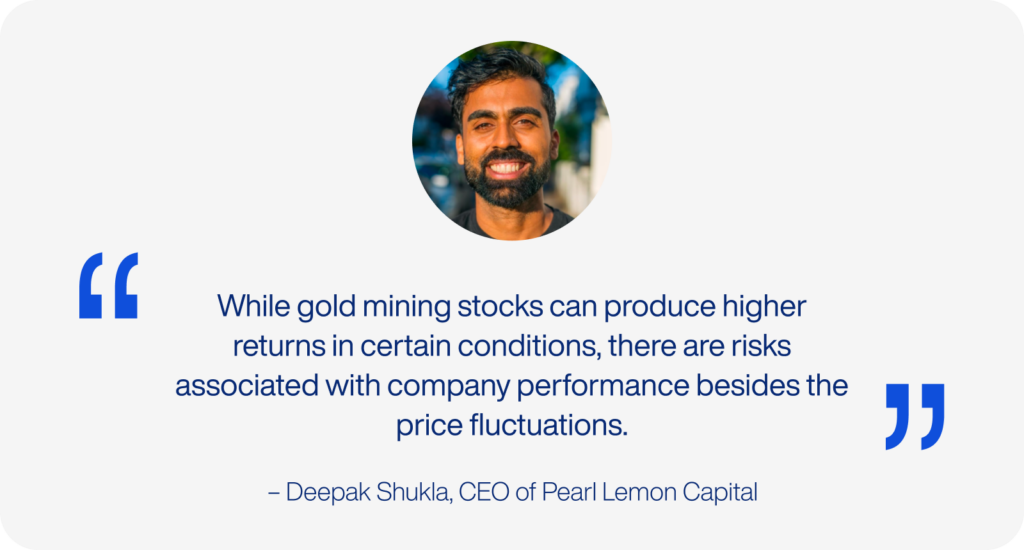
“While gold mining stocks can produce higher returns in certain conditions, there are risks associated with company performance besides the price fluctuations,” according to Deepak Shukla, the CEO of Pearl Lemon Capital, a business and property financing company.
- Indirect exposure: Due to other factors affecting the stock’s price, its relationship with gold’s price is sometimes uncertain.
How to Invest in Gold in the UAE Through Gold Stocks
Gold mining stocks are available on platforms offering access to international stocks.
5. Gold CFDs
Overview
Gold CFDs are derivatives that allow investors to gain exposure to the price movements of gold without owning physical or digital gold.
They are popular among short-term investors or traders who only want to profit from gold’s price swings rather than hold it as a long-term asset.
Unlike the other assets above, traders can easily go long on gold when they are positive about its trajectory, or short it when they are negative about its course. This allows them to explore a variety of gold day trading strategies.
Also, CFDs use leverage, which allows traders who know how to trade CFDs to control a large position with only a small deposit (margin).
Gold CFDs are different from gold futures, which are available through the Dubai Gold & Commodities Exchange (DGCX).
For one thing, gold CFDs don’t have expiry dates. They can theoretically be held indefinitely, though holding a CFD trade overnight comes with an overnight financing cost or swap fee.
Also, gold CFDs are more straightforward, and there are none of the risks that come with physical settlement.
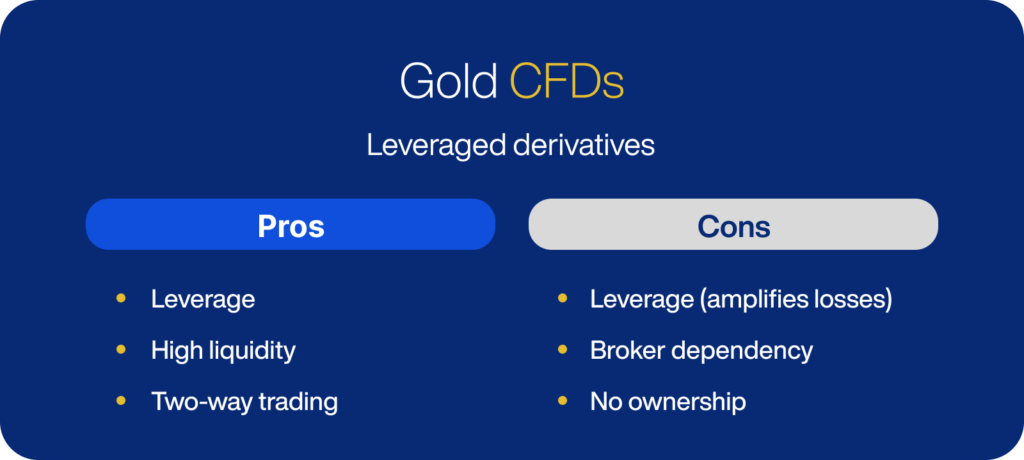
Pros of gold CFDs
- Leverage: Leverage can amplify potential gains when the market moves as traders predict.
- High liquidity: Like stock exchanges, CFD markets tend to have high liquidity, which makes it easy to quickly open and close trades.
- Two-way trading: Traders can benefit in both rising and falling gold markets.
Cons of gold CFDs
- Leverage: While leverage can amplify gains, it can also magnify losses when the market moves against the trader.
It is for this reason that Shukla suggests that only experienced traders who can manage risks efficiently should consider trading gold CFDs.
- Broker dependency: CFDs are contracts between traders and brokers. Thus, a lot depends on the solvency and reliability of the broker.
- No ownership: CFD traders don’t own the underlying asset, which makes the asset class inappropriate for long-term investors.
How to Buy Gold CFDs in Dubai
Daman Markets offers access to gold CFDs for traders interested in trading gold price movements rather than owning the asset.
We offer pro-grade liquidity through access to multiple top-tier liquidity providers.
To support fundamental, technical, and sentiment analysis, we offer high-quality trading tools like economic calendars, news reports, macroeconomic trends, market sentiment signals, and the popular MT5 trading platform.
We also provide analysis and educational resources through the Market Analysis section on our website and Daman Markets Academy. The latter is a library of articles, webinars, and interactive courses about the financial markets and onboarding videos for new users.
As a CMA-regulated broker, we provide multilingual customer support backed by 25 years of group experience in the UAE market.
Are you ready to explore gold CFDs in the UAE? Sign up now with Daman Markets for access to premium AI trading tools and educational resources.
Takeaways
- Investors like gold because it can act as a safe-haven asset, store of value, and portfolio diversifier.
- While gold has historically performed well during periods of uncertainty, it generates no income and can still experience significant market volatility.
- Physical gold, gold ETFs, digital gold, gold mining stocks, and gold CFDs each offer distinct advantages depending on whether your goal is wealth preservation, long-term investing, or active trading.
- The right gold investment option depends on factors such as ownership preference, liquidity needs, investment horizon, and risk tolerance.
Frequently Asked Questions
- Is Gold a Good Investment in the UAE?
Gold remains popular as a store of value, a hedge against market downturns, and a portfolio diversifier. Investors continue to see it as a good investment for these reasons, though it has its downsides (no income from holding it, volatility, and lower long-term returns compared to stocks).
- What is the Best Investment in Gold?
There is no best way to invest in gold. Quality options include gold bullion, gold ETFs, digital gold accounts or gold savings accounts, gold mining stocks, and gold CFDs.
The appropriate choice depends on your time horizon, investment style (direct or indirect), ownership preference, and liquidity needs.
- When Should I Invest in Gold?
If you are an investor, you can invest in gold anytime since you have a long-term horizon and shouldn’t be too bothered about timing. If you are a trader, it is more appropriate to wait for a good entry signal based on your trading strategy.
- How do I Buy Gold Online in the UAE?
You can buy gold online through physical gold retailers with an online presence, fintech platforms that offer gold mining stocks and ETFs, brokers that provide access to gold CFDs, and banks that offer digital gold accounts.