ar
ar
- Gold’s performance was strong in 2025, driven by Fed rate cuts, central bank buying and geopolitical tensions.
- Silver still outperformed gold, driven by high industrial demand, supply tightness and speculation.
- The gold-silver divergence highlighted different roles, with gold reacting mainly to macro and policy forces, while silver was highly sensitive to growth expectations and economic cycles.
As 2025 wraps up, precious metals have once again proven their appeal to markets.
Both gold and silver benefited from this year’s uncertainty, economic challenges and geopolitical tensions. Gold lived up to its reputation as a safe-haven asset, supported by central bank purchases and macroeconomic changes.
Silver’s story was a little different, which was highly volatile due to heavy industrial use and speculation.
2025 Performance: Gold Shines, Silver Soars
Gold has risen over 70% this year, marking its strongest performance since 1979. Gold’s surge was extraordinary, with the precious metal reaching 50 new all-time high price records this year.
Gold reached $4,500 per ounce in December, establishing its position as one of the best-performing assets this year, outperforming most stock indices in percentage returns. ⁽¹⁾
Silver’s price more than doubled this year, surging over 150% to mark its largest annual gain for the precious metal. Silver reached a new all-time high at $75 per ounce, outperforming gold.
The surge was driven by strong silver ETF investments, heavy industrial use and tightened physical supply. Silver’s speculation came with high volatility, which witnessed sharp price swings. ⁽²⁾
Why Gold Moved Differently Than Silver?
The divergence between the two metals has impacted both prices. While gold’s climb was impressive and steady, its large market and central bank purchases helped reduce sharp swings and also acted as an insurance asset during times of uncertainty.
Silver, however, was much more volatile, largely because of its smaller market size and its dual demand, which are industrial and investment. This makes it more sensitive to economic cycles.
Strong demand for industrial use, such as solar panels and electronics, has supported silver. These factors mean that when economic optimism rises, silver often surges. Any signs of global slowdown or weak industrial activity tend to hurt silver prices.
The price ratio between gold and silver was 89:1 in January. It peaked around 105:1 in April, and then declined to 60:1, indicating how rapidly silver outpaced gold.
Silver’s daily moves were three times more volatile than gold, due to speculators scalping for gains, making it a bumpier ride for silver than gold (the ratio shows how many ounces of silver are needed to buy one ounce of gold). ⁽³⁾
Gold was more stable than silver. Silver’s small market size and lower price meant even moderate capital flows could impact silver’s price significantly. The silver market also experienced events of supply tightness in 2025. For instance, a supply squeeze in London saw silver lease rates spike amid an inventory shortage.
Macro Drivers: Inflation, Yields, and Central Banks
Multiple macroeconomic and geopolitical forces drove the precious metals’ surge in 2025. Key drivers included:
1. Monetary Policy & US Dollar Weakness
The Federal Reserve has cut rates three times this year, a major reversal from prior years of tightening. This is one of the factors that caused a major decline of 10% in the US dollar, marking its worst annual drop since 2017.
This is where gold and silver took advantage. Expectations of rate cuts made non-yielding assets more attractive.
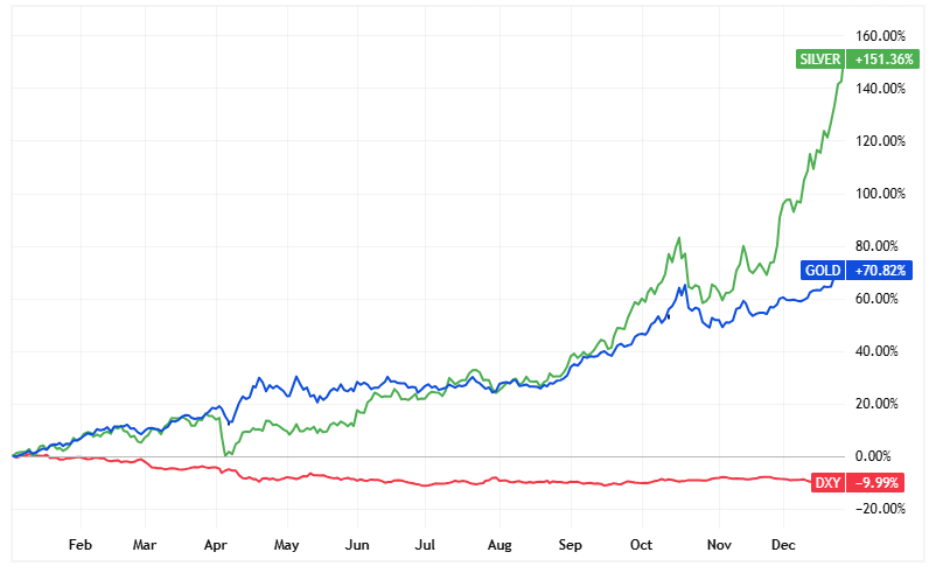
Gold, Silver and US Dollar Index 2025 Performance / Source: TradingView
2. Inflation and Real Yields
Inflation eased globally but remained above target in some developed countries. Gold’s role as an inflation hedge is both beneficial and misunderstood. Its price tends to rise not merely with inflation, but with the erosion of faith in monetary policy.
When real interest rates turn negative, the returns on holding cash or bonds are less than inflation. Gold becomes relatively more attractive, helping investors seek protection against the reduction of purchasing power.
3. Geopolitical Tensions
Geopolitical tensions also had a major role in triggering safe-haven flows into gold. Events such as the ongoing Russia-Ukraine war, tensions in the Middle East and trade tensions between the US and China have added more uncertainty throughout the year, which supported gold as a hedge against times of crisis.
4. Central Bank Buying
Central banks continued their gold purchases, adding almost 850 tons in reserves, marking a fourth consecutive year of high central bank demand for gold. Reports have shown that central banks accumulated around 80 tons per month this year, as nations sought to diversify reserves away from the US dollar. ⁽⁴⁾
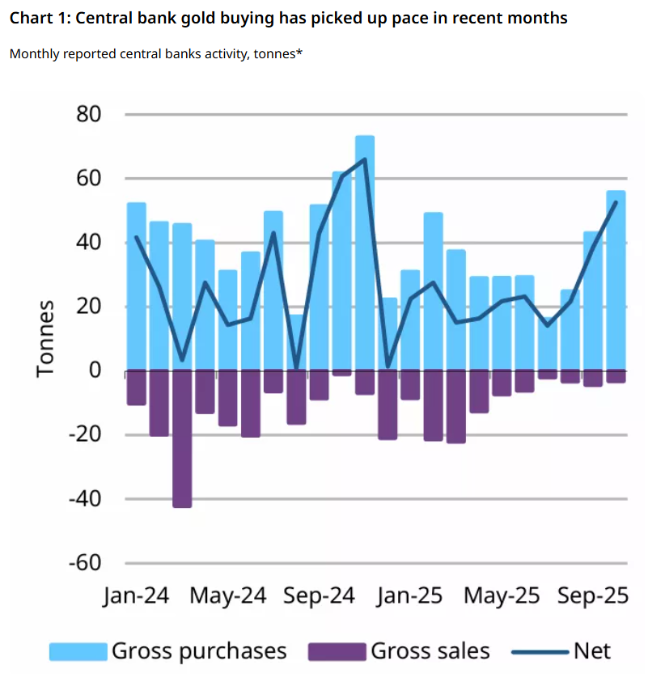
Central Bank Gold Purchases / Source: Kitco
5. Fiscal Deficits and Debt
Concerns over uncontrolled government debt and deficits also supported gold. Expansive fiscal policies and deficits in the US raised fears of credit risk, which led to waves of gold buying to hedge against market risks.
Globally, high debt levels and deficit spending kept investors wary of fiat currency stability, adding to gold’s attractiveness as a store of value outside the traditional financial system.
6. Investor Inflows
Investment demand was robust for both metals. Gold ETFs saw inflows of $82 billion, the largest inflow since 2020. Silver also benefited from investor demand, with holdings in silver ETFs rising to 4,000 tons. Physical demand also remained high, where purchases in India rose 13% YoY despite record prices. ⁽⁵⁾
Lessons from 2025
The rise in precious metals this year continues to support gold’s resilience as a safe-haven asset during times of uncertainty, while silver delivered massive returns but with higher volatility driven by speculation. Gold reacted more to macroeconomic data, while silver was mainly tied to industrial demand and carried a higher risk.
The macro picture showed that monetary easing and fiscal concerns boosted gold, while tight supply and heavy industrial usage caused silver to skyrocket. Both shined this year, but each had a very different path.