

 ar
- The Federal Reserve is expected to keep rates unchanged at its upcoming Wednesday meeting, marking its second consecutive pause after cutting rates three times last year, as surging oil prices and rising inflation make further easing increasingly difficult.
- With inflation already climbing before the Middle East conflict began and the labor market sending mixed signals, the Fed now faces simultaneous pressure on both sides of its dual mandate to keep inflation low while supporting employment.
- Rate cut expectations have been pushed back significantly, with the Fed widely expected to raise its inflation forecasts, trim its growth outlook, and delay anticipated cuts further.
As oil prices surge past $100 a barrel and inflation fears mount, expectations for Federal Reserve interest rate cuts are rapidly fading.
What once looked like a clear path to easing monetary policy this year has been thrown into doubt by events in the Middle East, leaving markets scrambled to reassess when or even whether relief from high borrowing costs will arrive.
The Inflation Problem Gets Bigger
The Federal Reserve is expected to keep the Fed Funds Rate unchanged at 3.75% on Wednesday, March 18, with the real question being how officials are thinking about the war in the Middle East and its effects to inflation.
That would be the second meeting in a row where the central bank has kept rates unchanged. Last year, the Fed cut interest rates three times in total, each one amounting to 25 basis points to support the weakening labor market.
Shipments being stuck in the Strait of Hormuz have sent oil prices sharply higher. Despite the US producing much of its own energy, oil prices are determined by global supply and demand, where its impact doesn’t just hit Americans, but the whole world.
As a result, economists expect US inflation to be on course to move toward 3.5% by summer, well above the Fed’s 2% target. The Fed’s core PCE index showed that inflation remained high, coming at 3.1% YoY, a further step away from where policymakers want to be. Crucially, this means inflation was already picking up before the conflict even started. ⁽¹⁾
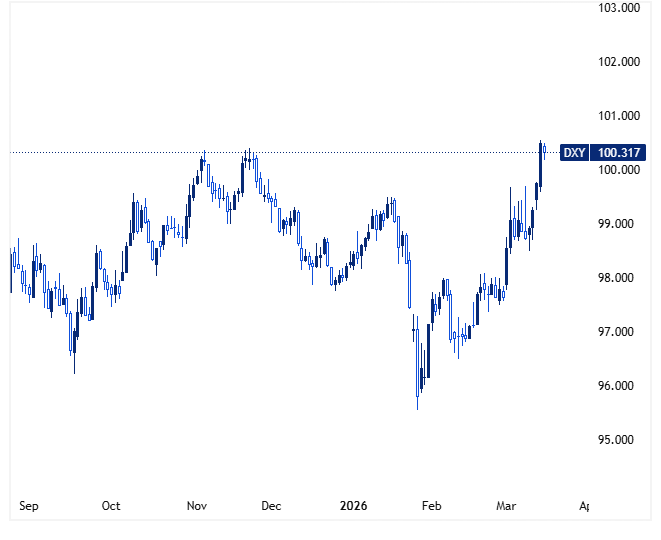
The US dollar has recently climbed to its highest levels in months, driven by rising energy costs, elevated geopolitical tensions, and reduced expectations of Fed rate cuts.
Jobs Data Adds to the Complications
The Fed’s headache is getting bigger by the day. January’s labor market report showed a strong performance, adding 130K during the month while the unemployment rate remained steady.
That brought some relief to the Fed and shifted its focus on inflation. Then, that relief was short-lived. February’s report suddenly showed job losses of 92K while the unemployment rate ticked up 0.1% to 4.4%. ⁽²⁾
Business surveys through February had pointed to solid GDP growth of around 3%, but rising geopolitical tensions and economic uncertainty are unlikely to sustain that momentum. Outside of the energy sector, conditions for growth look increasingly fragile. ⁽³⁾
Pushing Expectations Back
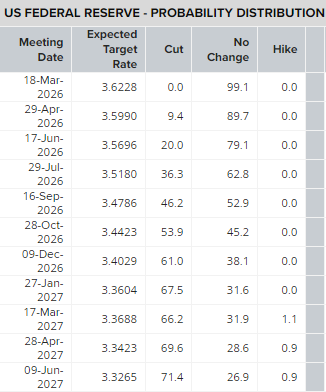
Economists thought that this was the year the US economy could see two early rate cuts. Instead, expectations have shifted, and economists now expect the next cut to come in June rather than March, with a second one possibly in October, leaving the Fed Funds Rate ending the year around 3.25%. ⁽⁴⁾
They also expressed misgivings about Kevin Warsh, the former Fed governor appointed by President Trump to succeed Chair Jerome Powell in May. Whether the incoming Fed chief finds room to maneuver will depend heavily on how energy prices and the geopolitical situation evolve. ⁽⁵⁾
In December, the Fed itself had been forecasting one rate cut in 2026 and a further cut in 2027. Given the new landscape, it is now widely expected that the Fed will trim its growth outlook, push its inflation forecasts higher, and delay that 2026 cut further into 2027. Powell is expected to use his press conference to stress the difficulty of setting policy in such an uncertain environment. ⁽⁶⁾
Traders fear the war could drive up inflation and drag down the job market, threatening both sides of the Fed’s dual mandate from Congress, to keep inflation low and employment high.


