ar
ar
- The Fed cut rates for the third time this year, but a rare 9–3 split shows deep disagreement over whether inflation or labor-market weakness is the bigger risk.
- Powell signaled a slower path ahead, saying the Fed has likely done enough to support jobs while keeping pressure on prices, but future cuts remain uncertain.
The Federal Reserve delivered a third straight rate cut in a decision that exposed the deepest policy divisions in years. A 9-3 vote highlighted disagreement over whether inflation or a weakening labor market poses the bigger economic risk.
Fed Chair Jerome Powell said the central bank has likely done enough to support employment while keeping pressure on prices, but the split shows a highly uncertain path for future cuts.
Breaking Down the Decision
The FOMC came to a vote of 9-3 to lower interest rates by 25 basis points to 3.75%. The decision was widely expected, but the Fed has changed its tone, now showing more uncertainty about future rate cuts.
The Fed’s October statement said it would consider several factors before making any further policy changes. The wording also returned to language last used last December, right before the Fed paused its rate cuts, saying it would evaluate “the extent and timing of additional adjustments.” ⁽¹⁾
Powell told reporters during the press conference that the Fed has done enough damage to the labor market while leaving rates high enough to continue the fight against inflation.
Unemployment moved to 4.4% in September, up from 4.1% in June. But prices, as measured by the PCE index, rose 2.8% YoY in September, still meaningfully higher than the central bank’s 2% target.
The government shutdown has further complicated the policy outlook by delaying the release of key data. ⁽²⁾
Powell also said that the latest rate cut should help stabilize the labor market while allowing inflation to resume its downward trend toward 2% once tariff effects have passed through. He also said that a rate hike is no longer on the table, but refused to promise that the next move will definitely be another cut. ⁽³⁾
Deep Divisions Inside the Fed
Division is running high among FOMC members, with three officials dissenting over the debate on whether labor market weakness or persistent inflation is the bigger danger to the US economy. The last time three members dissented was in 2019. Members who were against the decision include:
- Governor Stephen Miran, who wanted a 50-basis-point cut. This marks his third straight dissent for more and faster easing.
- Chicago Fed President Austan Goolsbee and Kansas City Fed President Jeffrey Schmid wanted to keep rates unchanged.
Fed officials also authorized new purchases of short-term Treasury securities to maintain the supply of bank reserves. ⁽⁴⁾
Economic Forecasts Show Fewer Cuts
The dot plot of individual officials’ expectations on rates indicated just one cut in 2026 and another in 2027 before the federal funds rate hits a longer-run target of around 3%. Seven officials see no cuts at all in 2026, while eight see two or more.
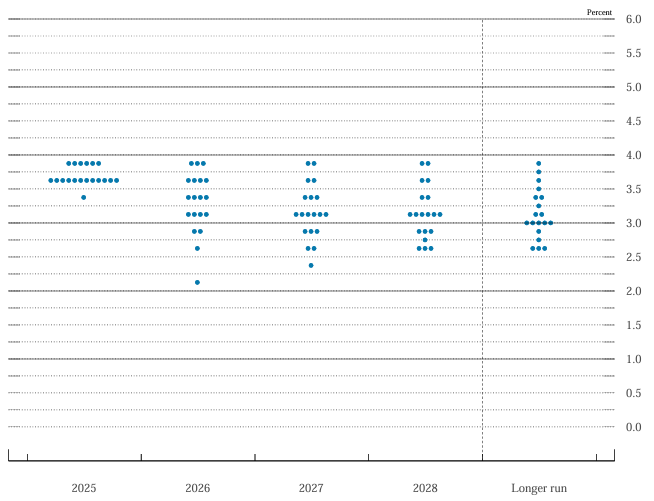
Fed Dot Plot / Source: Federal Reserve
FOMC officials upgraded their outlook for growth to 2.3% in 2026, up from the previous figure of 1.8%. They also expect inflation to fall to 2.4% in 2026, lower than the previous figure of 2.6%. ⁽⁵⁾
Powell also expects tariff-driven inflation to fade next year, assuming there are no major tariff announcements that could cause inflation to peak in Q1 2026.
The policy decision follows President Donald Trump’s announcement confirming he has chosen a successor to Powell. Details are expected early next year.
The White House has criticized the Fed for not cutting rates quicker, raising concerns about central bank independence.
Market Reaction
US stocks jumped on the rate cut decision. The Dow Jones closed almost 500 points higher, the S&P 500 surged 0.67%, and the Nasdaq climbed 0.77%.
The US dollar fell 0.4% after the announcement while gold surged 1%, nearing October levels.
Treasury yields fell, with the 10-year yield falling by 4.3 basis points to 4.143% after swinging between a session low of 4.137% and a three-month high of 4.209%. The 2-year Treasury yield fell 3.5 basis points while 5-year yields also declined by 4.3 basis points as the Fed announced the purchase of short-term Treasuries.