ar
- Gold is priced in US dollars, so a weaker dollar tends to lift the price of gold for buyers worldwide.
- Gold and the dollar compete as safe havens, each rising on a different kind of fear.
- The inverse relationship can break during extreme market stress, but tends to reassert over longer periods.
Ask any gold trader what they watch first each morning and many will say the dollar.
The two assets have pulled in opposite directions for decades, and the reasons run deeper than habit.
There are three economic mechanisms that link the precious metal to the world’s reserve currency.
How the Dollar Moves Gold
Gold is quoted in US dollars on global markets. That creates a direct, mechanical link between the two assets.
When the dollar weakens, it takes more dollars to buy the same ounce of gold. At the same time, gold becomes cheaper for buyers using other currencies, which increases demand internationally.
Both effects can push the gold price higher.
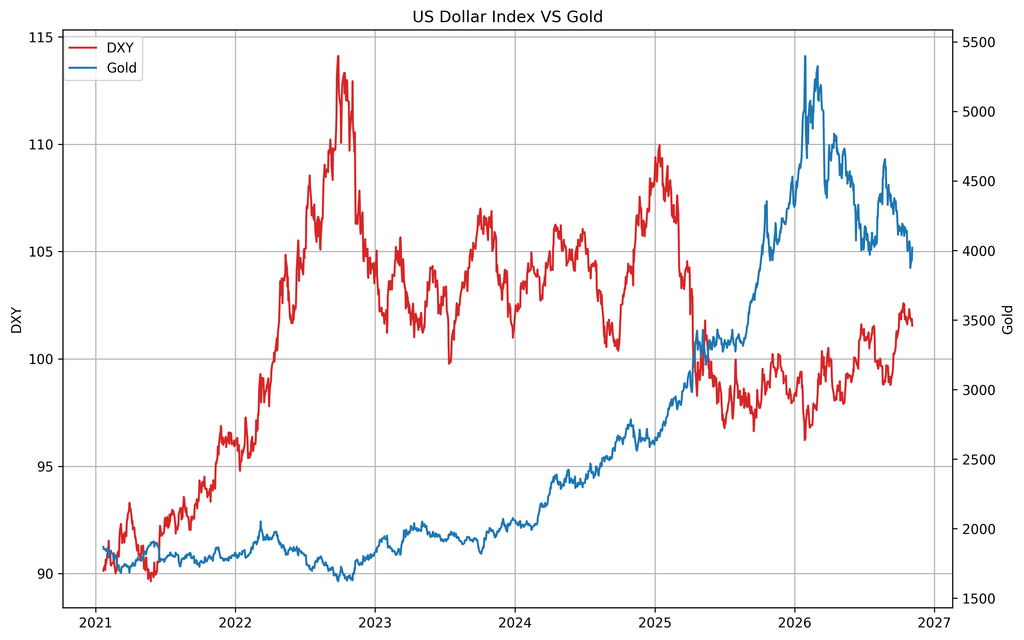
The reverse is equally true. A stronger dollar can compress gold prices in dollar terms and raise the cost for foreign buyers, reducing demand. ⁽¹⁾
From 2002 to 2008, the US dollar index fell from around 120 to below 72, while gold rose almost $280 per ounce to above $1,000, a gain of more than 250%. ⁽²⁾
The Safe-Haven Trade
Both gold and the US dollar are safe-haven assets, but each react to different kinds of fear.
The dollar tends to attract capital times of broad financial stress or higher interest rate environment. When the Fed hikes interest rates and is committed to more rate increases to fight inflation, the dollar rises alongside Treasury yields as investors demand higher returns from higher rates.
Gold can attract capital when investors are worried about a recession, geopolitical tensions, fiscal crises, or weakening confidence in monetary policy. These concerns can support demand even if the dollar remains strong.
Demand for safety can favor either asset, depending on the source of uncertainty. In some periods, both can attract capital at the same time.
Inflation and Real Interest Rates
Inflation heavily affects gold through real interest rates, which is the return available after inflation costs. Gold pays no interest, so higher real yields tend to increase the cost of holding the precious metal. The US 10-year TIPS trades around 2.60%, which provides investors with a positive inflation adjusted alternative to gold.
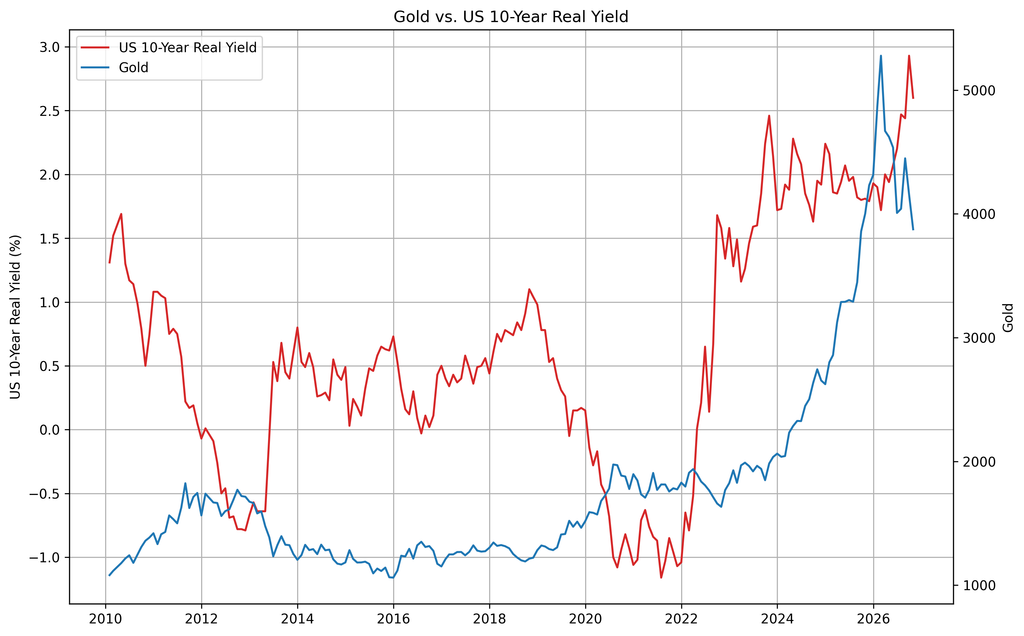
Since the US ended the conversion of dollars to gold in 1971, gold has outpaced cumulative US inflation, but not hasn’t consistently protected purchasing power over shorter periods. ⁽³⁾
During the 1970s stagflation, inflation in the US peaked at 14.8% in 1980, and gold rose from $35 per ounce in 1970 to $850 by January 1980. That is a gain of roughly 2,300% over a decade of sustained purchasing power erosion. ⁽⁴⁾
When markets price in rising inflation, they are also pricing in dollar weakness. Both forces converge on gold and reinforce the inverse relationship.
When the Relationship Breaks Down
The inverse relationship is consistent but not absolute. During periods of acute global stress, the link can weaken, or stop working entirely.
2022 was one such example. The Federal Reserve raised rates at the fastest pace in decades and the dollar surged to a 20-year high. By the usual logic, gold should have fallen sharply. Instead, it ended the year essentially flat.
What held gold up was a different source of demand. Central banks bought more than 1,000 tonnes of gold that year, the highest level on record ⁽⁵⁾, as geopolitical disruption and surging inflation drove reserve managers toward the metal.
What drives this kind of breakdown is the nature of the fear. Dollar strength during risk-off events reflects demand for liquidity in global transactions. Gold demand reflects concern about systemic risk or long-run purchasing power. During extreme conditions, both forces can run in parallel and offset each other.
Over longer horizons, the structural link between the dollar’s purchasing power and gold prices tends to reassert itself.
Final Thoughts
Gold and the dollar aren’t two separate markets that happen to disagree.
They’re linked by pricing, by competition for safe-haven money, and by inflation. Understand those three links, and every move in one tells you something about the other.
Sources: ⁽¹⁾ ScienceDirect, ⁽²⁾ CME Group, ⁽³⁾ ⁽⁴⁾ ⁽⁵⁾ World Gold Council