

 ar

- The US dollar faced increased volatility after renewed geopolitical tensions, with markets also focusing on upcoming economic data that could impact the Federal Reserve’s outlook.
- Risk-on currencies such as the AUD, GBP, and EUR rose due to diverging interest rate outlooks and growth optimism.
- The Japanese yen slightly rebounded on hawkish signals from BOJ Governor Ueda, while the Swiss Franc gained after renewed geopolitical tensions, since the currency is known for its safe-haven appeal.
In the latest FX moves, currencies moved on the latest economic data and renewed geopolitical tensions.
The US dollar consolidated after facing volatility in the previous session, while risk-on currencies took advantage of dollar volatility due to diverging central-bank outlooks, shifting interest rate expectations.
US Dollar Consolidates After Volatile Session
The US dollar index steadied after reaching two-week highs during a volatile session as markets reacted to the US attack on Venezuela alongside key economic data set to be released this week.
A US military operation in Venezuela over the weekend that led to the capture of President Nicolas Maduro triggered fresh geopolitical concerns, though the impact on markets has so far been subdued.
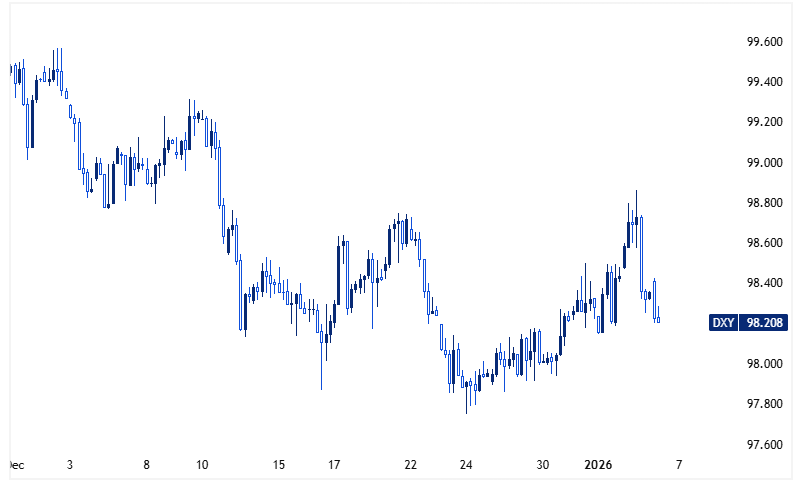
DXY 4H Chart / Source: TradingView
Moving away from geopolitics, markets will be focused on December’s labor market report due on Friday. Nonfarm Payrolls is forecasted at 55k while the unemployment rate is expected to decline to 4.5% in December, down from 4.6% in the previous report. ⁽¹⁾
Alongside the labor data, JOLTS job openings, ISM services PMI, and ADP employment change data will be released on Wednesday. Markets are expecting two rate cuts from the Federal Reserve this year, despite the Fed forecasting only one cut. ⁽²⁾
ISM manufacturing PMI showed a contraction of 47.9 in December. The report confirmed what a mixed year 2025 was for manufacturing, with weak business activity and inflation. ⁽³⁾
President Trump is also expected to announce his choice for the next chairperson of the Federal Reserve this month. Whoever that person is, they will probably be someone who supports Trump’s call for lower interest rates.
Pound and Euro Rise on Risk-On Sentiment
The pound and the euro rose on dollar weakness. The pound reached a 3-month high as markets focused on diverging interest rate outlooks between the Bank of England and the Federal Reserve. Markets are expecting two rate cuts this year from the Federal Reserve, while the Bank of England is expected to cut only once this year, potentially giving the pound an advantage over the dollar. ⁽⁴⁾

GBP/USD 4H Chart / Source: TradingView
The euro also received support from diverging outlooks. The ECB indicated rates are likely to remain on hold, citing resilient growth and inflation near target, while President Christine Lagarde warned that high uncertainty complicates forward guidance. ⁽⁵⁾
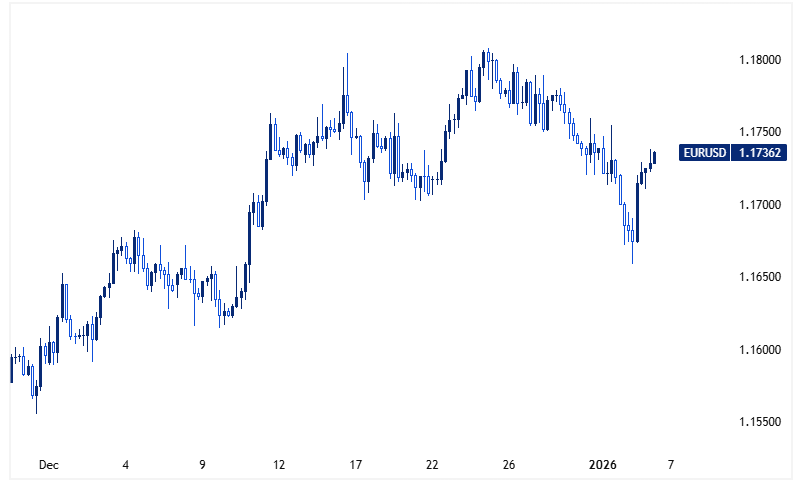
EUR/USD 4H Chart / Source: TradingView
Japanese Yen Lacks Conviction Despite Hawkish Signals
The Japanese yen slightly rebounded after reaching a two-week low after the Bank of Japan’s Governor Ueda’s comments that the BOJ will continue hiking interest rates if economic and price forecasts align. His comments indicate that the Japanese economy is moving away from a long period of deflation towards a more growth-driven economy.
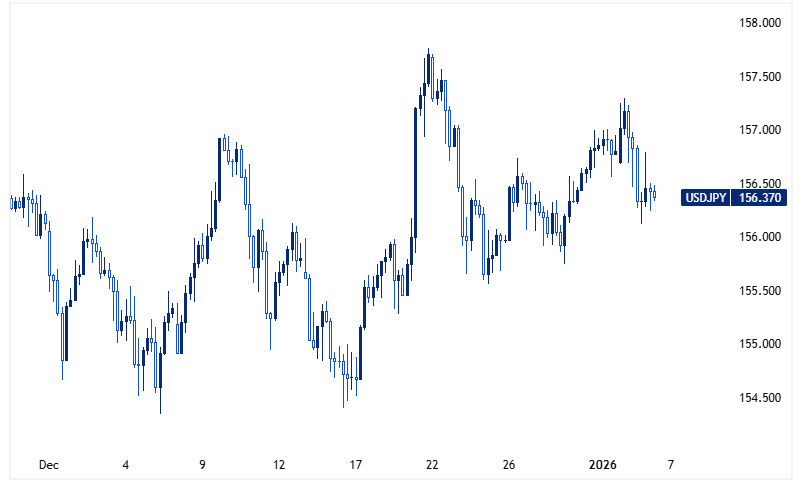
USD/JPY 4H Chart / Source: TradingView
However, fiscal concerns from Prime Minister Takaichi’s massive stimulus package, which plans to boost growth, are still pressuring the yen. Markets are cautious about a potential FX intervention from the finance minister, with business leaders calling on the government to address the yen’s weakness and support a stronger currency.
Aussie Dollar Rises on More Hawkish RBA
The Australian dollar climbed near 0.67 as markets ignored the impact of the heightened tensions between the US and Venezuela.
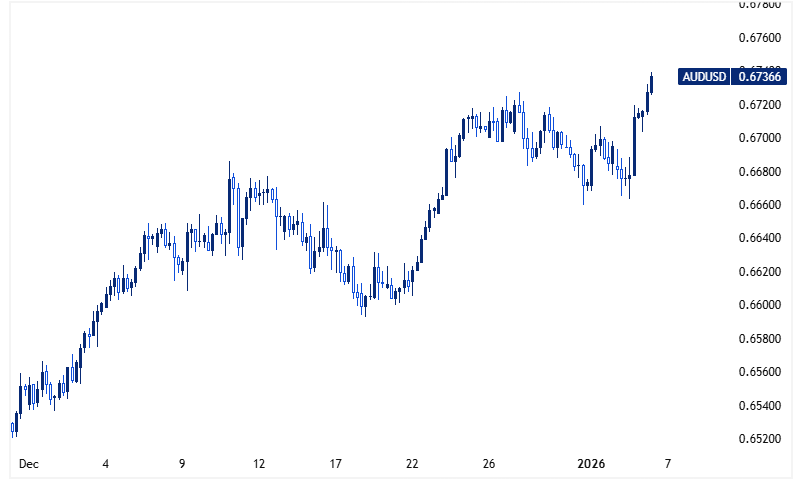
AUD/USD 4H Chart / Source: TradingView
Markets are pricing in a February rate from the Reserve Bank of Australia at 39%, depending on the upcoming inflation data. ⁽⁶⁾
The next inflation report is due on Wednesday, with a forecast of 3.7% YoY, down from the previous figure of 3.8%. Core inflation is expected to drop by 3.2% after a high reading of 3.3%. Inflation remains above the RBA’s target range of 2-3%. ⁽⁷⁾
Swiss Franc Holds Steady Near 15-Year Highs
The Swiss franc held steady near 2011 highs as markets reacted to renewed geopolitical tensions between the US and Venezuela. Global economic uncertainty tied to Trump-era trade policies, along with expectations of further rate cuts, also supported safe-haven demand.
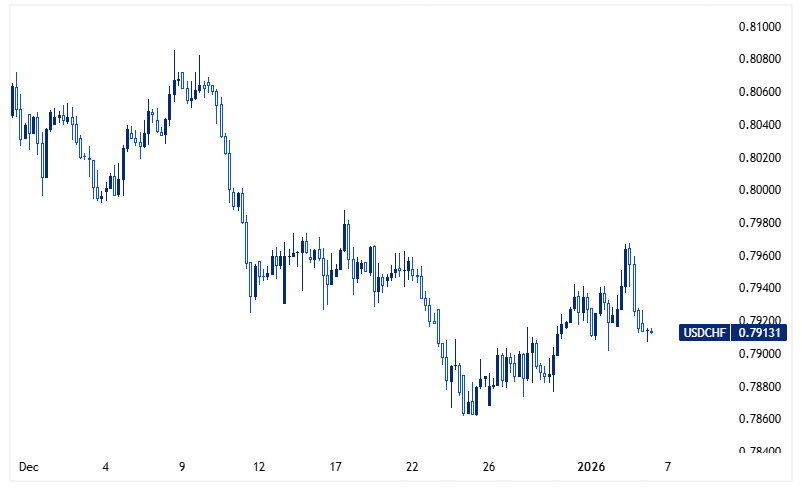
USD/CHF 4H Chart / Source: TradingView
Markets are now focused on Switzerland’s inflation report for clues on SNB policy, which is due on Thursday. The report is expected to show a decline of 0.1% MoM and an increase of 0.1% YoY after a flat reading in November. ⁽⁸⁾
The Swiss National Bank kept rates at 0% in December as it battles deflationary pressures. Analysts largely anticipate no changes in 2026. Meanwhile, a fresh PMI survey showed Swiss manufacturing activity contracted by more than expected, falling to a seven-month low in December. ⁽⁹⁾


