ar
ar
- The eurozone composite PMI edged up to 49.5 in June but remained in contraction for a fourth straight month.
- The UK’s services sector contracted at its fastest pace in over three years, dragging the composite PMI down to 49.4 and adding to a growing list of economic pressures facing the new government.
- US manufacturing surged to 55.7, its highest reading since May 2022, as businesses rushed to build inventory ahead of anticipated supply disruptions.
Private sector activity told two very different stories in June.
While the Eurozone and the UK continued to struggle with falling demand and weak business sentiment, the United States posted stronger-than-expected manufacturing growth, driven by companies racing to build stock ahead of anticipated shortages and price rises.
The contrast highlights the uneven global economic impact of the Middle East conflict.
Eurozone Activity Edges Up but Stays in Contraction
The Eurozone’s PMI composite came in at 49.5, rising from May’s 48.5 to hit a three-month high, although it still remained in contraction territory. New orders fell for a fourth straight month. The marginal recovery in the manufacturing sector wasn’t enough to reduce the decline in services demand. ⁽¹⁾
Employment slightly declined, with jobs in services rising while manufacturing payrolls continued to drop. Business confidence improved for a second straight month after hitting a 31-month low in April, though sentiment remained muted.
Forecasts show that GDP for the second quarter could come in at 0.1% following the weak PMI figures. ⁽²⁾
Germany Leads the Decline in Europe
Germany was the weakest performer among the EU economies. Its composite PMI showed a reading of 48 in June, falling from May’s 48.8 to mark its sharpest contraction in 18 months, well below its forecast of 49.9. ⁽³⁾
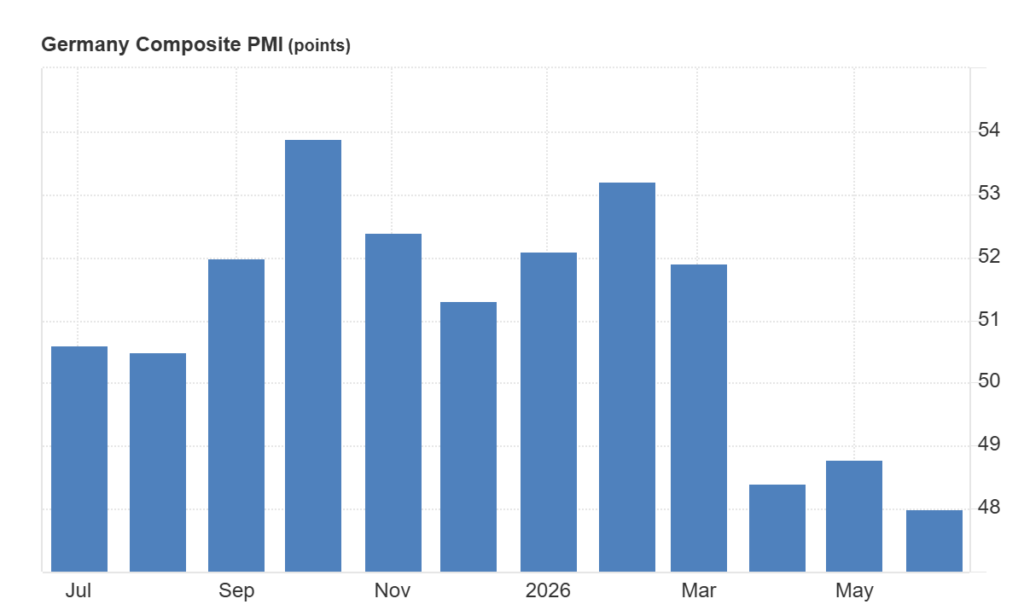
The services sector was the main drag. Germany’s services PMI fell to 46.8 from 48.1, its lowest reading since November 2022.
New business declined for a fourth consecutive month and at the fastest rate since December 2024. Manufacturing held flat, with its PMI edging marginally lower to 50. ⁽⁴⁾
France offered a slight contrast. The composite PMI contracted, but the pace has eased as output declines in both manufacturing and services have slowed. The rest of the eurozone recorded modest output growth. ⁽⁵⁾
Britain’s Services Sector Sinks Further
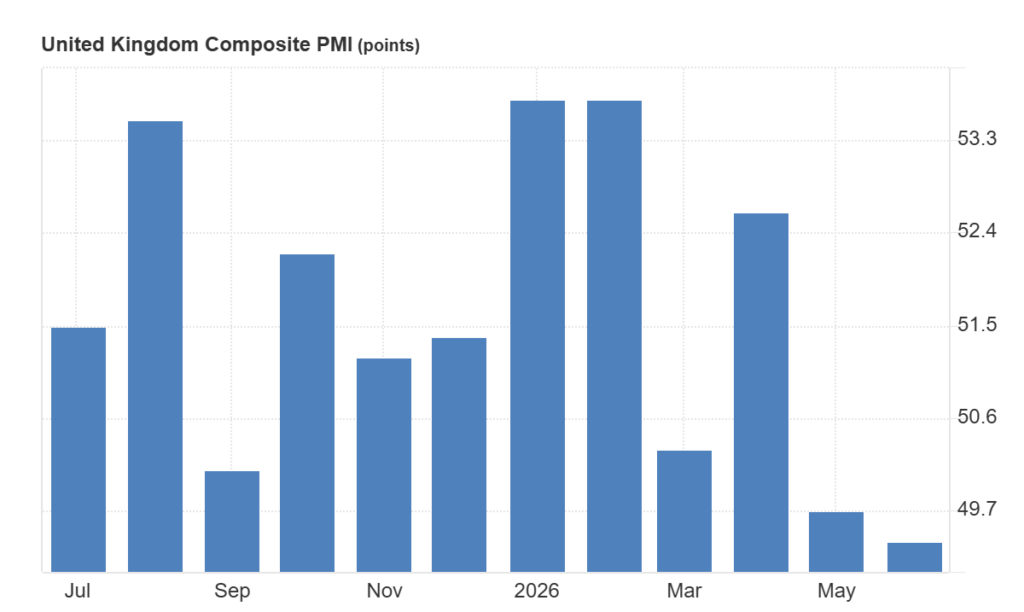
Outside the eurozone, the UK’s services sector contracted at its fastest pace in more than three years. The reading came in at 48.7 in June, down from the previous 49.3.
The new business index fell to its lowest level since January 2021. Manufacturing remained in expansion territory but dropped to a three-month low of 53.1 from May’s 53.9. ⁽⁶⁾
Overall, the UK’s composite PMI contracted to 49.4, down from May’s 49.7, reaching its lowest level since April 2025. The PMI data comes after Prime Minister Starmer announced his resignation, showing that the UK economy is facing several economic challenges that its most likely successor, Andy Burnham, will have to confront. ⁽⁷⁾
US Manufacturing Surges on Front-Running Demand
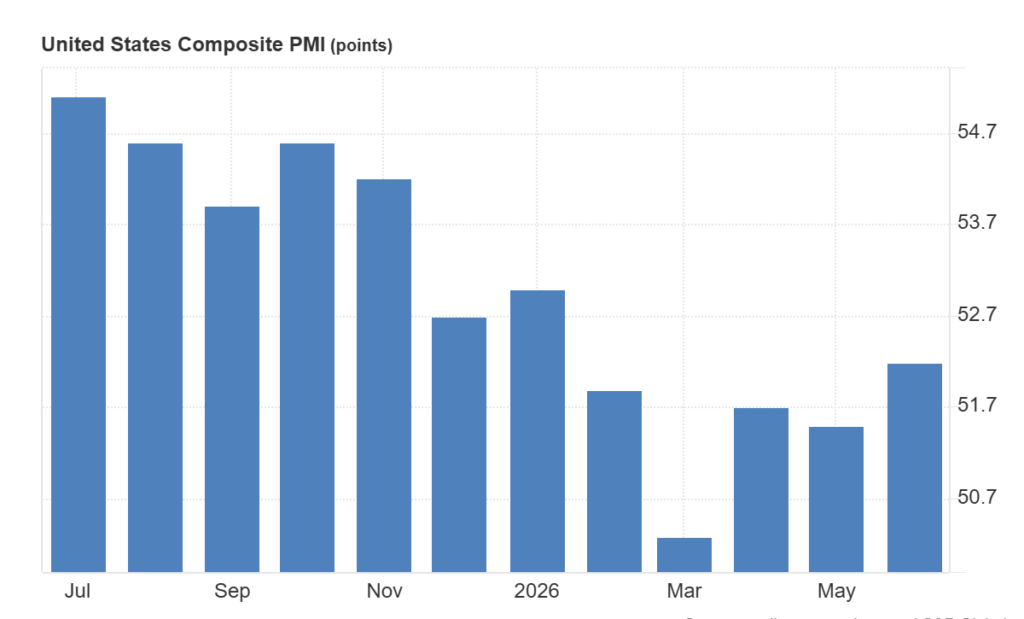
US business activity continued to expand for the fourth straight month in June. The manufacturing reading rose to 55.7 from 55.1 in May, marking its highest level since May 2022 and coming in well above its forecast of 54.8. ⁽⁸⁾
The jump was largely driven by a surge in new orders, which climbed above a four-year high as businesses rushed to stock up ahead of potential supply disruptions and higher prices linked to the US-Iran conflict.
Despite the headline strength, factory employment fell sharply. The manufacturing employment index dropped to 47, its lowest reading since May 2020, as firms cut jobs in response to rising raw material costs. Input cost inflation remained elevated, with factories continuing to pass higher costs on to consumers, though the pace slowed slightly. ⁽⁹⁾
Services also continued its expansion, showing a reading of 51.3, up from May’s 50.7. The expansion indicates that businesses are in better condition than before, as the services sector plays an important role in the US economy. ⁽¹⁰⁾
Composite PMI rose to 52.1 from May’s 51.5, mainly supported by the services sector due to the FIFA World Cup currently being hosted by the US, Canada and Mexico. ⁽¹¹⁾
Looking Ahead
With inflationary pressures showing tentative signs of easing, the ECB may now have more room to refocus on weakening domestic growth.
But the Fed remains in tightening mode, a divergence in policy direction that could widen the economic gap between the two regions in the months ahead.