ar
Europe faces overlapping financial risks from AI financing, strained government finances and energy supply disruptions.
The ECB’s November Financial Stability Review examines how these pressures could spread through investment portfolios, borrowing costs and weaker repayment capacity.
“Risks to euro area financial stability remain elevated, given persistent geoeconomic uncertainty and growing exposure to AI,” ECB Vice-President Boris Vujčić said. Banks retain strong financial buffers, but closer links with investment funds could amplify shocks across the system. ⁽¹⁾
Europe’s AI Exposure Goes Beyond Tech Firms
Despite potential gains to productivity, individual investments may not generate enough income to be profitable.
The ECB estimates that major tech firms in the US will have invested a total of $5.5 trillion in capital investment through 2030 (although this is likely to change over time). The ECB also estimates that off-balance sheet obligations in big tech will be over $4 trillion in Q2 2026. This includes contractual obligations, rather than just loans. ⁽²⁾
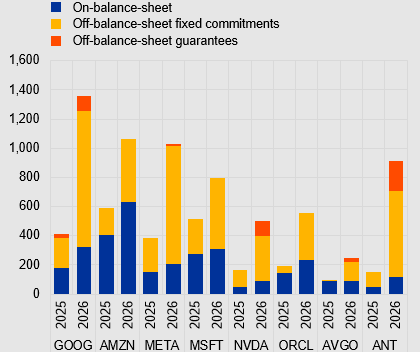
When suppliers fund the customers who buy from them, sales figures can look stronger than real demand.
Additionally, long-term debt may be held for longer than relevant equipment becomes obsolete. This is a risk according to the ECB. ⁽³⁾
A fall in demand could mean reduced operating profits for the business, lower asset value of equipment and ongoing financing commitments. As interest rates have increased, refinancing will be costly.
The main concern here is whether cash generated from customers can support the scale and financing structure of investment. But revenue growth alone cannot answer that question.
Strong AI revenue might coexist with financial vulnerability if investment spending and financial obligations rise faster than cash flows.
European institutions are still heavily involved in the AI investment cycle through several channels. The review places US technology and AI-related companies at 16%–26% of euro area non-banks’ equity investments, depending on the institutional sector. ⁽³⁾
A broad sector-based estimate puts banks’ AI-related lending commitments at approximately €75 billion, or 1.1% of corporate commitments, with important coverage limitations. ⁽³⁾
These exposures impact the euro area differently:
- Equity Investments
Where falling share prices can reduce portfolio values, leading to more cautious spending from households.
- Corporate Bonds
Wider credit spreads bring bond prices down, and refinancing becomes more expensive.
- Lending to Funds
Fund losses weaken counterparties and banks might tighten financing terms.
- Lending to Businesses Disrupted by AI
Borrowers lose revenue and credit losses can emerge outside the tech sector.
FX volatility is also another factor. A euro-based investor with euro funds holding unhedged US assets can experience both the dollar’s return on investment and the change in the EUR/USD value. Currency hedging reduces exposure but also comes with costs.
France’s High Debt is Making Borrowing Riskier
Government financing is becoming more vulnerable when large borrowing needs align with higher interest rates and uncertain investor demand.
French sovereign spreads are getting wider, which shows investors are demanding higher compensation for fiscal risks. Political uncertainty ahead of the French presidential election next year is still worrying investors.
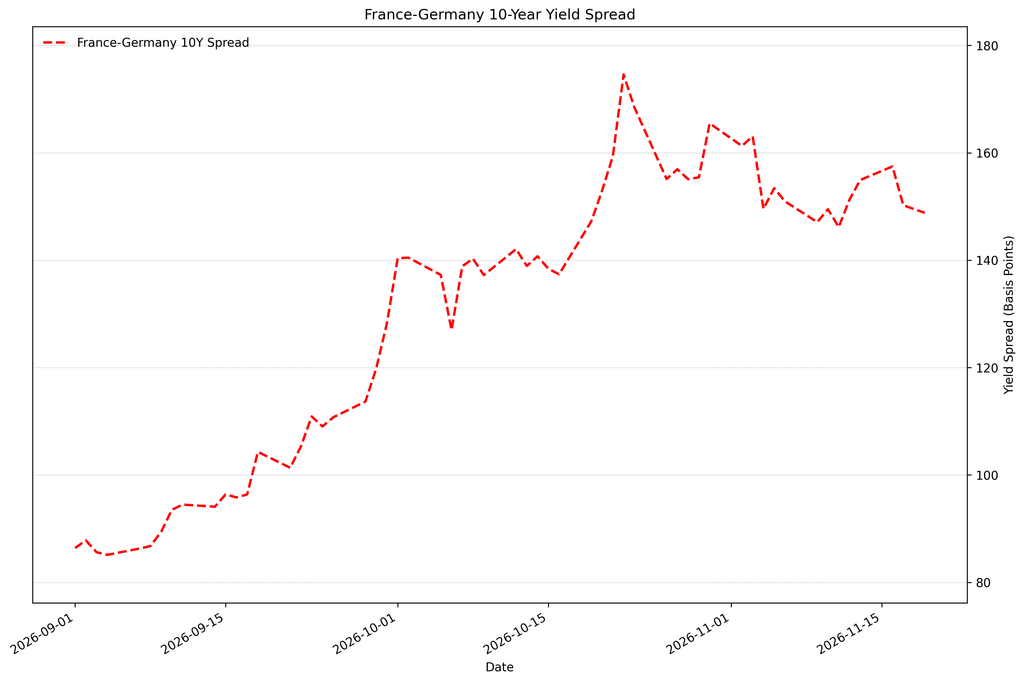
France’s public debt reached 119% of GDP, while the European Commission expects a budget deficit of 5.5% for 2026. This shows the ECB’s concern that higher financing costs can further weaken already damaged fiscal policies. ⁽³⁾
Persistent deficits require additional borrowing, while refinancing maturing debt at higher interest rates could increase the government’s interest bill, leaving less room for the government to respond to economic shocks.
As existing fixed-rate securities largely maintain their coupon rates, it will take time for the entire debt to be repriced, due to increasing yields. Increasing refinancing of existing debt and financing new deficits increases this burden.
Bond Stress Spreads Between Countries
The ECB also reported that leveraged hedge-fund selling with borrowed money made the bond market stress even worse. That means a yield increase can contain several components: expected policy rates, inflation compensation, fiscal concerns and market liquidity. ⁽⁴⁾
France’s bond market pressures have wider implications. The ECB finds that the widening yield spread between French and German bonds has spilled over to other highly indebted euro area nations, while German Bunds have benefited from safe-haven demand. ⁽³⁾
Although markets have generally continued to function in an orderly manner, this illustrates how concerns about one country can affect financing conditions elsewhere in the currency union.
There is also exposure in the investor base. Given Japan has significant exposure to French government bonds, higher yields at home or changes in the exchange rate may make Japanese assets more attractive, leading to further decreases in prices of long-dated European bonds. ⁽³⁾
Fiscal uncertainty is adding to pressure on the euro, alongside stronger expectations of Federal Reserve rate hikes, exposure to the energy shock and reduced expectations of further ECB tightening. ⁽⁵⁾
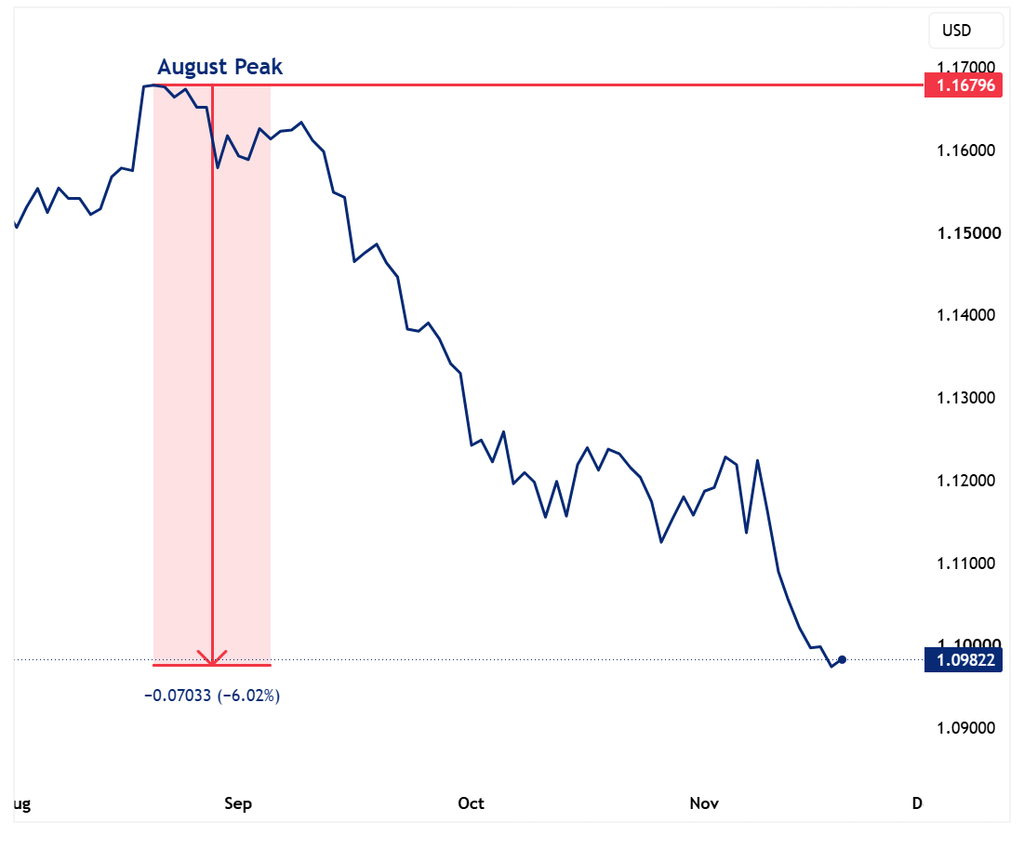
Higher French yields may offer limited support when they reflect fiscal risk, while tighter financing conditions could further weaken growth. If investors shift away from euro area assets it could extend the currency’s losses.
Energy Costs Add to Financial Pressures
Higher energy costs squeeze household purchasing power and business profits. Companies that cannot pass rising production and transport costs to customers must absorb them through lower margins, leaving less cash available for investment and debt repayments.
The share of troubled bank loans to energy-intensive businesses remained at 4.2% in Q2, unchanged from last year, meaning that higher energy prices could take a while to cause loan repayment problems. However, risks could rise gradually if financial reserves are depleted. ⁽³⁾
The ECB’s analysis finds that oil supply shocks can cause “a lagged, gradual and prolonged deterioration in bank asset quality.” ⁽⁶⁾
Its modelling suggests that the initial banking effects of the Strait of Hormuz disruption might become visible during 2027, although corporate financial buffers and oil inventory drawdowns could soften the impact. ⁽⁶⁾
The pressure can then feed back into the economy. Businesses may postpone investment, while banks reduce lending to riskier borrowers.
Persistent energy inflation also complicates the ECB’s decisions, as expensive financing adds to borrowers’ costs, and long-running subsidies put more strain on public finances.