ar
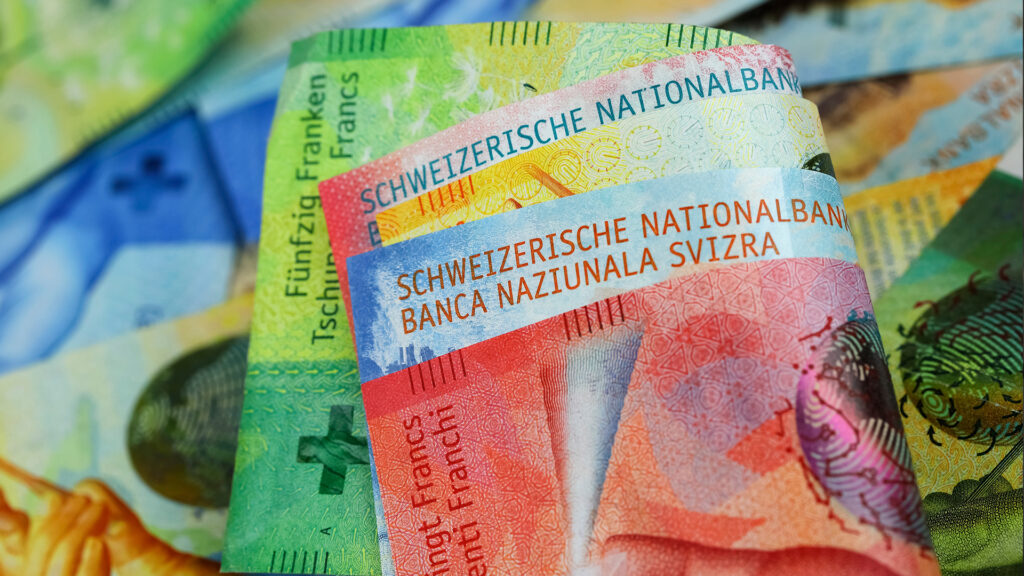
The Swiss franc hit a five-month high against the euro on November 6, one day after the Nasdaq 100 fell more than 6%. The Swiss National Bank’s policy rate was still 0%, while the European Central Bank’s deposit rate stood at 2.50%.
By the ECB’s daily reference rates, one euro bought 0.9143 francs, down from 0.9478 at the end of September, indicating a 3.7% gain for the franc against the euro.
The rate gap made euros more rewarding to hold for yield. But during a sell-off, investors can put more value on how a currency holds up under stress. That demand has a consequence for Swiss monetary policy.
A stronger franc makes imports cheaper and can take pressure off the Swiss National Bank (SNB) to raise rates. In that sense, the strong franc may be part of the reason why Swiss rates are low.
Why Swiss Interest Rates Tend to be Lower
Over the 15 years examined in a 2026 SNB study, inflation averaged 0.4% in Switzerland compared with 2.2% in the eurozone. Goods, especially food and energy, accounted for about two-thirds of the gap. ⁽¹⁾

Lower inflation is less impactful on returns, so investors can accept lower yields. Switzerland’s stable politics, careful government spending, and trusted central bank also make investors comfortable earning less on assets they see as safe.
SNB researchers estimate that Switzerland has a lower neutral real interest rate than other major economies. The neutral real rate is the inflation-adjusted rate at which the economy runs at full capacity with stable inflation. ⁽²⁾
The estimate varies by model, but it helps explain why Switzerland can run lower policy rates than its peers. The move to zero had a more immediate cause. The SNB cut from 0.25% to 0% in June 2025 after annual inflation fell to −0.1% in May. Its definition of price stability is inflation between 0% and 2% over the medium term. ⁽³⁾
Lower inflation also changes how to read the franc’s long-term rise. From January 2025 to April 2026, the franc gained around 7.5% against a trade-weighted basket of currencies. After adjusting for Switzerland’s lower inflation, the gain was just over 4%.
That smaller figure gives a better sense of the pressure on exporters’ competitiveness, because it accounts for how much prices rose in Switzerland and abroad.
What Attracts Buyers to the Franc
During times of uncertainty or crisis, foreign investors can buy Swiss assets while Swiss investors bring their funds back home or hedge their foreign holdings. After the collapse of Lehman Brothers in September 2008, SNB researchers found that Swiss banks pulling back from overseas markets accounted for a substantial share of net banking inflows. ⁽⁴⁾
Switzerland’s external balance gives that channel scale. At the end of Q2 2026, its foreign assets exceeded its external liabilities by CHF 986 billion. How much of that translates into franc demand depends on what investors convert, hedge or leave invested abroad. ⁽⁵⁾
Carry trades can push the franc in either direction. When volatility is low, traders can engage in carry trading by borrowing francs, selling them and buying higher-yielding currencies.
Between the SNB’s June and September 2026 meetings, the franc fell around 3% on a trade-weighted basis (measuring the Swiss franc against a basket of currencies, with more weight given to Switzerland’s trading partners). The SNB pointed to wider interest-rate gaps and low volatility, which made the franc more attractive than the Japanese yen as the funding currency.
When markets become volatile, traders usually focus on the franc by either closing their carry trade positions and buying back francs to repay their borrowing or buy Swiss assets.
That can add to the demand already coming from investors seeking safety.
What Drove the Rally?
Swiss inflation rose to 1.5% in October, and Switzerland’s two-year government bond yield edged up to 0.201% on the day of the release.
The franc had already gained about 3.1% against the euro in October. Concerns over France’s debt and its ability to pass the 2027 budget pushed French borrowing costs higher, putting pressure on the euro and drawing investors toward the franc. The November tech sell-off gave the franc a further lift.
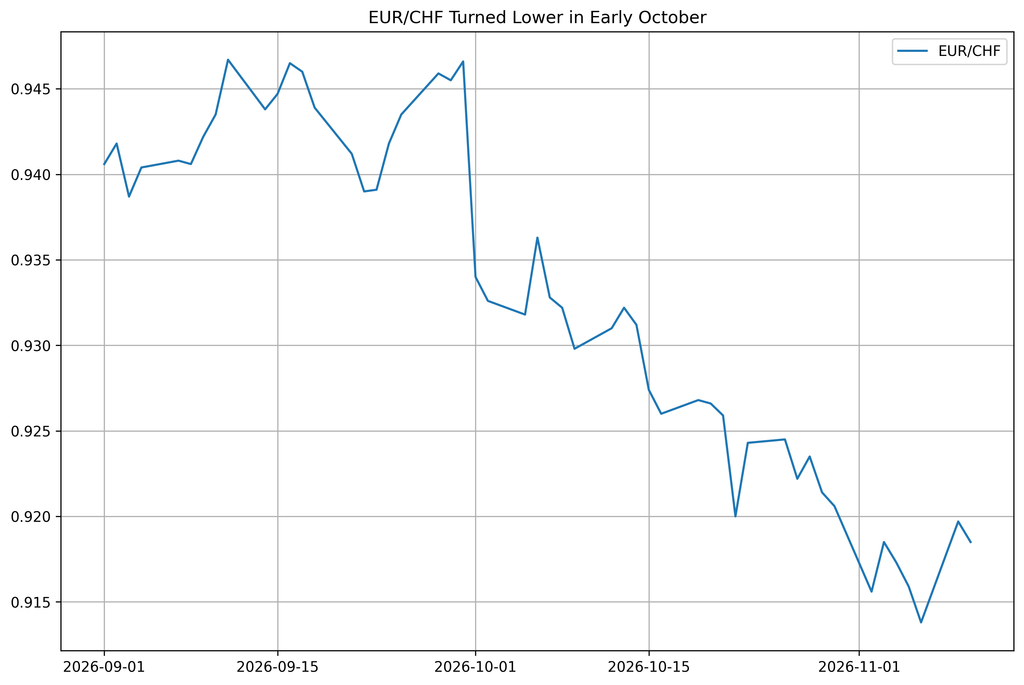
Between November 5 and 6, the Swiss yield rose from 0.192% to 0.206%, while Germany’s two-year yield held near 2.98%. That narrowed the German–Swiss yield gap from 278.4 to 277.1 basis points, a modest move in the franc’s favor. The franc also drew safe-haven demand as US tech stocks sold off, with EUR/CHF falling from 0.9180 to 0.9143. ⁽⁶⁾
With Swiss rates at 0% and Japanese rates at 1.25%, the franc offered cheaper funding for the same Australian dollar position. The November sell-off showed how quickly that advantage could be overwhelmed by a move in the exchange rate.
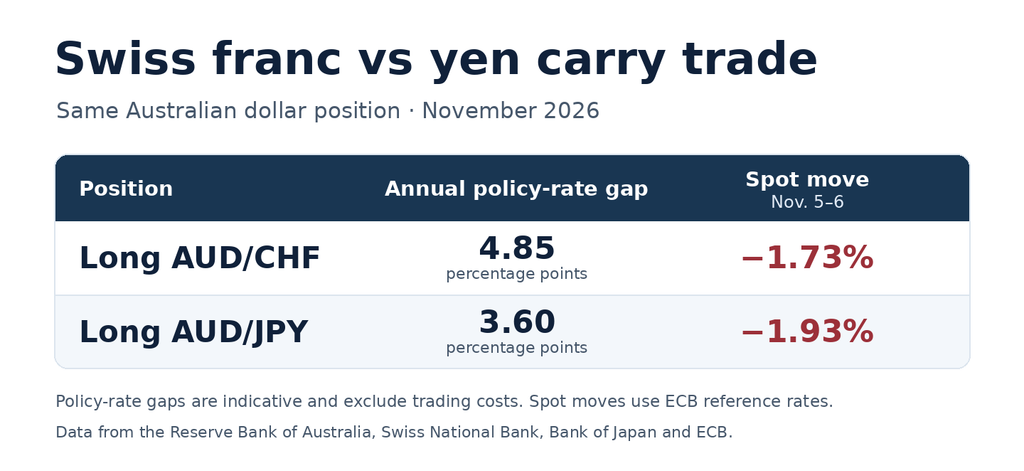
The yen gained more than the franc against the Australian dollar between November 5 and 6, so the yen-funded trade lost more on the exchange rate. Even the 1.73% drop in AUD/CHF was equivalent to about 19 weeks of interest at a hypothetical annual rate of 4.85%, before costs.
Over the same period, the franc fell 0.12% against the US dollar as investors also sought safety in the dollar.
A 0% policy rate made the franc cheap to borrow, but its rally against the Australian dollar was enough to wipe out weeks of potential carry. The yen and US dollar still outperformed the franc over the same period, showing that its safe-haven strength depends on which currency it’s paired with.
When Does the SNB Want a Stronger Franc?
About a quarter of Switzerland’s consumer basket is imported, according to the SNB. When energy and other foreign goods get more expensive, a stronger franc can cushion the increase.
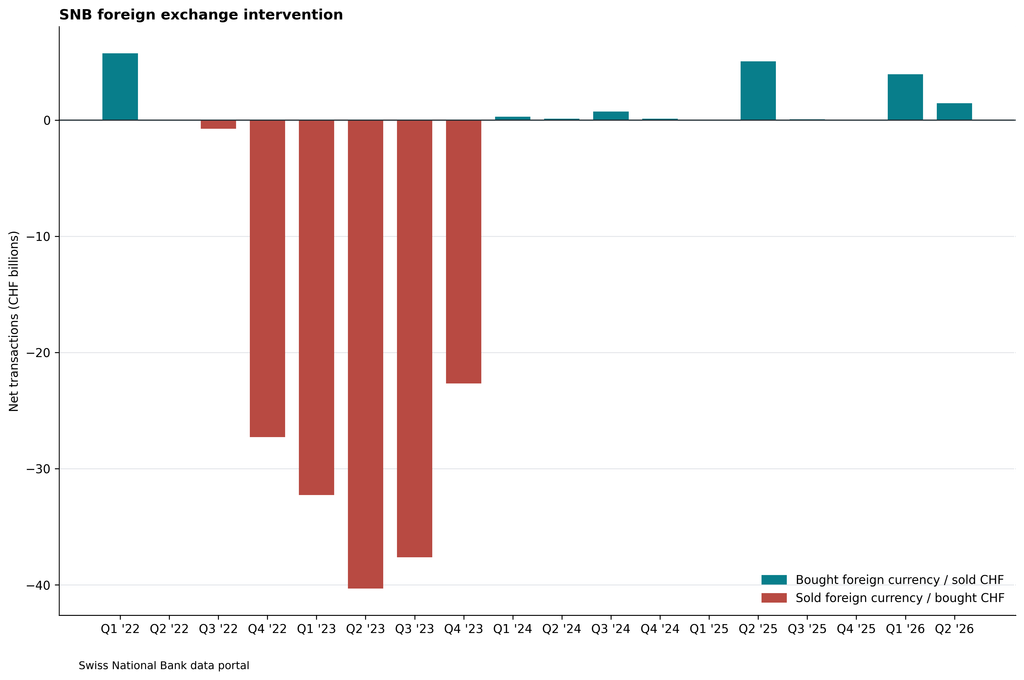
In 2023, the SNB sold CHF 132.9 billion in foreign currency, buying francs in the process. Chairman Martin Schlegel later said the SNB would have needed to raise rates further without those sales. In the first half of 2026, it went the other way, buying CHF 5.4 billion in foreign currency as it sought to slow the franc’s appreciation amid the Middle East conflict. ⁽⁷⁾
Its most dramatic example is January 2015, when the SNB cut its sight deposit rate to -0.75% on the same day it scrapped its CHF 1.20 per euro floor. The franc skyrocketed almost 19% in a single day. Ending the commitment to buy foreign currency to defend the floor mattered more to the exchange rate that day than the simultaneous cut. ⁽⁸⁾
Going into December, the question is whether higher fuel prices spread into the rest of the Swiss economy. In September, the SNB projected 0.8% inflation in both 2027 and 2028, assuming the policy rate stayed at zero. ⁽⁹⁾
October’s 1.5% reading surprised the central bank, and Schlegel said he was watching for spillovers into wages and rents. A stronger franc can absorb some of an imported energy shock. If inflation starts spreading through domestic prices, the policy rate has more work to do.