ar
ar
- More oil is leaving the Gulf, but shipments of diesel, gasoline, and jet fuel are still only about half of what’s normal, meaning businesses aren’t feeling much relief at the pump just yet.
- On top of that, Russia is holding back its fuel exports and shipping costs are climbing. Meanwhile, US officials are looking for ways to bring prices down at home.
- There’s also a cloud of uncertainty hanging over the market. Attacks on ports, refineries, and pipelines could disrupt supplies all over again and send prices climbing.
Oil is flowing out of the Middle East again, but that hasn’t translated into lower prices at the pump. While crude shipments are picking up, the supply of refined fuels like diesel, gasoline, and jet fuel is still lagging far behind.
This uneven recovery is a big reason why fuel prices are still stubbornly high, even though more crude is on the move. With fewer shipments of diesel, gasoline, and jet fuel, plus expensive shipping and the constant threat of new disruptions, getting fuel to buyers is still costly.
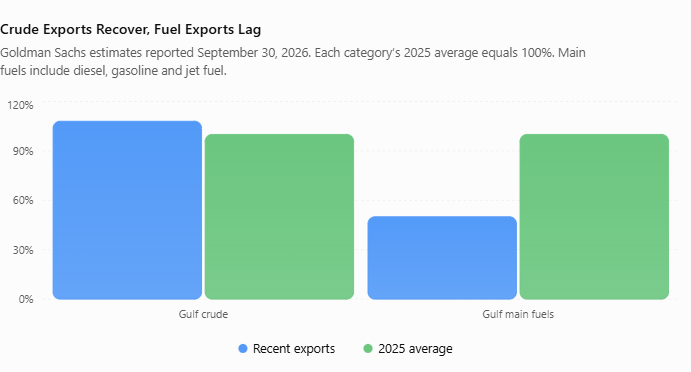
Gulf crude exports reached 108% of their 2025 average, while combined diesel, gasoline and jet fuel exports remained around 50%, according to Goldman Sachs’ late-September estimates.
For families and businesses, hearing that oil exports are recovering sounds like good news. But it doesn’t mean the fuel shortage is over just yet.
More Oil Is Moving, but the Recovery Is Uneven
Gulf oil producers have gotten creative, finding new ways to move oil through the Strait of Hormuz and along other routes after months of turmoil from the conflict.
Goldman Sachs expects Gulf oil exports to reach 23.3 million barrels per day in a report released last week, matching last year’s average. Its figures include shipments carried by vessels with their location-tracking systems switched off. ⁽¹⁾
Crude accounted for nearly 90% of the September recovery, according to the bank. Estimated crude exports reached 19 million barrels per day over the past week, above their 2025 average. ⁽²⁾
But shipments of diesel, gasoline, and jet fuel are still only half of this year’s normal. What’s the catch…? Well just because more crude is moving doesn’t mean the fuels that keep cars, planes, and trucks running are back to normal too. ⁽³⁾
Diesel Supplies Face Pressure From Several Directions
The shortage isn’t only happening in the Gulf. Russia has extended its ban on its diesel exports for fuel producers until the end of October, adding pressure to an already damaged market. ⁽⁴⁾
Russia is usually the world’s second-largest diesel exporter after the US. Its restrictions followed domestic fuel shortages and rising prices linked to Ukrainian drone attacks on refineries. ⁽⁵⁾

In the US, data showed that crude oil inventories rose by around 900,000 barrels in the week that ended on September 25, while gasoline stocks fell by 1.7 million barrels. Distillate inventories, which include diesel and heating oil, dropped by 2.3 million barrels and stood 14% below their five-year seasonal average. ⁽⁶⁾
The White House has even asked the European Union to release emergency diesel inventories, showing how governments are scrambling for immediate supplies while the broader market struggles to recover. ⁽⁷⁾
Export Restrictions Could Shift the Problem
President Trump said he’s still thinking about banning diesel exports. That might mean more fuel stays in the US, but it could leave buyers in other countries with even less, shifting the problem instead of solving it.
This possibility is already making waves in the crude market. Traders are watching to see if US refiners could end up with too much diesel on their hands, which might lead them to cut back on processing crude oil.
Shipping Routes Are Still Costly and Vulnerable
Saudi Arabia has resumed tanker loadings at its Red Sea port of Yanbu after restarting its East-West pipeline. The route helps move crude around Hormuz, but its recovery does not remove the wider security risks. ⁽⁸⁾
Some exporters are getting oil to market by transferring it between ships near Oman. Gulf officials say these workarounds are costly and can’t last forever.
Shipping oil is more expensive than ever, and the threat of new attacks on ports, refineries, or pipelines keeps everyone on edge, even as more oil is moving.
What Would Bring Fuel Prices Down?
Real relief won’t come just from loading more crude onto ships. Markets need refined fuel supplies to bounce back, deliveries to become more dependable, and shipping costs to come down.
The diplomatic outlook also matters. Iran said that it had received a US response to its latest ceasefire proposal, renewing hopes for progress. However, a lasting agreement remains uncertain. ⁽⁹⁾
For now, more crude exports are helping a bit. But with fuel shortages sticking around and shipping routes still up in the air, it could be a while before drivers and businesses see real relief.