ar
ar
Tech stocks are feeling the heat from rising Treasury yields, even as AI demand keeps earnings strong. For some companies, the challenge is living up to sky-high growth expectations. Others are juggling the added cost of funding their next big expansion.
That difference is key when you look at software players like Palantir and Salesforce, chip giants like Nvidia and Broadcom, or infrastructure names such as Oracle and CoreWeave.
Treasury Yields Keep Pressure on Valuations
The US 10-year Treasury yield is hovering near levels last seen in 2007, hitting 5.2% after jumping about 50 basis points just this month. That spike has raised the bar for what investors expect from stocks and other assets.
The Nasdaq 100 dropped 1% yesterday as Treasury yields surged. Tensions in the Middle East have pushed oil prices higher again after President Trump turned down Iran’s proposal to reopen the Strait of Hormuz, keeping inflation worries front and center.

Meanwhile, resilient US economic data, business investment and higher consumer inflation expectations have reinforced bets of further Federal Reserve tightening. The Fed raised its target range by 25 basis points to 3.75%–4.00% on September 16. Chair Kevin Warsh said the central bank remained focused on returning inflation to 2%.
That sets up a tug-of-war for stocks. A strong economy can boost earnings, but higher yields make investors less willing to pay up for those future profits.
Why Future Growth Becomes Worth Less Today
A discounted cash flow valuation estimates a stock’s value from the cash a company is expected to generate in the future. Investors discount those expected cash flows to calculate what they are worth today, using a rate that reflects both returns on safer assets and the risks of owning the stock.
As yields climb, investors want more bang for their buck from stocks. If a company’s future cash flow projections stay the same, those dollars are simply worth less today, especially if the payoff is years away.
This hits tech companies hardest, since their valuations often hinge on years of growth in AI, cloud, or software. Even profitable firms can see their shares wobble if investors have already baked in big expectations for the future.
Higher Financing Costs Add Another Challenge
Rising yields aren’t just a profit problem, they also make it pricier for companies to borrow.
Companies looking to issue new debt or refinance what they already owe are staring down higher interest bills. If they have floating-rate loans, those costs can jump even faster as short-term rates rise, eating into profits and leaving less cash for everything else.
That’s a big deal for tech, where companies are still pouring money into data centers and infrastructure. Higher borrowing costs mean these investments have to work even harder to pay off.
But not every company feels the pinch the same way. Firms with plenty of cash coming in can fund growth more easily, while those that lean on outside financing are more exposed.
Existing fixed-rate debt also provides protection until it’s time to refinance. Financing resilience and share-price sensitivity therefore need to be assessed separately.
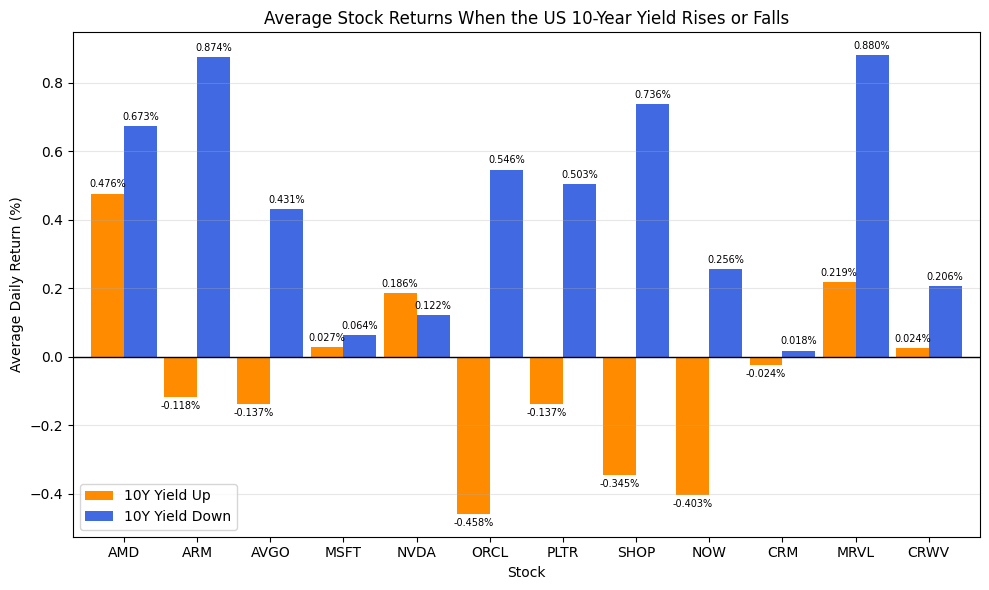
How the Exposure Differs Across Tech Stocks
Software: Growth Expectations and Financial Flexibility
Palantir and Shopify reported YoY revenue growth of 93% and 34%, respectively, in Q2, with neither reporting outstanding borrowings during the quarter. This limits direct exposure to rising debt borrowing costs. ⁽¹⁾
Their stock prices can still face pressure if higher yields continue to make investors less willing to pay for the growth these companies are expected to generate.
ServiceNow and Adobe also continued to grow, with subscription revenue rising 24.5% at ServiceNow and total revenue increasing 13% at Adobe in their latest quarters. For these businesses, maintaining customer spending and turning AI products into paying subscriptions help support the earnings investors are valuing. ⁽²⁾
Salesforce shows why debt needs to be considered alongside cash generation. It had $39.5 billion in outstanding debt principal as of July 31, but generated nearly $8 billion in operating cash flow over the first six months of its fiscal year. ⁽³⁾
That cash supports debt servicing, although refinancing at higher rates could leave less available for acquisitions, investment and shareholder returns.
AI and Semiconductors: Strong Demand, Different Debt Burdens
Data-center demand is a major revenue driver for Nvidia and AMD. Their second-quarter data-center sales reached $89 billion and $6.7 billion, respectively. AMD’s figure includes server processors as well as AI accelerators. ⁽⁴⁾
Both companies have more cash than debt, giving them room to keep investing even as borrowing gets pricier. That’s good for business, but their stock prices still hinge on hitting ambitious growth targets.
Broadcom carries the heaviest debt load among the chipmakers, with $61.1 billion in outstanding principal. However, Broadcom generated $13.7 billion in free cash flow in its fiscal third quarter, which ended on August 2. ⁽⁵⁾
That cash pile helps Broadcom pay down debt and means it doesn’t have to borrow as much. But if its cash flow slows and refinancing stays costly, the pressure could ramp up.

Arm and Marvell reported revenue growth of 22% and 37%, respectively, while Marvell carried approximately $5 billion in debt. Chip suppliers also face an indirect risk. ⁽⁶⁾
If financing costs or construction delays slow their customers’ data-center projects, expected chip orders could arrive later. That is a possible transmission channel, rather than evidence that orders have already weakened.
Strong Cash Generation: More Funding Flexibility
Microsoft offers a contrast to companies that depend heavily on external financing. It held $76.8 billion in cash and short-term investments on June 30 and generated $55.4 billion in operating cash flow in its latest quarter. ⁽⁷⁾
That gives it more flexibility to fund AI investment as borrowing costs rise. Its financing is well covered, but its shares are still exposed to higher yields, and investors will keep assessing whether its spending produces adequate returns.
AI Infrastructure: Turning Contracts Into Cash
Oracle is a case study in how strong growth can coexist with financing pressure. Revenue rose 30% in the quarter that ended August 31, but capital expenditure of $28.5 billion exceeded operating cash flow, leaving free cash flow negative by $5.4 billion. ⁽⁸⁾
With $125 billion in senior notes and other long-term borrowings, Oracle needs its expanding infrastructure to generate enough cash to support both investment and debt obligations. ⁽⁹⁾
Delivery timing adds another challenge. A Reuters report shows that Oracle issued a notice invoking contractual protections against potential delays at the Project Jupiter development in New Mexico.
Oracle said the project remained on schedule, and its partners said their financial commitments had not changed. The notice highlights a risk for investors: if a project is delayed, the revenue expected from it may arrive later.
CoreWeave’s financing burden is already visible in its results. Second-quarter revenue more than doubled to approximately $2.6 billion, but net interest expense reached $640 million, roughly a quarter of revenue, alongside $35.6 billion in debt. ⁽¹⁰⁾
Rapid sales growth therefore has to cover a substantial financing bill before it can translate into sustained net profitability.
Unlike the valuation effect linked to longer-term Treasury yields, CoreWeave’s floating-rate borrowing is more directly exposed to changes in short-term interest rates.
Can Earnings Keep Up With Yields?
Treasury yields alone will not determine where tech stocks go next. If yields keep rising, investors may demand stronger earnings and clearer returns from AI spending, particularly from companies funding large projects with debt.
If yields start to fall, some of the pressure on valuations could ease. But with third-quarter earnings just a month out, every company still has to prove that its expected growth is turning into real cash.