ar
ar
The last quarter of the year opens with the bond market already making up its mind.
Yields are at levels not seen since before the financial crisis, and this week’s data decides whether that’s justified or overdone.
Payrolls on Friday is the one that matters, but the RBA and Eurozone inflation may have moved the mood well before then.
Calendar Events
- Reserve Bank of Australia Interest Rate Decision – Sep. 29
- Canada Monthly GDP – Sep. 29
- US JOLTS Job Openings – Sep. 29
- Australia CPI – Sep. 30
- US ADP Employment Change – Sep. 30
- US PCE Index – Sep. 30
- US Final Q2 GDP – Sep. 30
- US ISM Manufacturing PMI – Oct. 1
- Japan Tokyo CPI – Oct. 2
- Eurozone Flash CPI – Oct. 2
- US Non-Farm Payrolls – Oct. 2
- US Unemployment Rate – Oct. 2
- US Average Hourly Earnings – Oct. 2
Top Things to Watch
1. US High Impact Economic Data
US hiring tops the market agenda this week as rising Treasury yields push up borrowing costs and investors weigh the Fed’s next move. The 10-year yield touched 5.225% last week, its highest since 2007, amid inflation concerns and expectations of further tightening.
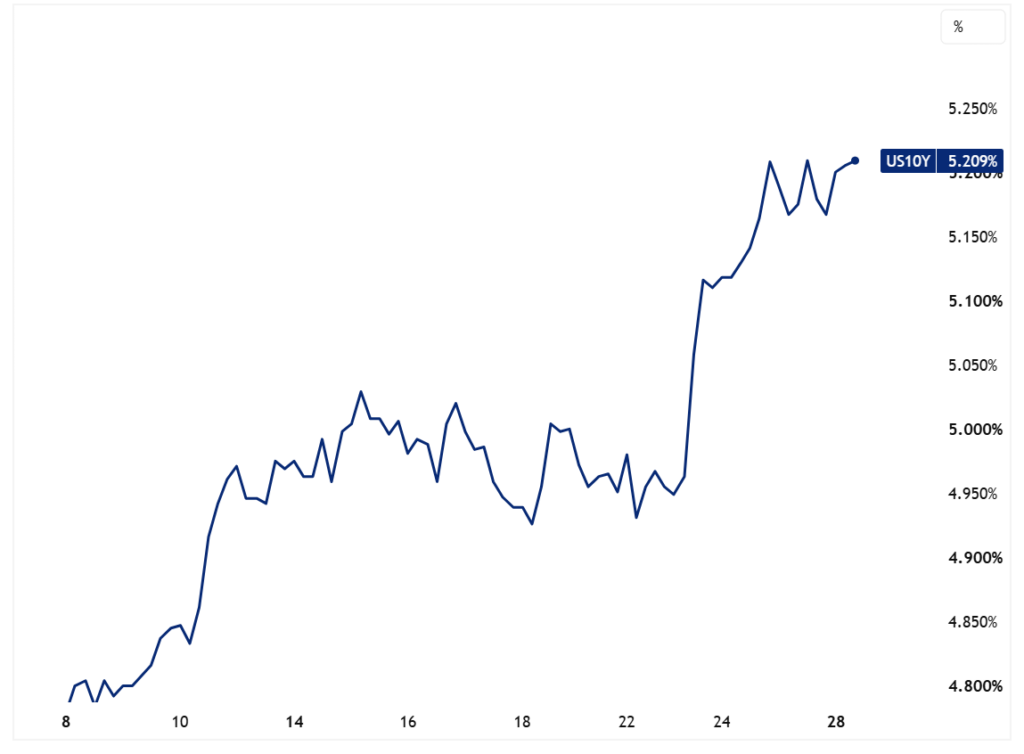
September’s non-farm payrolls report, due on Friday, will show whether hiring maintained momentum after August’s 162,000 gain, the strongest in five months. Markets will also watch whether the unemployment rate holds at 4.1%, annual wage growth cools further from 3.1%, and revisions of the payrolls report.
Together with Wednesday’s PCE inflation and GDP data, the jobs report will help shape expectations for the Fed’s October 27–28 meeting.
2. Hormuz Talks Keep Oil in Focus
Diplomacy remains a key driver of the oil outlook after President Trump rejected Iran’s latest proposal on Saturday but said he expected further talks this week. Oil rebounded earlier in the morning today as the setback renewed uncertainty over efforts to reopen the Strait of Hormuz and lift the US blockade of Iranian ports.
This week, attention turns to shipping access and Saudi exports. Shipments through Ras Tanura and Hormuz have increased, while Yanbu’s recovery remains in focus after tanker loadings had yet to resume as of September 25. Further Houthi attacks over the weekend also highlight the continuing risks to regional supply routes.
3. Reserve Bank of Australia Interest Rate Decision
The Reserve Bank of Australia meets on Tuesday, with all four major Australian banks expecting a 25-basis-point hike to 4.60%. ANZ also expects another increase in November, with market expectations of a rate hike reaching 95%.
July’s headline inflation eased to 3.5%, but trimmed mean inflation held at 3.6%. Governor Michele Bullock has highlighted energy and domestic demand risks without committing to a hike. August’s CPI figure will be released on Wednesday, immediately after the decision.
4. Eurozone Flash CPI Estimate
September’s flash inflation estimate will be released on Friday, following two consecutive monthly increases in the annual headline rate. August inflation was confirmed at 3.2%, up from July’s 2.9% and June’s 2.8%. Energy inflation accelerated to 14.3% from 10.3% in July.
Underlying pressures were more subdued. Core inflation eased to 2.4% from 2.5%, while services inflation slowed to 3.0% from 3.3%. September’s report will help establish whether the energy shock is spreading more broadly through consumer prices ahead of the ECB’s next policy decision.