ar
ar
- The BoE is expected to hold rates at 3.75% on Thursday despite inflation rising to 3.1% in August, as a weaker labour market supports the case for waiting.
- The BoJ is widely expected to raise rates to 1.25% on Friday, its highest level since 1995, with a record yen intervention and pressure from Washington adding to the case.
- GBP/JPY is trading near its lowest level this year, and guidance from Bailey and Ueda on what comes next may matter more than the decisions themselves.
The Bank of England and Bank of Japan both meet this week, and they’re headed in opposite directions. The BoE is expected to hold rates tomorrow, while the BoJ looks set to hike on Friday, its third increase in under a year.
Both decisions come as oil prices continue to rise, adding more uncertainty to inflation on both sides.
BoE Expected to Hold Despite Higher Inflation
The Bank of England is expected to keep its policy rate at 3.75% despite inflation rising to 3.1% YoY in August from 2.9% in July due to a renewed climb in energy prices caused by tensions in the Middle East. ⁽¹⁾
Governor Andrew Bailey recently denied that the BoE has a hidden plan to raise rates this year, saying policymakers would need more evidence that higher oil prices were producing broader and more persistent domestic inflation before supporting a hike.
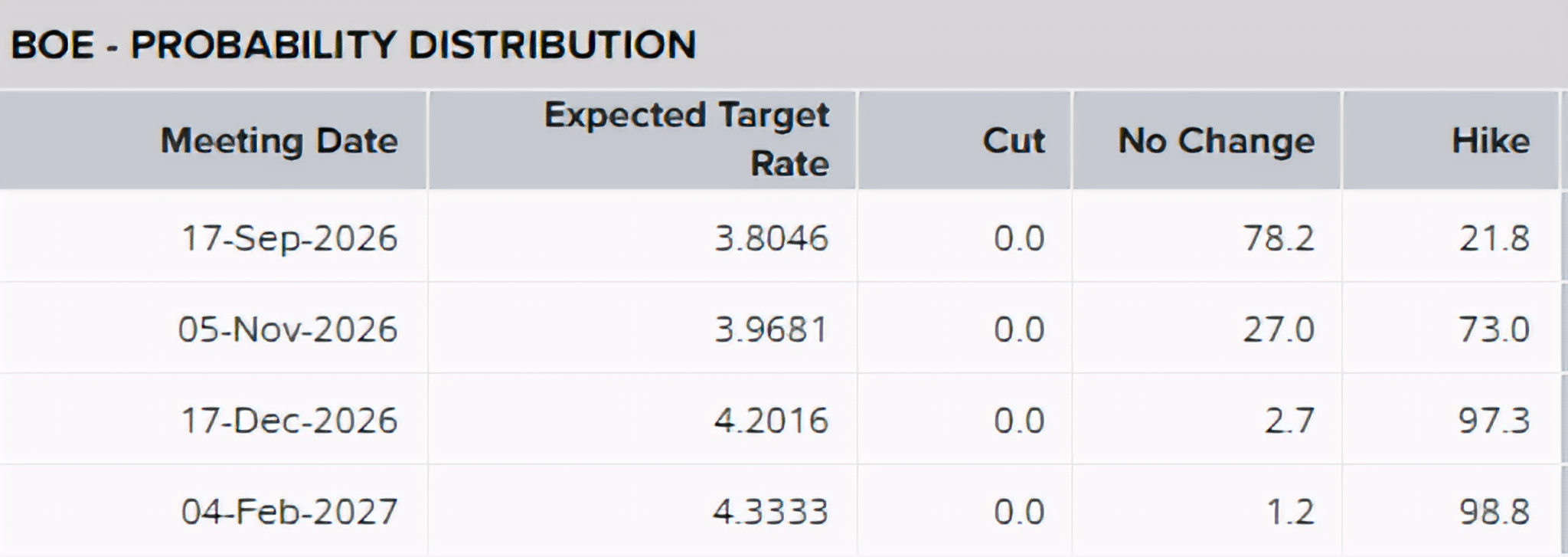
Financial markets have taken a more hawkish view, however, pricing an almost 22% probability of a hike this week and a 73% probability at the November meeting.
Despite the increase in inflation, the case for holding rates is reinforced by a softer labor market, with vacancies falling to their lowest non-pandemic level since 2014 and payroll employment declining by another 26,000 in August. ⁽²⁾
The BoE is also expected to slow quantitative tightening from £70 billion to £50 billion a year, mainly because fewer gilts are maturing rather than because of a broader change in strategy. ⁽³⁾
Bank of Japan Poised to Raise Rates Again
Moving onto the Pacific, the Bank of Japan is expected to raise its policy rate to 1.25% at its meeting on Friday, the highest level in roughly 31 years. This would mark the third hike in under a year, the fastest pace of tightening since 1990.
The case for higher rates rests on underlying inflation remaining around the BoJ’s 2% target, rising inflation expectations and the risk that elevated oil prices and a weak yen could increase import costs.
The yen’s decline to 40-year lows has added to the pressure, prompting Japan’s Ministry of Finance to spend a record ¥15.4 trillion on currency intervention between late July and late August, including a rare, coordinated operation with the United States.
US Treasury Secretary Scott Bessent has pushed for more decisive monetary action to contain yen weakness and stabilize inflation expectations.
Markets currently price an 81% probability of a BoJ rate hike. But the bigger question is whether Governor Kazuo Ueda signals that another hike could follow before year-end. ⁽⁴⁾
Ueda’s guidance matters for the bond market too. Japanese government bond yields have already climbed sharply, with the 10-year yield now above 3%. A more aggressive tone from the BoJ could push yields higher and encourage Japanese investors to pull their capital back into domestic assets.
Where Does GBP/JPY Go from Here?
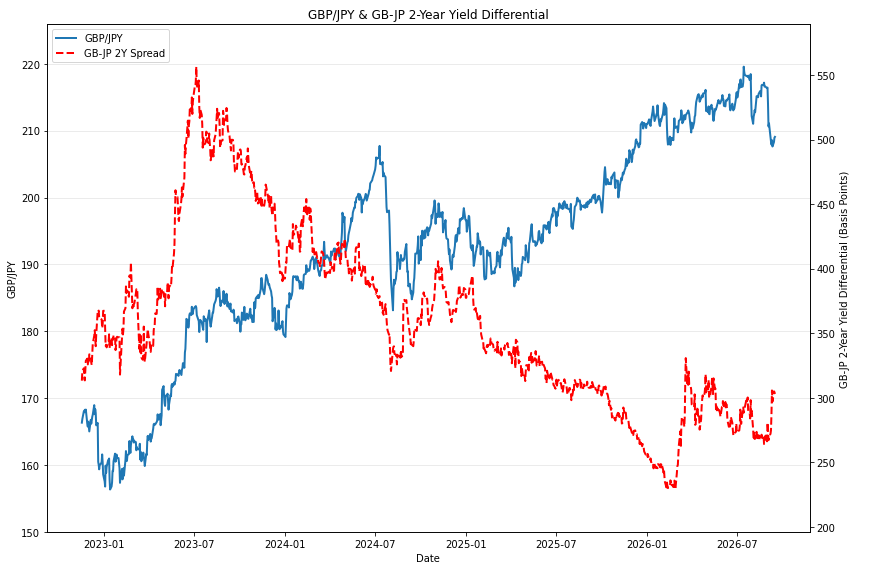
GBP/JPY is trading near 209, close to its lowest level since February. The pair had climbed as high as 219.6 in July, a level not seen since 2008, before pulling back about 5% from that peak.
Interest-rate expectations have influenced the move, though they haven’t been the pair’s only driver. The UK-Japan two-year yield spread stands at 302.9 basis points in favor of the UK, but it has narrowed rather than widened even as GBP/JPY rose since 2023.
That gap points to other forces at work too, including yen weakness tied to oil prices and the intervention efforts described above.
The rate outlook itself isn’t one-sided either. Markets are close to pricing a BoE hike in November, while another BoJ increase before year-end is not yet certain. The pair will therefore react to how each central bank describes its next move, rather than simply whether the expected decisions are delivered.
A BoJ hike paired with signals of another increase could strengthen the yen, especially if the BoE pushes back against November hike bets because of UK labor-market weakness.
As a net energy importer, though, the UK could see rising oil prices strengthen the case for a hike by keeping inflation elevated, which cuts the other way. Conversely, GBP/JPY could rebound if the BoJ delivers a cautious message and higher oil prices continue to weigh on the yen.
The yen has been highly volatile over the past couple of months, following the first intervention in late April, and is likely to remain volatile as Japan’s Ministry of Finance and the US Treasury remain alert to further yen weakness.
With both immediate decisions already largely priced in, the clearest market signal will come from what Bailey and Ueda say about the months ahead.