ar
ar
In late July, the Bank of Japan held rates steady as it balanced further normalization against mounting pressure in the bond market. At the same time, Tokyo intervened to support its currency. Two institutions, two competing pressures, and limited room to address one without intensifying the other.
Two Institutions, One Problem
Japan’s policy dilemma was on full display at the end of July.
At its latest meeting, the Bank of Japan kept its policy rate unchanged at 1%, following a 25-basis-point increase in June. Hajime Takata was the only policymaker to support another hike, voting to raise the rate to 1.25%. ⁽¹⁾
At almost the same time, Japan intervened to support the yen on Thursday, followed by coordinated action with the United States on Friday. USD/JPY fell roughly 3.8% over the two sessions, from 163.65 to 157.46 on Friday, July 31.
USD/JPY is now trading near 156.70. Earlier today, it briefly fell by around 1% to 155.20 after the confirmation of the intervention.
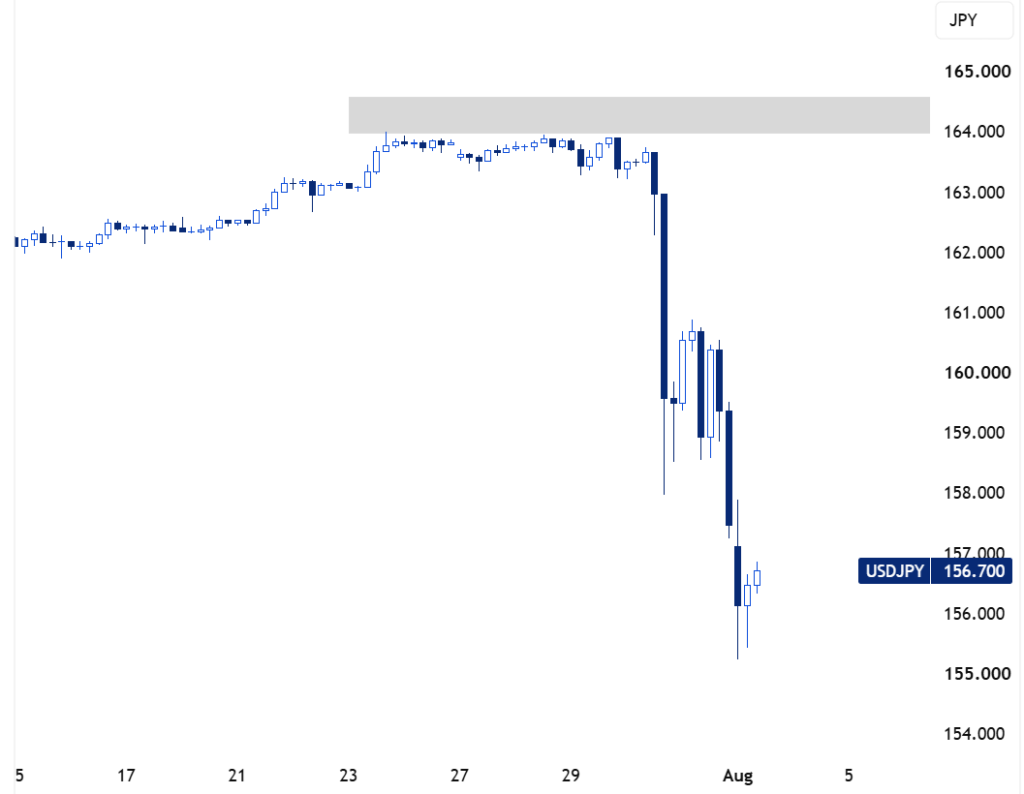
These moves capture the crossroads facing Japan. The BOJ is trying to normalize monetary policy without destabilizing the government-bond market, while the Ministry of Finance is being forced to defend the yen against the consequences of that caution.
Japan wants higher interest rates, a stable currency and an orderly bond market. The difficulty is that it may not be able to achieve all three simultaneously.
The Policy Rate Does Not Tell the Whole Story
A rate hike should have supported the yen. It didn’t. The BOJ raised its interest rates from 0.75% to 1% in June, its highest level in 31 years, normally enough to draw capital in. But Japan’s economy isn’t like any other.
The BOJ kept interest rates near or below zero for much of the past three decades while purchasing government bonds on a massive scale, helping hold down borrowing costs across the yield curve.
As a result, the yen is influenced not only by the overnight rate, but also by the returns available on longer-term Japanese assets and the BOJ’s willingness to let those returns rise.
Currency markets price in expectations for interest rates, and short-term rate differentials determine the cost of the carry trade of the yen. Japan’s 2-year government bond yield sits at 1.51%, while the US 2-year Treasury yield is trading at 4.26%, leaving a gap of 275 basis points in favor of the dollar.
However, what happens at the long end of the Japanese yield curve shows whether the BOJ is truly prepared to step away from its role as the bond market’s dominant buyer.
Bond Purchases Continue Despite QT
The BOJ’s planned JGB purchases currently stand at about ¥2.5 trillion per month. It plans to reduce them to ¥2.3 trillion in the fourth quarter and ¥2.1 trillion in early 2027, before maintaining purchases at approximately ¥2 trillion per month from April 2027. ⁽²⁾
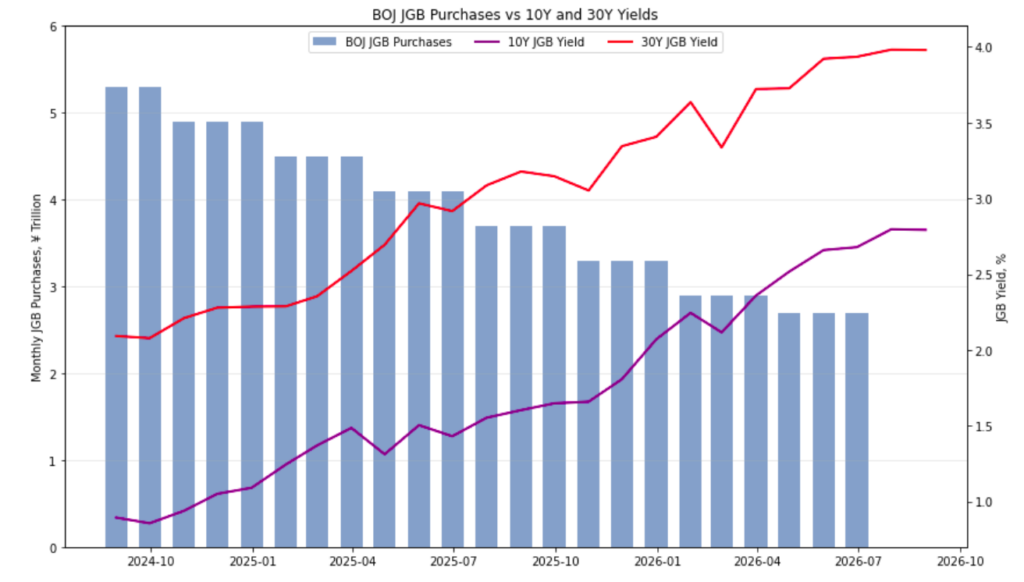
The BOJ’s planned monthly JGB purchases have declined even as 10-year and 30-year yields moved higher.
The BOJ is still buying bonds, but its purchases are smaller than the volume of bonds reaching maturity, so its total holdings are gradually declining. The BOJ projects that its holdings will fall to almost ¥480 trillion by the end of March 2027, around 17% below their June 2024 level. ⁽³⁾
This is quantitative tightening, but it is deliberately slow. The BOJ also retains the ability to increase purchases if long-term yields rise too quickly.
Long-Term Yields Are Already Testing the Limits
Despite continued BOJ purchases, the bond market has begun demanding significantly higher returns.
10-year JGB yield trades around 2.82%, remaining near its highest level in 30 years. The 30-year yield trades around 4%, while the 40-year yield moved above 4%. These levels show that the BOJ is allowing yields to rise, but its continued bond purchases may still limit how far and how quickly they move. ⁽⁴⁾
Allowing yields to rise would make Japanese bonds more attractive, potentially encouraging domestic investors to bring capital home. This could support the yen and reduce the appeal of yen-funded carry trades. However, higher yields would also increase the government’s financing costs.
The IMF estimates Japan’s gross public debt at around twice the size of its economy, the highest ratio among major economies. Meanwhile, government interest payments are projected to rise from ¥10.5 trillion in fiscal 2025 to ¥13 trillion in fiscal 2026 and potentially ¥21.6 trillion by fiscal 2029. ⁽⁵⁾
This limits how quickly the BOJ can reduce its bond purchases and leave yields entirely to market forces. A rapid repricing could sharply increase future debt-servicing costs, pressure banks and insurers holding JGBs, and weaken confidence in the government’s fiscal position. ⁽⁶⁾
The BOJ’s bond purchases therefore help contain fiscal stress. But they do not eliminate it. Instead, part of that pressure can be transferred from the bond market to the currency.
From Bond-Market Stress to Yen Weakness
By limiting the rise in Japanese yields, the BOJ reduces the risk of a bond-market crisis. However, relatively low domestic returns encourage capital to move abroad and maintain demand for yen-funded carry trades, putting downward pressure on the yen.
A weaker yen then raises the cost of imported energy, food and raw materials. This damages household purchasing power and creates additional inflation, particularly when Japan is already facing higher oil prices.
Japan and the United States confirmed that they conducted coordinated yen-buying intervention last Friday, their first joint currency action since 2011. Both countries said they were prepared to intervene again. Market estimates based on BOJ data also suggested that Tokyo may have spent as much as ¥8.2 trillion, approximately $59 billion, buying yen on Thursday. ⁽⁷⁾
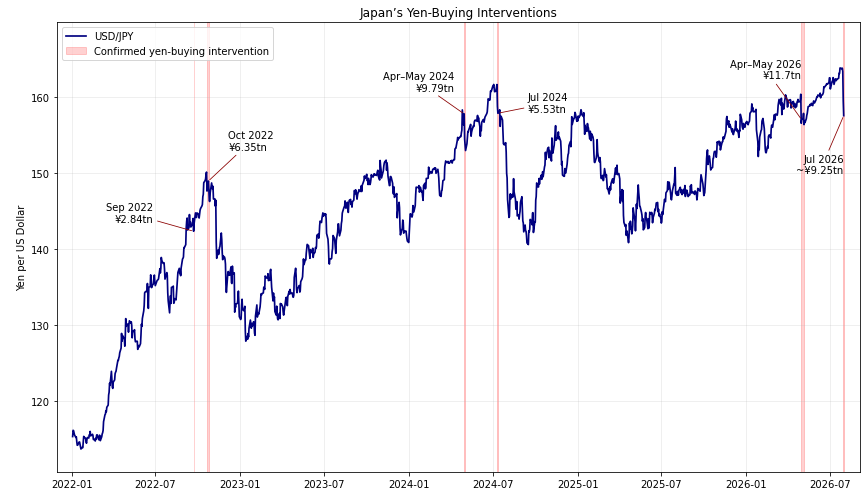
The announcement helped the yen strengthen, reaching its strongest level since early May.
However, intervention does not remove the structural pressure on the currency. Wide interest-rate differentials, elevated import costs and the BOJ’s cautious normalization remain. Coordinated action can slow yen depreciation, but a lasting recovery will depend on whether the BOJ allows domestic rates and yields to rise further.
Japan’s Policy Crossroads
The BOJ now faces two possible paths.
It could raise rates more aggressively and reduce bond purchases faster. This would support the yen and strengthen the fight against inflation, but it could drive long-term yields higher, increase debt-servicing costs and expose weaknesses in the bond market.
It could continue protecting the JGB market through large purchases and only gradual rate increases. This would reduce the risk of an immediate fiscal or financial shock, but it could leave the yen under sustained pressure.
The second path is the one Japan is currently following: gradual rate increases, a controlled reduction in bond purchases and direct currency intervention whenever yen depreciation becomes excessive.
That approach buys time, but it does not resolve the underlying contradiction. Intervention can force short-yen positions to unwind and slow the pace of depreciation, but it cannot permanently offset the monetary and fiscal forces weighing on the currency.
The cost of normalization must ultimately be absorbed somewhere, through losses for bondholders, currency depreciation or higher import costs for Japanese households. For now, Japan is prioritizing bond-market stability while using intervention to contain the consequences for the yen.