

 ar
- The Bank of Japan announces its next interest rate decision on Tuesday, expected to hold rates steady at 0.75% as uncertainty from the Middle East continues to impact economic conditions.
- Inflation remains a headache for the BOJ, especially wholesale prices, as companies passed on rising costs to consumers.
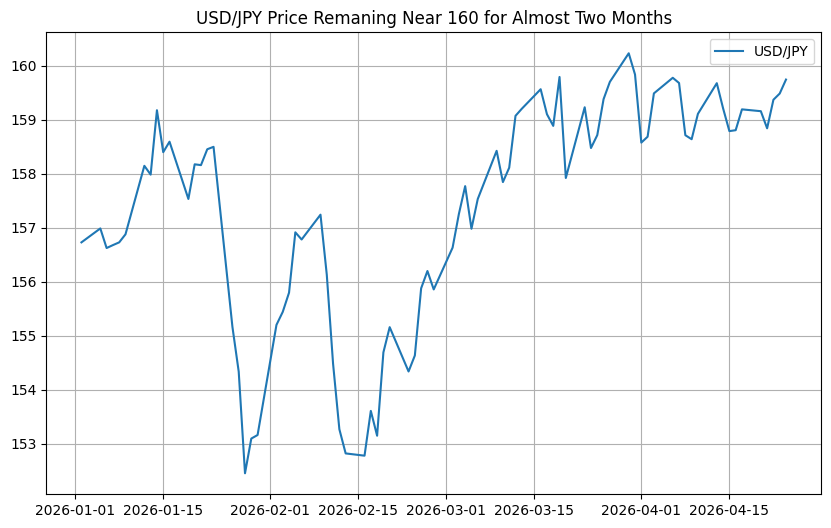
- The Japanese yen remains weak around 160 per dollar, which led to intervention warnings from Japan’s finance minister, with plans for action coordinated alongside the US.
Markets kick off a busy week packed with rate decisions from major central banks. The Bank of Japan (BOJ) is first in the lineup, where policymakers are expected to hold rates at 0.75% on Tuesday.
As tensions in the Middle East hold, oil prices remain elevated, leading to an inflation surge globally that has impacted economic growth.
For Japan, the situation remains critical as Japan relies heavily on imported energy, where much of it flows through the Strait of Hormuz.
Guidance from BOJ officials has been limited, leaving markets heavily focused on forward signals.
Pressure from Weak Yen and Rising Prices
The Bank of Japan’s path remains uncertain as the yen continues to weaken, with inflation squeezing household budgets. When the BOJ started hiking interest rates back in March 2024, it marked a historic exit from years of negative rates.
The central bank’s most recent rate hike was in December of last year, when it raised rates by 25 basis points to 0.75%, and has kept them steady at this level ever since.
At a news conference in Washington last week, BOJ Governor Kazuo Ueda acknowledged the difficult position the Middle East conflict has created. Its effects have driven inflation higher and weighed on economic growth. ⁽¹⁾
? Quote
“One aspect of what’s happening now is a negative supply shock. Dealing with this through monetary policy is an extremely difficult challenge.” ~BOJ Governor Kazuo Ueda
Ueda added that the BOJ aims to manage its policy rate to achieve stable 2% inflation over time. ⁽²⁾
Inflation Edges Higher as Fuel Costs Rise
Japan’s headline inflation for March came in at 1.5% YoY, rising from February’s 1.3%, while core inflation came in at 1.8%, above its forecast of 1.7% ⁽³⁾
Japanese Prime Minister Sanae Takaichi has been considering steps to reduce the economic blow from rising fuel costs, including curbing gasoline prices. Tokyo has also released crude oil from its stockpiles with hopes of avoiding an oil shock.
Wholesale inflation also showed an increase in March as companies passed on rising costs to consumers, coming in at 3.1% YoY from February’s 2.7%. Analysts expect consumer inflation to rebound back above 2% in the future. ⁽⁴⁾
Markets Shift Rate Hike Bets to June
Given the heightened uncertainty, analysts have pushed back their expectations for the next rate hike. Economists’ surveys showed that more than half now expect the BOJ to make changes to monetary policy in June rather than April. ⁽⁵⁾
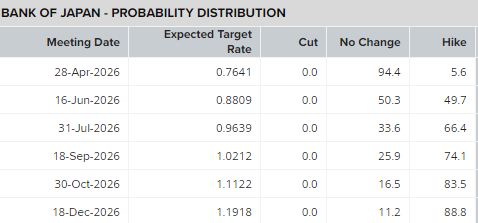
With a rate hold widely anticipated, investors will look to Governor Ueda’s post-meeting news conference on Tuesday for clues about the central bank’s policy path.
Markets expect Ueda to keep adopting the wait-and-see stance, given the lack of data on how the Middle East conflict will affect broader economic activity and inflation.
The BOJ will also release its quarterly economic and inflation projections next week, including forecasts for fiscal year 2028 for the first time.
Currency Intervention Warnings
Persistent yen weakness has renewed intervention warnings from officials, as authorities signal readiness to act if volatility intensifies.
Last Friday, Japan’s Finance Minister Katayama stressed that the government stands ready to take “decisive action” in coordination with the US as the yen hovered near the psychologically important 160-per-dollar level. ⁽⁶⁾
“We have been seeing speculative activity on currency markets influenced by volatility in oil-related prices,” Katayama said.
This comes after signals from the New York Fed in January, which raised expectations of a possible joint currency intervention, the first one in 15 years.


