ar
- Chancellor Rachel Reeves delivered her Spring Budget yesterday and talked about the state of the UK economy and public finances instead of major policy moves, alongside downgraded economic growth.
- Reeves promised stability and consistency, and plans to propose closer ties with the European Union after the Brexit vote, alongside other promises for the British people.
- Investor focus also shifted to the current conflict in the Middle East, which sent oil prices and UK Gilt yields up.
The UK’s Finance Minister, Rachel Reeves, has delivered her latest update on the state of the UK economy and public finance, with the chancellor stating that growth could be lower than expected this year.
Reeves also said she would provide stability for the economy during a budget update speech yesterday that included no major policy changes, but the statement was overshadowed by the ongoing conflict in the Middle East.
Promise of Stability in Turbulent Times
At the core of Reeves’ address was a firm call for predictability. The Chancellor stressed the importance of consistency in government policy and investment in infrastructure, while holding the previous Conservative administration accountable for allowing inflation to rise dramatically and pushing interest rates to a 15-year high. Stability, she argued, is the single most important precondition for economic growth. ⁽¹⁾
Reeves expressed confidence that a sustained period of calm, particularly after the prolonged political turbulence that followed the Brexit vote, could reignite business investment. Looking ahead, she outlined plans to propose closer post-Brexit trade ties with the European Union in the coming weeks, alongside reforms designed to tackle youth unemployment, which has risen sharply. ⁽²⁾
The government has already indicated that the annual Autumn Budget will be its main fiscal event, which it believes will provide much-needed certainty for households and businesses alike.
Economic Forecasts & Fiscal Outlook
The Chancellor unveiled new forecasts pointing to lower inflation and borrowing than previously anticipated. However, the headline growth figure for 2026 was downgraded to 1.1%, down from the earlier estimate of 1.4%. The Office for Budget Responsibility (OBR) projects growth will recover to 1.6% in both 2027 and 2028, before settling at 1.5% in 2029 and 2030. ⁽³⁾
Reeves was clear that the Spring Statement was intended as an interim update rather than a vehicle for major policy shifts, with changes only on the table if there is a significant change to the economic outlook that requires a response. That measured tone is understandable given that the US economy expanded by just 0.1% in the fourth quarter. ⁽⁴⁾
On the fiscal side, the OBR forecasts show Reeves has £23.6 billion ($31.4 billion) worth of room to stay within her main fiscal target, while the government is expected to borrow £18 billion ($23.97 billion) less than anticipated in November. Going forward, the OBR will reserve its full assessment of the fiscal rules for the Autumn Budget. ⁽⁵⁾
Energy Prices & Market Reaction
Those carefully constructed forecasts, however, face a serious stress test. The US-Israeli war against Iran has sent US Gilt yields soaring, rattling financial markets and adding a new layer of complexity to the government’s economic outlook.
For a second consecutive day, government bond yields surged as investors grew increasingly concerned that a sustained doubling of gas prices could force the Bank of England to keep borrowing costs higher for longer.
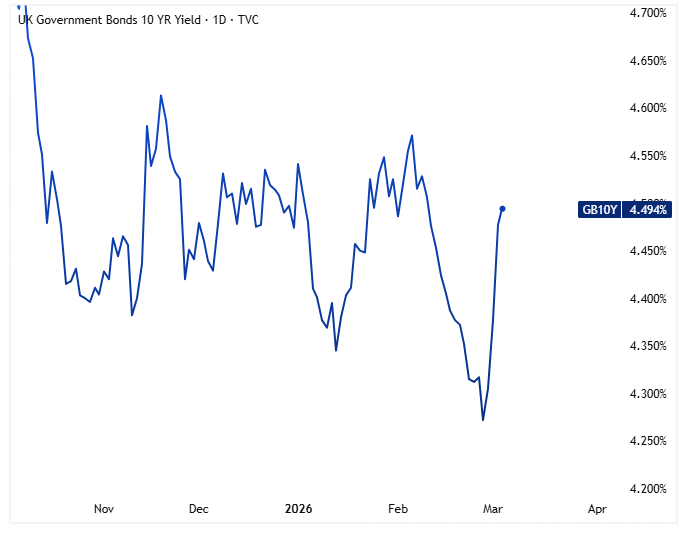
UK Gilt Yields Daily Chart / Source: TradingView
Oil prices are up more than 13% since Monday, prompting widespread calls to reverse the planned end of the fuel duty freeze in September. With the US still carrying the highest inflation rate among G7 nations, the path to interest rate cuts remains a challenging one.
Political Pressures & Challenges
Beyond the economic headwinds, Reeves and Prime Minister Keir Starmer are navigating a difficult political moment.
Many employers continue to argue that higher taxes and rising costs are actively deterring them from hiring, a pressure that will only intensify if economic conditions worsen.
Starmer, meanwhile, faces mounting questions over his political future following Labor’s defeat in a parliamentary by-election last week, with May’s local elections now firmly in the spotlight as the next major test of his leadership. ⁽⁶⁾