

 ar
- The European Central Bank is expected to keep interest rates unchanged at 2.15% for the fifth straight meeting amid trade uncertainty and a stronger euro.
- US President Trump’s trade threats have sent shockwaves throughout Europe, especially when he demanded that Europe sell Greenland or face higher tariffs.
- Despite trade uncertainty, the eurozone economy proved to be resilient, with Germany recovering from two years of economic contraction.
- With the currency reaching 2021 highs, this could further dampen inflation while raising costs for exporters, weighing on external competitiveness.
The European Central Bank (ECB) finds itself in a tricky spot heading into its next policy meeting on Thursday, February 5.
Between President Trump’s ever-shifting trade policies keeping everyone on edge and the euro’s steady climb, officials are widely expected to hold interest rates steady at 2.15%, marking what would be the fifth consecutive meeting without a change.
The announcement comes at 17:15 (GMT+4), followed by a press conference with ECB President Christine Lagarde that markets will be watching closely for any hints about the bank’s next move.
Interest Rates Staying Put
The expected rate hold reflects the ECB’s cautious stance amid the economic and political uncertainty currently facing Europe. Financial markets had previously anticipated rate hikes later in 2026, but those expectations are now shifting. Some economists suggest any rate increases may not materialize until 2028.⁽¹⁾
Trump’s Greenland Drama Creates Jitters
Uncertainty from US policies continues to ripple across Europe. The latest episode unfolded at the World Economic Forum, where President Trump previously demanded that Europe sell Greenland to the US or face steeper tariffs.
Though he walked back the threat later that same day, announcing a framework deal with NATO on Greenland instead, the damage was already done. European financial markets had already absorbed the shock.
ECB President Christine Lagarde is likely to acknowledge that while the euro area economy is doing well, the risks remain high. An economist from Swedbank stated, “The first weeks of 2026 have clearly shown that trade deals and agreements are very fragile.” ⁽²⁾
Lagarde said the uncertainty caused by Trump’s shifting trade policies matters more than any single tariff threat, as this unpredictability damages business confidence and can slow economic growth.
Europe Looks for New Friends
Despite Trump eventually backing off, the episode reinforced efforts across the old continent to fortify partnerships elsewhere.
As a result, Europe signed a trade deal with India last week, following a separate pact with South American countries earlier in the month.
The Strong Euro Problem
The euro climbed to its highest level since 2021, reaching $1.20 last week due to a major weakness in the US dollar. However, that surge could sound good on one side, but it creates some issues for the ECB.
Usually, when a currency experiences a major surge, its country’s exports become more expensive and pushes inflation lower. That’s what is happening in the eurozone.
With inflation already expected to stay below the 2% target this year and next, that’s not what policymakers want to see.
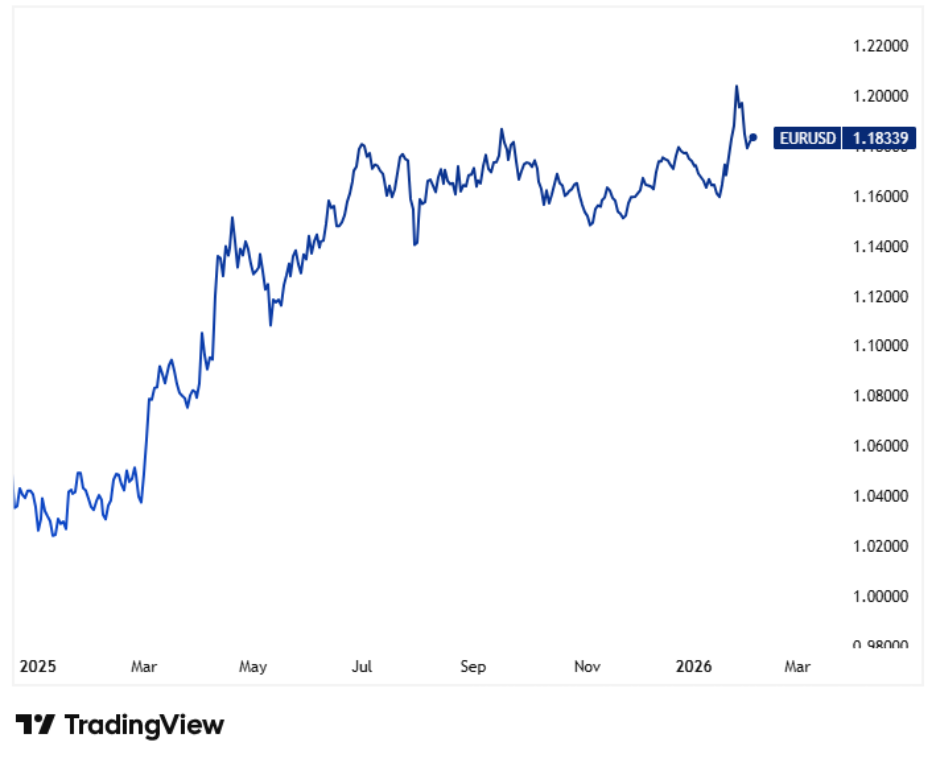
EUR/USD Daily Chart / Source: TradingView
Some officials, including Austria’s central bank governor Kocher, are stressing the need to be ready to act quickly if needed. However, most economists think the ECB won’t cut rates just yet. Traders are only pricing in about a 15% chance of a rate cut by summer. ⁽³⁾
The ECB cares more about how fast the euro moves than where it sits.
Economic Outlook: Reasons for Hope
Despite all the uncertainty, there are some bright spots. The ECB currently views its monetary policy stance as appropriate.
Officials observed that economic activity had proven more resilient than expected, with unemployment remaining at historically low levels, and the inflation outlook was favorable, with prices projected to stay around target over the forecast horizon. ⁽⁴⁾
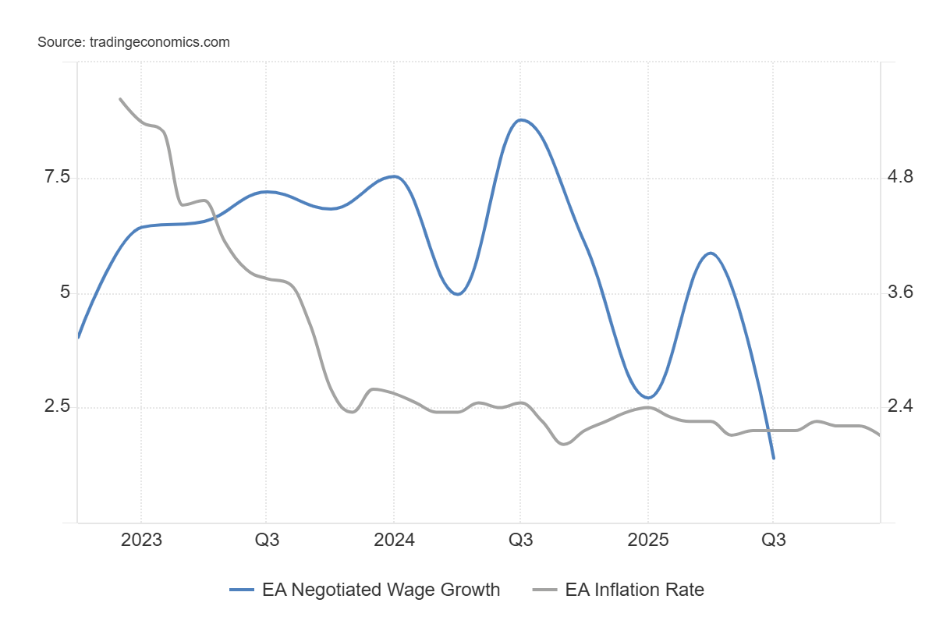
Inflation and Wage Growth Comparison / Source: Trading Economics
While wage growth remains elevated, the sharp decline in inflation has allowed real incomes to turn positive across the euro area.
The eurozone economy finished 2025 on a strong note, with an expansion of 1.5%, reaching its highest level since 2022. Germany, which is Europe’s largest economy, encountered mixed growth since 2022, but finally saw some hope of recovery, ending 2025 with 0.2% growth. The German economy faced a contraction of 0.9% in 2023 and 0.2% in 2024. ⁽⁵⁾
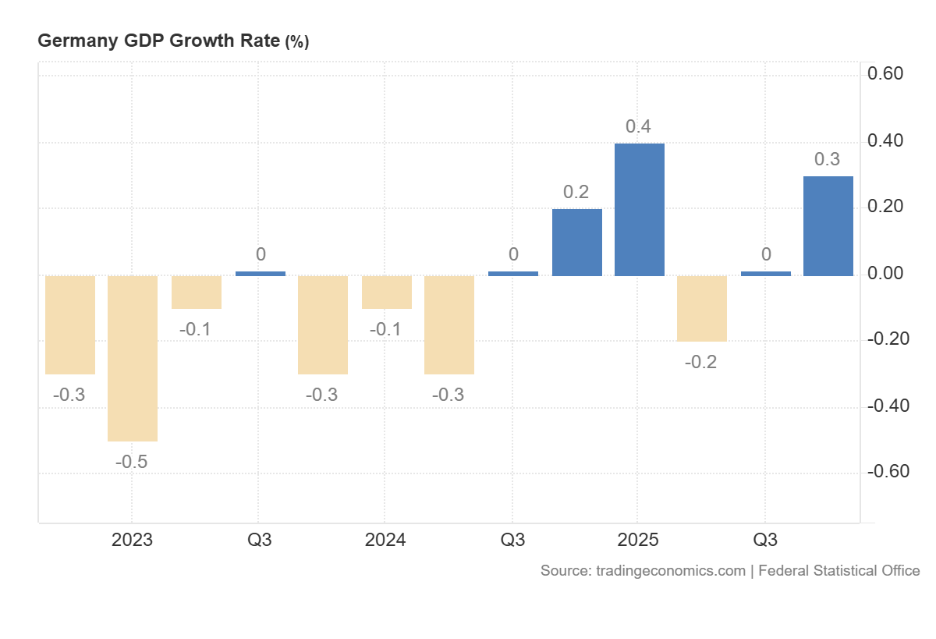
Germany Quarterly GDP / Source: Trading Economics
Looking ahead, economists expect 1.2% growth this year for Germany. Much of that hope rests on governments ramping up spending on infrastructure and defense. Germany is expected to benefit more from these investments than other eurozone nations. ⁽⁶⁾
The Fed Factor
The risk of central bank independence came back in focus after Fed Chair Powell was served with grand jury subpoenas in January alongside Trump’s demands for lower interest rates.
If the Federal Reserve cuts interest rates further, it could significantly weaken the US dollar and fuel inflation. A stronger euro, meanwhile, could keep interest rates elevated and increase financial stability risks.
Trump’s nomination of Kevin Warsh as the next Fed chair has helped the dollar regain ground after major losses, due to his hawkish stance.
The ECB issued a rare joint statement with other major central banks earlier in January, expressing solidarity with Powell and stating that central bank independence was crucial for price and financial stability.
What’s Next for Interest Rates?
The ECB’s latest projections show inflation running just below 2% this year and next, before hitting their target in 2028. Most economists see more downside risks to inflation in the coming months and more upside risks in 2027. ⁽⁷⁾
For now, ECB chief Philip Lane says the central bank won’t be debating any rate changes. But with Trump in the White House and the euro on the rise, that calm could be disrupted at any moment. ⁽⁸⁾


