

 ar

- US stocks faltered under pressure from overstretched AI valuations and layoffs, fueling concerns over labor market risks.
- Safe-haven demand rose as traders shifted to the yen, with bets of a possible Fed rate cut in December.
- The Bank of England held rates steady ahead of the Autumn Budget and said that inflation has peaked.
- Chinese exports declined significantly, particularly to the US, as weak sentiment weighed on the Chinese yuan.
Global markets are wrapping up the week with mixed sentiment, as traders and investors reacted to a series of major developments across stock markets, currencies and political fronts.
Volatility doesn’t appear to be easing off any time soon, with traders still cautious ahead of economic updates and political decisions.
Stocks Remained in Sell-Off Mode with Overstretched Tech Valuations
US stocks, mainly tech, extended declines amid concerns about overstretched valuations.
AI stocks have been under pressure since the start of November despite robust earnings, with AMD declining more than 7% alongside Nvidia’s 6.5% drop and Palantir’s 7% fall from Wednesday.
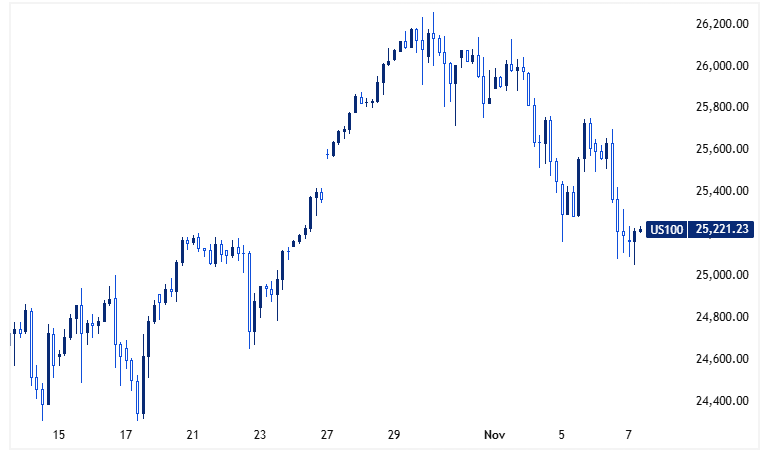
NASDAQ 100 Index Chart / Source: TradingView
The declines were also linked to labor market concerns, as October saw huge layoffs with job cuts reaching more than 153,000.
This opens the door to more uncertainty about the US economy, especially considering the lack of economic data releases on hand amid the ongoing and longest US government shutdown in history. ⁽¹⁾
Markets also monitored the Supreme Court hearing for the Trump administration’s tariff policy. The Supreme Court justices expressed some skepticism about the legalization of tariffs, leading many investors to question whether tariffs will be ruled out or not. ⁽²⁾
Yen Remains Steady on Safe-Haven Demand
The Japanese yen held gains as markets went into risk-off sentiment, triggered by rising concerns of overstretched AI valuations. The US dollar weakened due to rising concerns about the labor market, which boosted expectations of a Federal Reserve rate cut in December and also contributed to the yen’s gains.
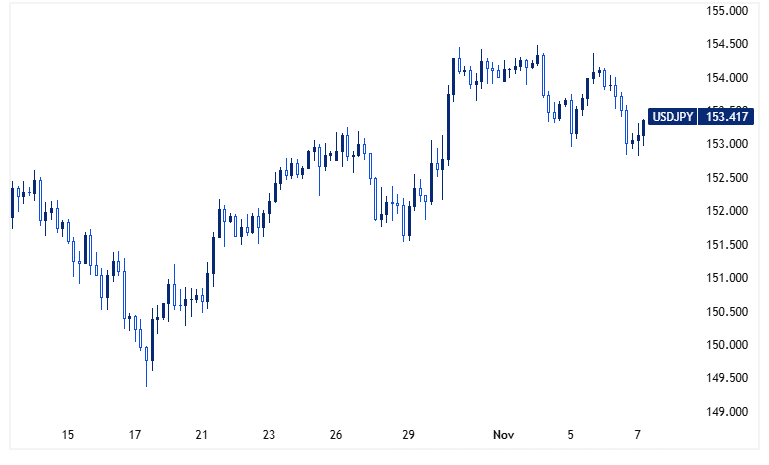
USD/JPY Chart / Source: TradingView
Japanese data showed household spending rose 1.8% in September, easing from a 2.3% gain in August and missing forecasts of 2.5%. Wage gains continued to pressure inflation, with real wages down 1.4% year-on-year, marking a ninth consecutive monthly decline. ⁽³⁾
Bank of Japan Governor Kazuo Ueda said the 2026 wage outlook will be crucial in determining when to resume tightening after the BOJ kept interest rates unchanged last week. ⁽⁴⁾
Bank of England Holds Steady, Signalling More Cuts
The Bank of England kept interest rates unchanged at 4%, with the Monetary Policy Committee voting 5-4 (5 voting for a rate hold, 4 voting for a cut) to keep rates at 4%, signaling a dovish hold.
The MPC saw a bigger risk of weaker demand in the UK economy, also stating that inflation, which is sitting at 3.8%, is likely to have peaked and that a disinflationary trend could be underway. ⁽⁵⁾
BOE Governor Bailey was among those who decided to keep borrowing costs unchanged, but he was the only one of those five who felt that overall inflation risks had moved down. He also stated that a rate cut might be possible in December. The BOE is likely to follow a more gradual downward approach, but it also needs more data to rely on. ⁽⁶⁾
The BOE’s pause decision also came because of the upcoming UK Autumn Budget, which is due on November 26. Chancellor Rachel Reeves is expected to announce tax rises to cover a £20–50 billion fiscal gap driven by weak productivity and higher debt costs. She has hinted at possible income tax increases, which could help cool inflation by curbing consumer demand. ⁽⁷⁾
The Pound held steady after the BOE’s decision and remained near seven-month lows.
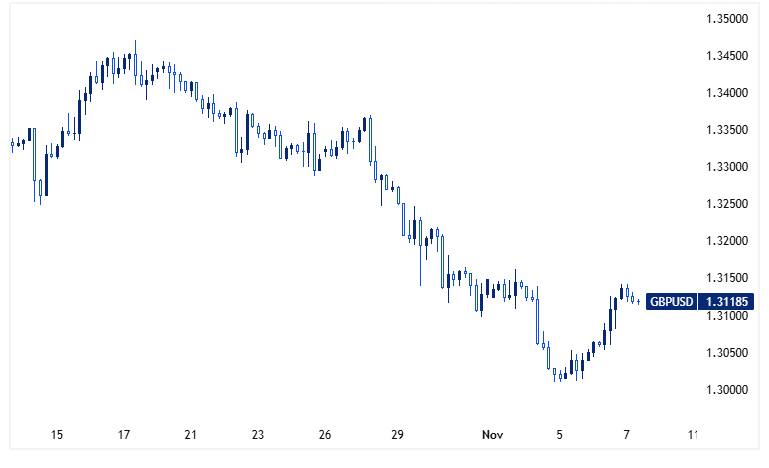
GBP/USD Chart / Source: TradingView
Chinese Exports Drop, Pressuring the Yuan
The Chinese Yuan dropped on Friday, marking its first weekly decline in a month due to weak export data that weighed on sentiment. China’s exports fell in October, declining by 1.1% YoY and missing the forecast of 3% YoY growth. Imports also came in short, coming in at 1% instead of 3.2%. ⁽⁸⁾
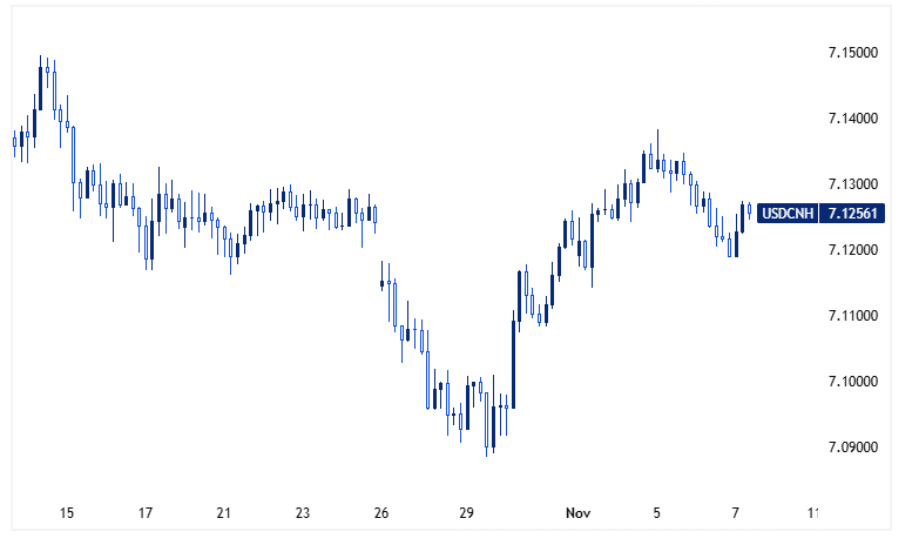
USD/CNH Chart / Source: TradingView
Chinese exporters and US buyers have relieved their concerns as US President Trump and Chinese President Xi Jinping reached a deal during their meeting in South Korea, leading to a de-escalation from a situation that had threatened ongoing relations into a trade war.
China’s exports to the US declined 25% YoY in October, marking the seventh consecutive month of double-digit declines. ⁽⁹⁾


