ar
ar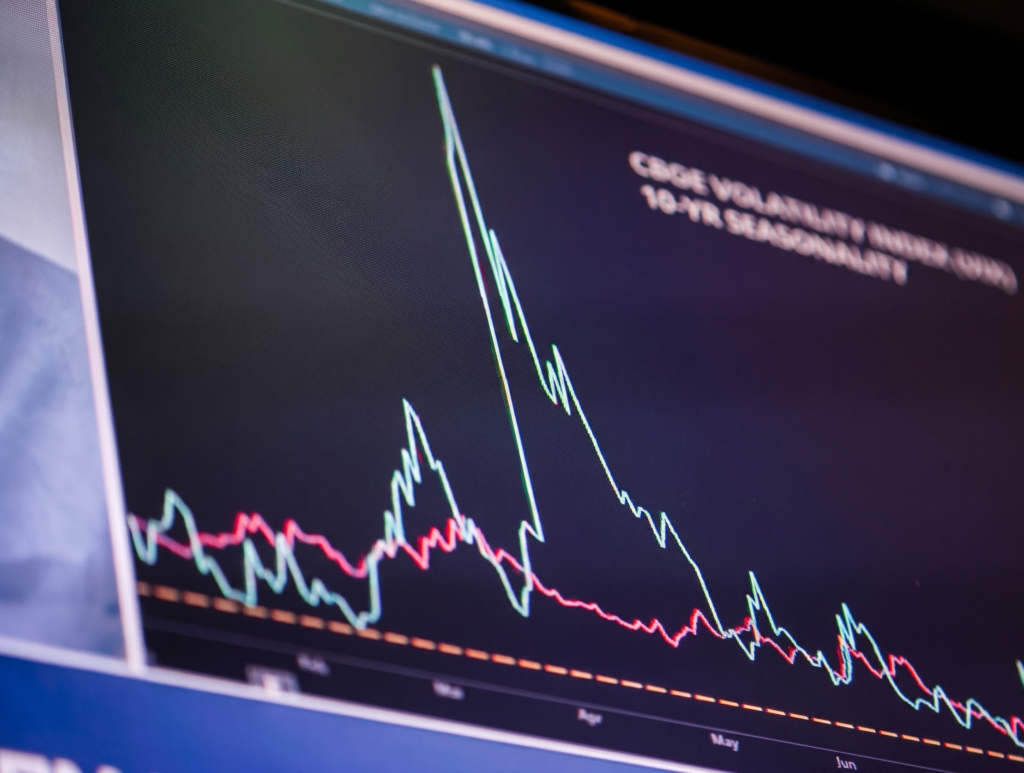
- The VIX measures expected volatility in S&P 500 options over the next 30 days. It tracks how much uncertainty investors are pricing in, not how much the market has already moved.
- A reading above 30 typically signals elevated market stress. The VIX has only exceeded 80 twice in its history, during the 2008 financial crisis and the March 2020 COVID crash.
- Geopolitical escalation is one of the fastest VIX catalysts. It creates simultaneous uncertainty across energy costs, supply chains, and corporate earnings.
Every time markets turn uncertain, one number climbs alongside them. That number is the VIX.
Traders have called it the Fear Index for decades. The name has stuck because the VIX does not measure what has already happened in markets.
It measures what investors expect to happen next. Specifically, how much price movement they are bracing for over the coming 30 days.
How the VIX Works
The VIX is calculated by the Chicago Board Options Exchange (CBOE) using real-time prices from S&P 500 options. ⁽¹⁾
Options are contracts that give investors the right to buy or sell an asset at a fixed price. When markets feel uncertain, investors pay more for these contracts. Put options, which are often used to protect against falling prices, can become especially expensive.
The VIX captures that pricing. When options are expensive, the VIX is high. When options are cheap, it is low. A high reading means the market is paying a significant premium to hedge against sharp moves.
That premium is what the VIX measures.
The Numbers Traders Watch
- Below 20: Markets are relatively calm. Investors are generally comfortable taking on risk.
- 20 to 30: Elevated uncertainty. Investors are pricing in more potential for sharp moves.
- Above 30: Heightened fear. Traders are bracing for higher volatility.
The VIX has only breached as high as 80 twice since it launched in 1993. ⁽¹⁾ It closed at 80.86 on November 20, 2008 during the global financial crisis, and reached 82.69 on March 16, 2020 at the height of the COVID-19 market crash. ⁽²⁾

Those extremes were short-lived. But even a move from 15 to 30 is enough to shift how institutional traders allocate capital and how much risk they are willing to carry.
How Geopolitical Events Push the VIX Higher
Geopolitical escalation is one of the most reliable VIX catalysts. The reason is the breadth of uncertainty it creates at once.
When a conflict threatens a major energy route, traders face a wave of unknowns all at once. Will oil prices rise? Will supply chains tighten? Will corporate margins compress? Will central banks be forced to respond?
Each of those questions feeds into equity market uncertainty. The VIX registers all of them together. This is why events that trigger oil market stress and a broad risk-off shift tend to move the VIX sharply.
The connection is not direct, rather it runs through the economic chain — from energy prices to inflation expectations to earnings uncertainty to options pricing.
What the VIX Doesn’t Capture
The VIX is equity-specific. It reflects uncertainty in S&P 500 options, not in oil markets, credit markets, or currencies.
Stress can build in credit spreads or crude futures without the VIX yet responding. Traders who rely on the VIX alone may miss risk that is accumulating elsewhere in the financial system.
This is why the VIX works best as one input among several, not as a standalone read on global market conditions.
What the VIX Does Well
The VIX shines in reflecting how much fear the equity market has priced in for the next 30 days.
When geopolitical events, energy shocks, and macro uncertainty converge, that number tends to climb quickly. When calm returns, it falls just as fast.
Understanding what moves the VIX helps traders read risk appetite more precisely. It is not a predictor. It is a gauge. A snapshot of collective uncertainty at any given moment.