ar
ar
- The UK economy expanded by 0.4% in the second quarter, supported by services, household spending and stronger business investment.
- However, rising energy bills, a cooling labor market and continued disruption in the Strait of Hormuz threaten to weaken growth during the second half of the year.
The UK’s economy grew more than expected in June, giving Prime Minister Andy Burnham a rare piece of good news as his government deals with the fallout from the Iran war and rising energy costs.
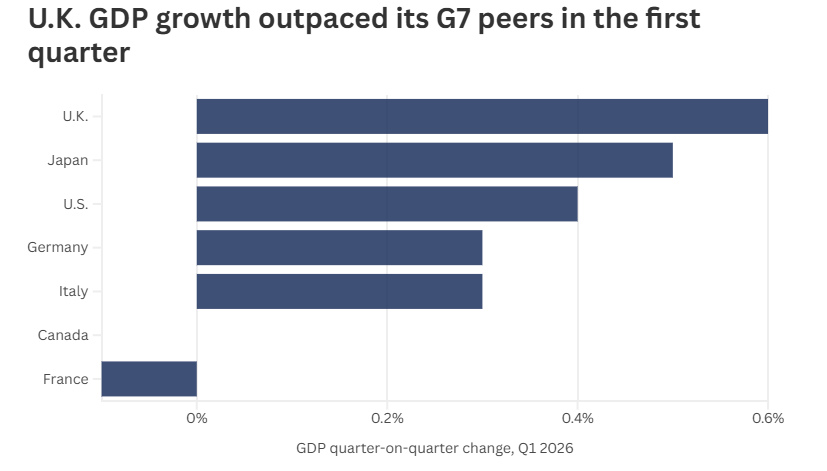
New data from the Office for National Statistics shows the UK is on track to be the fastest growing economy in the G7 for the first half of 2026. But economists warn this strong run may not last much longer.
A Surprise Jump in June
The UK economy grew by 0.3% MoM in June, beating forecasts of flat growth, followed by a flat performance in May.
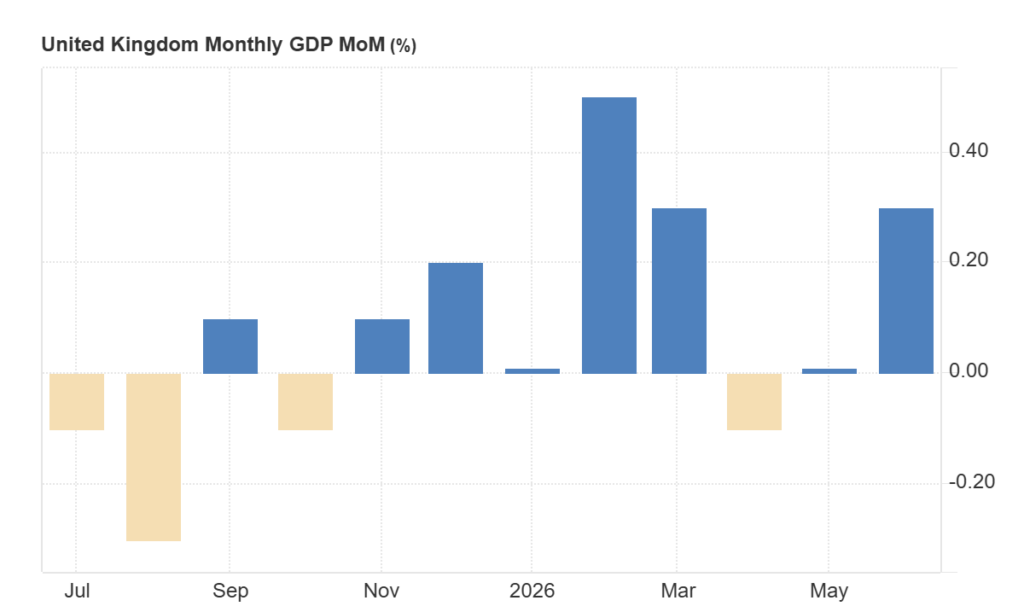
Quarterly GDP grew by 0.4% in the second quarter, following growth of 0.6% in Q1. The economy was 1.2% larger than in the same period of 2025, while GDP per capita also increased by 0.4% during the quarter. ⁽¹⁾
Fewer businesses reported that the Middle East conflict had weighed on turnover during June, coinciding with a temporary ceasefire that has since broken down.
Hot weather boosted spending at retailers, and the men’s football World Cup gave a lift to drinks makers, food companies, TV production, and advertising firms.
Services Lead the Expansion
Services output grew by 0.5% in Q2 and provided the largest contribution to economic growth. Information and communication activity rose by 2.7%, supported by strong growth in computer programming and consultancy. Professional, scientific and technical activities also increased by 1.7%. ⁽²⁾
Manufacturing rose by 1%, providing some support for growth, with pharmaceutical production recording a particularly strong increase. However, the wider production sector showed no overall growth because gains in manufacturing were reduced by falling energy and water output. ⁽³⁾
Construction grew by 0.3% during the quarter, but output remained 2.0% lower than a year earlier. This shows that parts of the economy are still struggling despite the improvement in headline GDP. ⁽⁴⁾
Second Quarter Growth Slows but Still Leads the G7
Although UK GDP growth slowed from 0.6% in Q1 to 0.4% in Q2, it matched economists’ expectations and left the UK as the fastest-growing G7 economy in the first half of 2026.
While reported US growth rates of 2.1% and 1.5% appear higher, they are annualized; on the UK’s non-annualized basis, they equal approximately 0.5% and 0.4%, respectively.
Business investment was a bright spot, rising 1.7% when analysts had predicted a decline of 0.5%. Some economists point to spending on computing infrastructure tied to artificial intelligence as one reason for the jump. ⁽⁵⁾
Deutsche Bank has raised its full year growth forecast to 1.1% YoY, well above the IMF’s earlier estimate of 0.8% made back in the spring. ⁽⁶⁾
Middle East Conflict is Still Creating Problems
Despite the strong numbers, the conflict in the Middle East remains a major risk to the UK economy. The IMF warned in April that the UK would be hit harder by the conflict than any other advanced economy, largely because of its reliance on imported oil and gas.
Treasury officials have reportedly shown Prime Minister Burnham worst case scenarios in which growth could slow to just 0.3% next year if disruption to shipping through the Strait of Hormuz continues. Fuel imports in June already reached their highest level since December 2022, once adjusted for inflation. ⁽⁷⁾

Energy Bills Set to Bite Households
Higher household energy bills could now weaken that momentum. During Q2, consumers were partly shielded by lower summer energy demand and Ofgem’s price cap. However, energy prices for a typical household covered by the cap rose by 13% from July. ⁽⁸⁾
Burnham has announced relief measures, including a tax cut expected to reduce electricity bills by about £45 a year starting in October. Still, inflation remains high and many households have little room left to absorb further cost increases. ⁽⁹⁾
What Comes Next?
The UK economy has avoided stagnation and entered the second half of 2026 with more momentum than it had at the end of last year. Services, consumer spending and business investment are all providing support.
However, the recovery remains vulnerable. The labor market is cooling, interest rates remain restrictive and higher energy costs threaten to lift inflation while weakening household purchasing power. Public debt, which stood close to 95% of GDP in June, also limits the government’s ability to provide significant fiscal support.