ar
ar
- A historic forced liquidation wiped out trillions in gold and silver in a single session
- Leverage, margin calls, and exchange rules broke the precious metals rally, not fundamentals
- Kevin Warsh nomination lifted the dollar and real yields, adding macro pressure at the worst possible time
- Five CME margin hikes in nine days and a China liquidity trap turned silver into ground zero
- Divergence, miner underperformance, and overextension warned the rally was running on borrowed time
A Market Built on Leverage Finally Snaps
When markets go vertical and dominate headlines for months, they attract hedge funds, institutions, and late retail FOMO. That environment also attracts heavy leverage.
Leverage is the accelerant. The more leveraged a market becomes, the faster, sharper, and more brutal the unwind when it finally turns.
That is exactly what happened in precious metals last Friday. Silver collapsed by roughly 32% in a single session, while gold plunged more than 12%. Moves of this scale do not occur in normal market conditions. They only occur during systemic stress events driven by forced selling and margin calls rather than voluntary repositioning.
Massive Price Drop and Market Impact
Leading into the crash, gold and silver had reached extreme levels. Gold traded above 5,500 dollars per ounce while silver surged beyond 115 dollars per ounce. These were historic prices supported by strong momentum, inflation hedging, and speculative positioning.
The reversal was equally historic. On Friday, gold dropped from roughly 5,380 to near 4,680 in a matter of hours. Silver fell from around 115 to near 75 before stabilizing. Silver recorded its largest absolute daily drop ever, and its biggest percentage decline since the Hunt Brothers episode in 1980. ⁽¹⁾
The selloff erased extraordinary gains. Gold was up close to 30% in January before the crash. Silver had gained nearly 70%. Such rapid advances, especially in leveraged markets, are rarely sustainable without corrections. ⁽²⁾
Warsh Nomination Adds Macro Pressure
Market sentiment shifted sharply after US President Donald Trump announced the nomination of Kevin Warsh as the next Federal Reserve chair. Investors had been positioned for a more dovish outcome. Instead, Warsh is widely viewed as an institutional hawk due to his long-standing focus on inflation risks and his support for reducing the Federal Reserve balance sheet. ⁽³⁾
While Warsh has criticized the Fed for being slow to adjust policy in the past, markets interpreted his nomination as signaling stronger policy discipline rather than looser monetary conditions. This pushed US real yields higher and strengthened the dollar, reducing the appeal of non yielding assets such as gold and silver. ⁽⁴⁾
The Fed narrative did not cause the crash on its own, but it acted as an additional trigger in an already fragile, over leveraged market.
Leverage and Margin Rules Turned Volatility into a Cascade
The true driver of the collapse was leverage and margin mechanics.
On January 13, CME shifted from fixed dollar margins to percentage-based margin requirements. This meant that as silver prices rose, the capital required to hold a single futures contract rose with it. Leverage was effectively capped at higher prices, and even small pullbacks became dangerous for leveraged longs. ⁽⁵⁾
Between January 13 and January 27, CME increased maintenance margins multiple times to ensure adequate collateral coverage amid rising volatility. In total, there were five margin hikes within nine days. This created a coiled spring of selling pressure. ⁽⁶⁾
As prices started to fall, leveraged traders faced margin calls. They were forced to either post large amounts of additional capital or liquidate positions immediately. Many had no choice but to sell. ⁽⁷⁾
The China Liquidity Trap Accelerated Silver Selling
Silver suffered more than gold due to additional market specific pressures.
On January 30, the Shenzhen Stock Exchange implemented a full day trading halt on the SDIC Silver LOF. This trapped Chinese institutional and retail traders inside domestic products. Unable to liquidate local positions, they were forced to sell offshore exposure including COMEX futures and silver ETFs to raise liquidity or hedge risk. ⁽⁸⁾
This created a liquidity trap. Selling pressure intensified outside China precisely when liquidity was already thinning due to margin calls. The result was cascading forced liquidation across global silver markets. ⁽⁹⁾
Technical Signals Were Already Warning of Exhaustion
The crash did not come without warning.
One of the most overlooked tools in trading is divergence. RSI divergence shows when price continues to rise while momentum fades. That signals rising risk and increasingly fragile upside.
In silver, bearish RSI divergence had already developed during the January blow off top. At the same time, silver miners ETFs failed to confirm the new highs in spot silver. When smart money is bullish, miners usually lead. When miners lag, it often signals distribution rather than accumulation.
Silver continued higher while miners stalled. This divergence, combined with a stretched impulsive move, signaled exhaustion. Individually, these signals are useful. Together, they are powerful warnings.
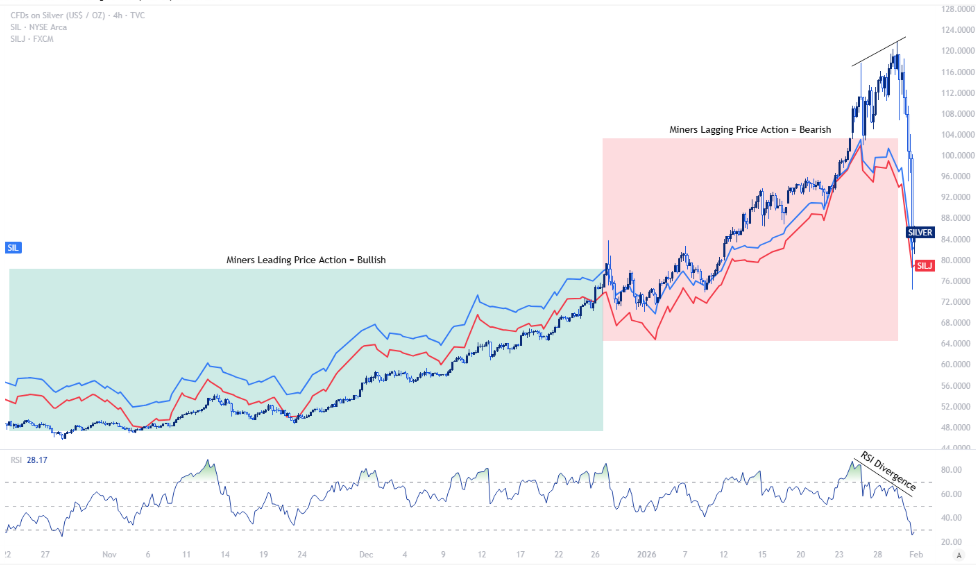
Silver 4H Chart Compared With Global X Silver Miners ETF and Amplify Junior Silver Miners ETF / Source: TradingView
What we have seen so far is only the initial liquidation phase. The move paused due to the weekend, but price structure has not yet fully developed.
It is too early to project depth or timing. This is the patience phase. Professional risk management means waiting for structure and confirmation, not guessing bottoms or reacting emotionally to headlines.
Markets will reveal their intentions in price behavior. Until then, discipline matters more than conviction.
The Real Lesson Is Risk Management
This crash was not a failure of gold or silver as assets. It was a failure of leverage and risk control.
Forced liquidation says nothing about long term fundamentals. It says everything about positioning. History shows that some of the strongest long-term rallies in precious metals have followed the most violent liquidations. Excess leverage is flushed out. Weak hands are removed. The market resets.
The most important lesson from this episode is clear. Money and risk management matter more than direction. Markets are not stable because prices rise slowly. They are stable only until leverage is tested.
Last Friday, leverage was tested. And it failed.