

 ar

- Higher fuel and freight costs are testing whether smaller companies can raise prices without losing customers.
- Cheaper share prices may offer limited reassurance when debt costs threaten future earnings.
- A recovery supported by improving profits would carry more weight than a rebound driven mainly by hopes for cheaper funding.
Wall Street’s record highs are showing a growing division among the indices. Large tech stocks are drawing investors into the S&P 500 and the Nasdaq 100, while smaller cap stocks are facing rising pressure from higher borrowing costs.
At the start of this year, the Russell 2000 was among the market’s strongest performers, gaining almost 23% at its peak in August before rising Treasury yields began to pressure small caps.
Then, that lead faded when Treasury yields started to rise, with elevated oil prices and persistent inflation raising concerns that borrowing costs could remain elevated. The Russell 2000 is now up almost 12% YTD after a decline of more than 9.5%, nearing a correction at 10%.
The index has now fallen behind the S&P 500 and the Nasdaq 100, which are up 13.22% and almost 22% respectively.
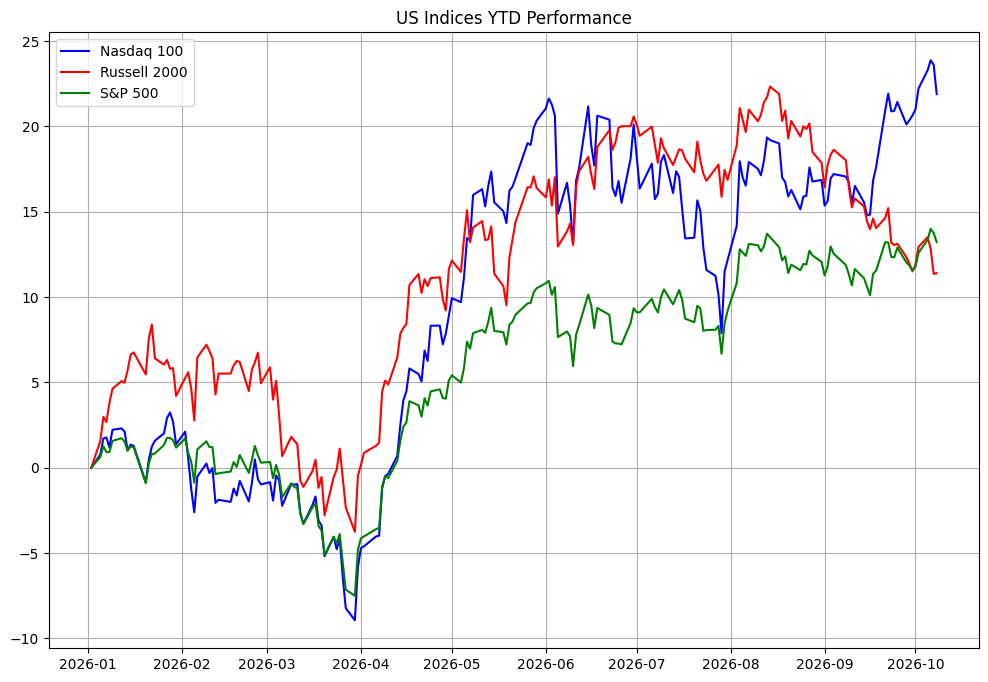
Higher Yields Hit Smaller Balance Sheets
The direct pressure is coming from the bond market, where the 10-year Treasury yield briefly touched 5.36% on Wednesday, its highest level since 2002 as inflation concerns and higher oil prices continued to weigh on government bonds.
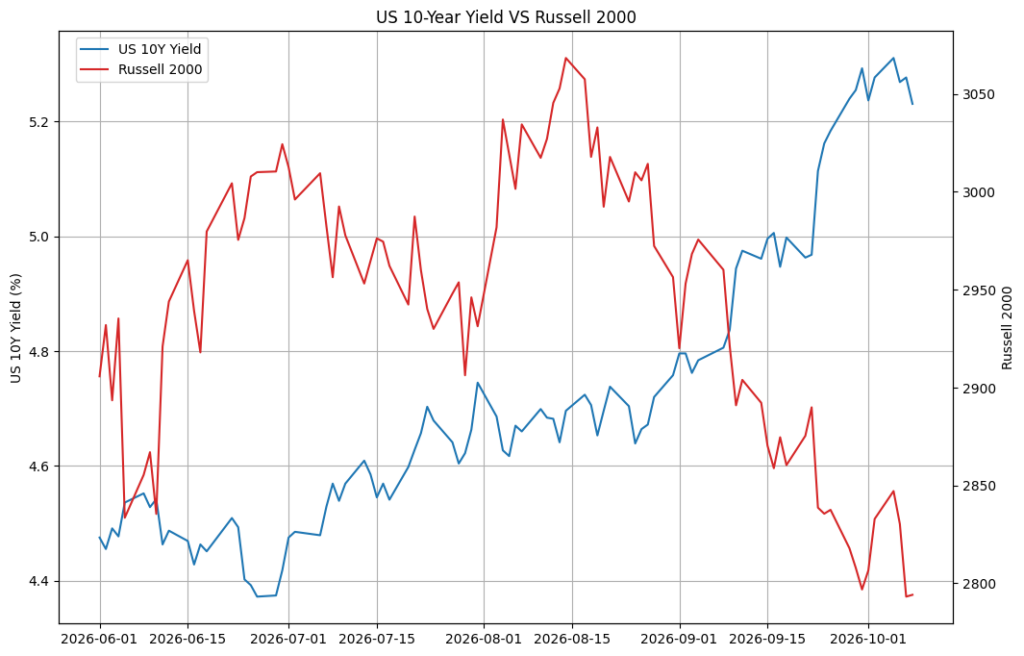
The Fed’s September minutes, released on Wednesday, showed most officials considered another rate increase likely to be appropriate before year-end. That keeps the prospect of further borrowing pressure in focus. ⁽¹⁾
For small companies, rising borrowing costs can impact both profits and stock prices, leaving businesses with floating-rate loans that have higher payments when the rates linked to those loans increase. Companies replacing maturing debt may also have to accept more expensive financing.

That leaves less money for hiring, investments and expansion, especially among businesses that are already operating with small profit margins.
The pressure extends beyond small caps. Real estate companies face higher financing costs, while industrial and materials businesses can see their profit margins squeezed by both borrowing costs and rising energy expenses.
Higher Oil Prices Test Pricing Power
Elevated energy costs are also another factor driving the pressure. Brent crude jumped to $105 per barrel yesterday as tensions on Gulf shipping renewed supply concerns.
The US Energy Information Administration stated that tight global distillate supply, elevated crude prices and higher crack spreads pushed diesel prices higher. Refining margins themselves were elevated because of tight fuel supply. ⁽²⁾
This can heavily affect companies that are exposed to energy shocks, where they pass over those costs onto their customers and could weaken demand, while absorbing them could lead to reduced profits. Oil producers may benefit from higher selling prices, so the impact varies across small caps.
Higher revenue can also be misleading if it reflects price increases while customers buy fewer goods. Sales volumes and profit margins provide a clearer test of resilience.
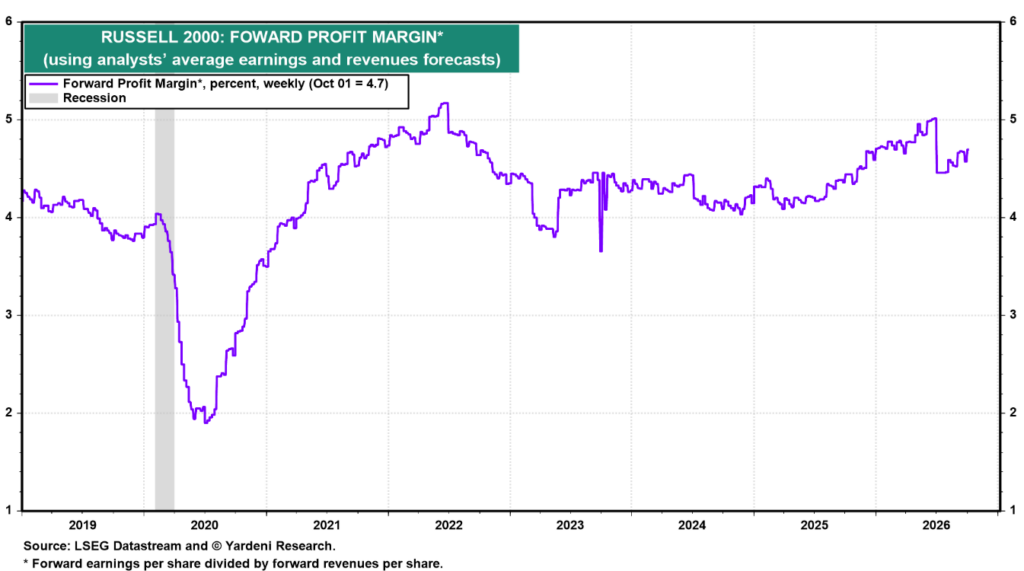
The AI Boom Is Widening the Gap
Investors have now shifted to large tech stocks due to their strong earnings and investment opportunities created by AI. Their gains drove the S&P 500 and the Nasdaq to new record highs, even while other sectors struggled to follow up.
Small caps have less exposure to technology, limiting their ability to benefit from that enthusiasm. But sector differences do not explain everything. The distinction is increasingly about financial strength. Investors appear more willing to accept higher rates when companies have substantial cash resources and convincing earnings growth.
Steve Sosnick, chief strategist at Interactive Brokers, described a healthy but uneven economy, with AI data-center investment playing a prominent role. Growth concentrated in a few industries may offer limited support to smaller businesses elsewhere. ⁽³⁾
Cheaper Shares Still Carry Debt Risks
Falling prices have made small caps look less expensive, but lower valuations alone may not resolve their problems.
Bank of America stated in a note recently that Russell 2000 valuations are already below their historical averages recorded when Treasury yields were at similar levels. Their research also shows that higher yields have sometimes coincided with stronger earnings, helping small caps absorb the pressure on share valuations. ⁽⁴⁾
However, the bank warns that today’s companies are more exposed to borrowing costs. Higher debt levels and a larger share of unprofitable businesses make comparisons with earlier periods less reassuring.
According to BofA, roughly half of small-cap debt is short-term or carries floating rates, while more long-term borrowing is approaching repayment over the next five years. ⁽⁵⁾
The risk is that apparently cheap shares still face earnings pressure as interest expenses rise. A lower share price does not reduce the company’s debt bill.
Who Leads the Recovery Matters
The Russell 2000 includes both profitable and unprofitable companies. That means its performance can reflect changing expectations for businesses with very different financial positions. LSEG confirms that the index includes unprofitable firms.
If small-cap stocks rise while the companies are still losing money, investors may be hoping that lower borrowing costs will help them. Stronger profits across smaller companies would be a clearer sign that their businesses are improving. For traders, the companies driving the gains therefore matter alongside the index level.
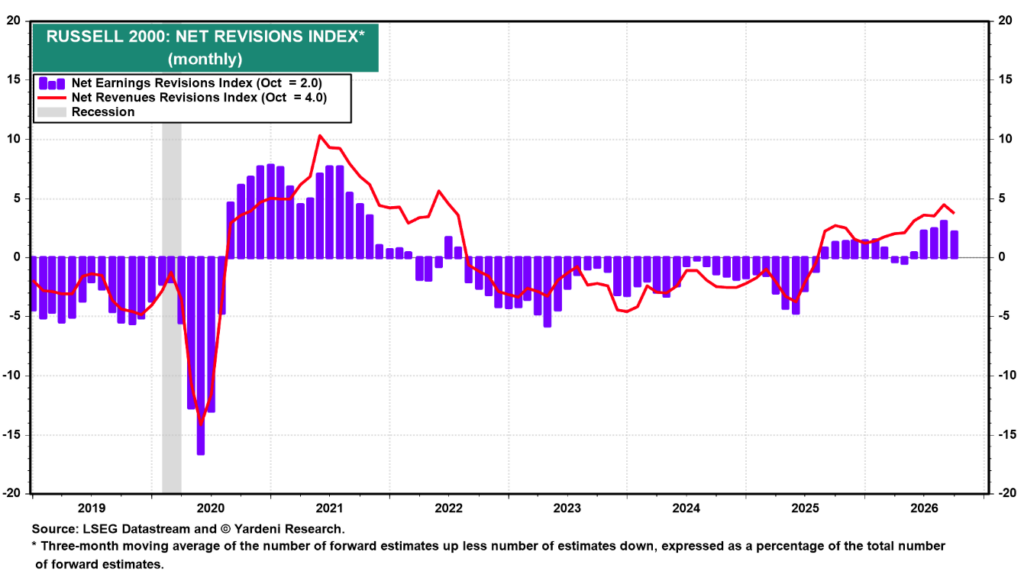
The important distinction is why yields fall. Easing inflation could relieve borrowing pressure, while weakening demand could also hurt sales. For small caps, a lasting improvement depends on whether lower financing costs arrive alongside resilient earnings.


