ar
ar
- JP Morgan, Citigroup, Bank of America, and Goldman Sachs all beat Q2 expectations as trading revenue, investment banking fees, IPO activity, and M&A surged.
- Equity trading delivered record results across these four banks, while major deals such as SpaceX’s IPO and large corporate mergers boosted advisory fees.
- Despite strong profits, bank executives warned that Middle East tensions, persistent inflation, rising expenses, and government deficits are the key risks.
The second quarter of 2026 delivered one of the strongest earnings rounds in recent history for Wall Street’s biggest banks.
JP Morgan, Citigroup, Bank of America and Goldman Sachs all surpassed analysts’ forecasts for earnings, with performances driven by SpaceX’s IPO, mergers and acquisitions, and volatility fueled by geopolitics.
Investors got a clear signal this week despite ongoing risks like the Middle East conflict and sticky inflation. Even through those risks, corporate America and Wall Street are finding plenty of ways to make money.
JPMorgan: Biggest Bank, Biggest Number
JP Morgan kicked off the earnings season with results that stunned the most optimistic forecasters. The bank’s profit surged 41% to $21.2 billion, with earnings per share coming in at $7.70, far above the forecast of $5.64 per share. Total revenue climbed 28% to $57 billion. ⁽¹⁾
A large chunk of the gain came from a one-time $4.6 billion profit on the sale of Visa shares, plus another $1 billion from certain equity investments. But even stripping out those special items, net income of $16.9 billion still beat expectations easily. ⁽²⁾
CEO Jamie Dimon welcomed the results, pointing to an AI-driven investment environment, government stimulus, and eased regulation.
But at the same time, he echoed the risks from the Middle East conflict, inflation, and large government deficits.
Equity trading was the standout performer, surging 86% to a record of $6 billion, while investment banking fees rose 30%. The bank raised its 2026 expense forecast to $107.5 billion from the $105 billion it previously forecasted. ⁽³⁾
Citigroup’s Best Quarter in a Decade
Next in the lineup, Citigroup reported its best quarter in 10 years, with profits rising 45%, revenue hitting $24.8 billion, and earnings per share coming in at $3.15, above its forecast of $2.73. ⁽⁴⁾
Investment banking fees jumped 44% to $1.55 billion, helped by the bank’s role in SpaceX’s record-breaking IPO and its work advising on the $44.8 billion merger between Unilever’s and McCormick’s food divisions.
Trading was another bright spot. Equities revenue rose 45%, while other fixed-income trading and commodities climbed 25%. Net interest income rose 13% for the quarter. ⁽⁵⁾

CEO Jane Fraser has been leading a major overhaul at Citi, selling off consumer businesses, cutting management layers, and tightening risk controls. The strategy appears to be paying off, with returns on common equity reaching 13%, at the top end of the bank’s target range. ⁽⁶⁾
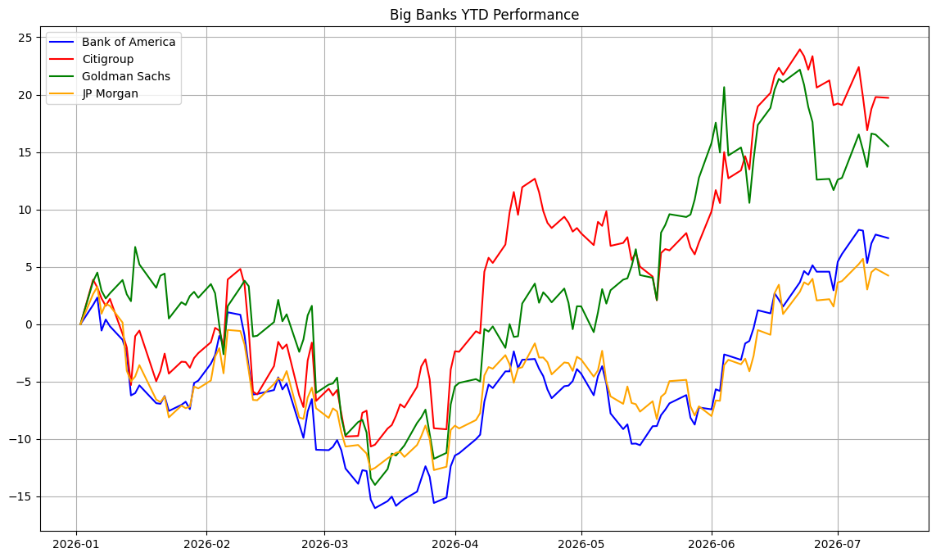
Citi’s stock is already up more than 20% this year and has outperformed most of its peers.
BofA Beats Its Own Forecast
Bank of America beat its profit estimates too, supported by record trading activity. Sales and trading division’s revenue surged 34% to a record $7.1 billion, coming in well above the 15% increase that CEO Brian Moynihan had expected earlier. Equities trading alone climbed 70% to $3.6 billion. ⁽⁷⁾
Earnings came in at $1.21 per share, comfortably ahead of the $1.13 analysts expected. Investment banking fees rose 50% to $2.1 billion, boosted by the bank’s role in SpaceX’s IPO and its advisory work on NextEra Energy’s $66.8 billion acquisition of Dominion Energy. ⁽⁸⁾
Analysts attributed the strong performance to AI-related investment, lighter regulation and elevated market volatility.
One analyst noted that with over $2.5 trillion in announced global M&A so far this year, banks should keep collecting fees as those deals close over the coming months.
Goldman’s Equities Desk Steals the Show
Last in the list, Goldman Sachs rounded out the day with perhaps the most dramatic beat of all. Profit came in at $6.63 billion from $3.72 billion a year earlier, while EPS increased to $20.98 from $10.91, and came in well above the $14.48 per share analysts expected. ⁽⁹⁾
The bank’s equities business posted record revenue of $7.42 billion, up 72% from a year earlier, while fixed income, currency, and commodities revenue rose 32%.
Investment banking fees climbed 55% to $3.40 billion, and the bank advised on more than $1 trillion in announced mergers during the first half of the year, a record pace. ⁽¹⁰⁾
On Monday, Goldman Sachs’ board of directors raised the quarterly dividend from $4.50 to $5.00 per share, an increase of about 11%. Shareholders who own Goldman Sachs shares as of September 1, 2026, will receive the new dividend payment on September 29, 2026. ⁽¹¹⁾
CEO David Solomon described the momentum as a “flywheel,” saying clients are increasingly turning to Goldman for their most complex deals.