

 ar

- The Middle East conflict is already pushing energy prices higher, disrupting supply chains and forcing businesses across Europe and the US to raise prices at their fastest rates in years.
- Economic growth is slowing in major economies, with France contracting, Germany losing momentum, and both the UK and US hitting multi-month lows in business activity.
- Central banks including the Federal Reserve and the Bank of England are caught in a difficult position, holding rates steady while facing the threat of inflation rising well above their targets.
The ongoing Middle East conflict isn’t just causing a regional problem but is also sending shockwaves through major economies.
From Europe to the US, business and consumers are once again facing higher energy prices, disrupted supply chains, and slow growth. The most recent PMI data indicate a concerning picture, which shows inflation rising while growth slows, bringing stagflation fears to the table.
Eurozone Growth Stalls as Energy Costs Surge
Eurozone PMI showed that private sector growth almost stalled as inflation expectations surged and delivery dates slowed – the root cause of this coming from the impacts of Middle East tensions.
As oil prices remained elevated at around $100 per barrel, eurozone inflation is already picking up, and economic growth is expected to take a hit as expensive fuel reduces household purchasing power and lowers corporate profits and sentiment.
The flash PMI composite, which is the average between the services and manufacturing PMIs, came in at 50.5 in the eurozone, reaching almost 1-year lows and coming in below February’s figure of 51.9 as the conflict drove costs higher and triggered the worst supply chain disruption since 2022. ⁽¹⁾
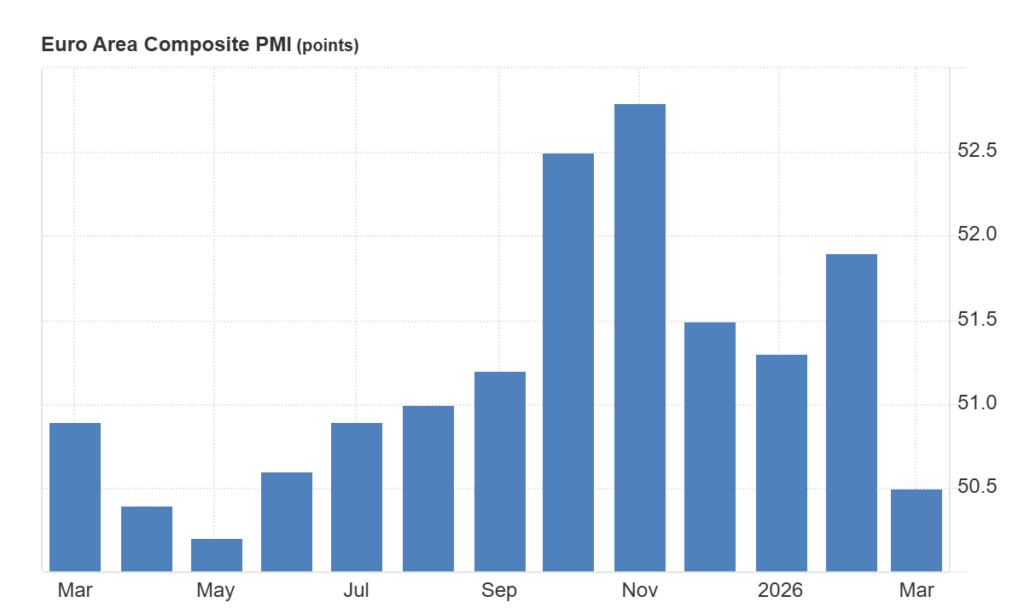
Diving deeper into the report, manufacturing came in at 51.4, coming in better than expected. But the drag was services, which came in at 50.1, coming in lower than expected.
The index for manufacturing prices jumped to 68.6 from 58.0, while the delivery times index plunged to 40.9 from 47.3, suggesting that firms anticipate massive delays and a surge in prices. ⁽²⁾
The flash euro zone PMI could show signs of stagflation as the war in the Middle East drives prices sharply higher while slowing growth.
Comparing the two biggest economies in the region, France and Germany showed different results. France’s PMIs painted a weak performance picture, reaching October 2025 lows due to weak demand and ongoing supply disruptions. ⁽³⁾
However, Germany remained in expansion territory but slowed to its weakest pace in three months in March as services lost momentum and costs surged.
Manufacturing drove the growth due to a rise in new orders, brought on by companies reacting to the disruption and uncertainty, with some bringing forward purchases over concerns about potential supply disruption in the coming months. ⁽⁴⁾
Rising Costs Deepen the UK’s Economic Strain
The eurozone isn’t the only region facing a slowdown, as the UK continues to face mounting economic challenges. UK PMI weakened, marking its slowest pace in six months, while manufacturing costs rose at their fastest rate since the 1990s, largely driven by the ongoing conflict.
UK composite PMI came in at 51, down from 53.2. This was lower than expected and the lowest reading since September 2025. March’s flash PMIs show that the conflict in the Middle East is already going a long way to boost inflation and extinguish GDP growth. ⁽⁵⁾
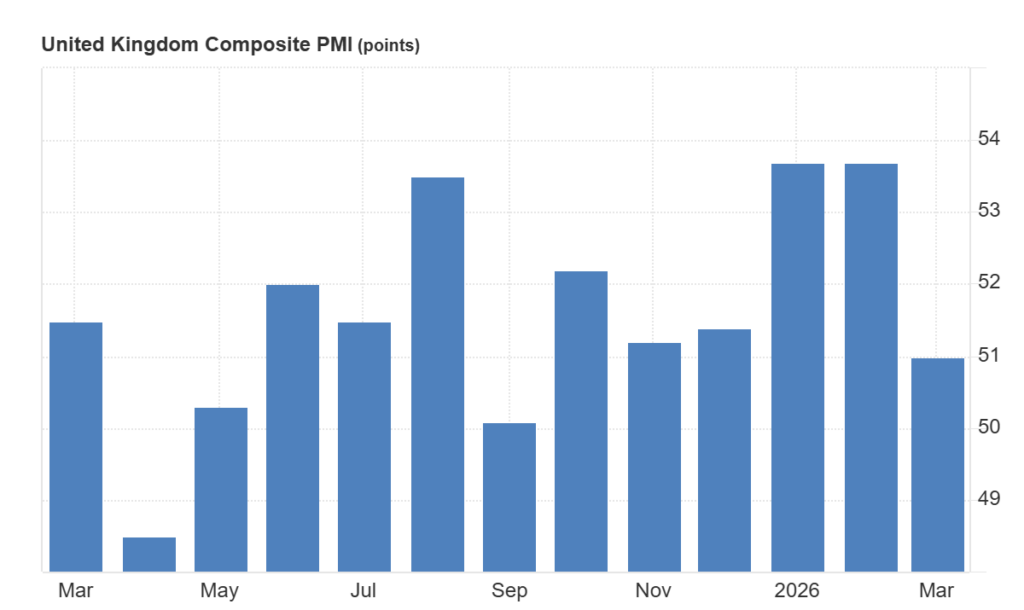
Manufacturing PMI came in at 51.4, higher than its expected figure but down from last month’s figure of 51.7. Services PMI was the main driver in the slowdown, coming in below its estimate at 51.2 and down from February’s 53.9. ⁽⁶⁾
Input prices for British manufacturers jumped to 70.2 in March from 56.0 in February, the biggest leap from one month to the next since sterling tumbled out of Europe’s Exchange Rate Mechanism in 1992. ⁽⁷⁾
Rising fuel, transport, and energy costs drove the surge, with businesses increasing prices at their fastest pace since April 2025.
This is adding pressure to the Bank of England as it navigates a difficult balance between rising inflation and slowing growth. While the Bank of England held rates steady last week, it signaled readiness to act if needed, with inflation now expected to climb toward 3.5% later this year.
Resilient but Slowing: US Activity Hits 11-Month Lows
US business activity remained in expansion mode but slipped to 11-month lows due to higher energy prices caused by the ongoing conflict, reinforcing fears of accelerated inflation in the months ahead.
The US composite PMI came in at 51.4 this month. This was the lowest level since last April and followed a 51.9 reading in February. ⁽⁸⁾
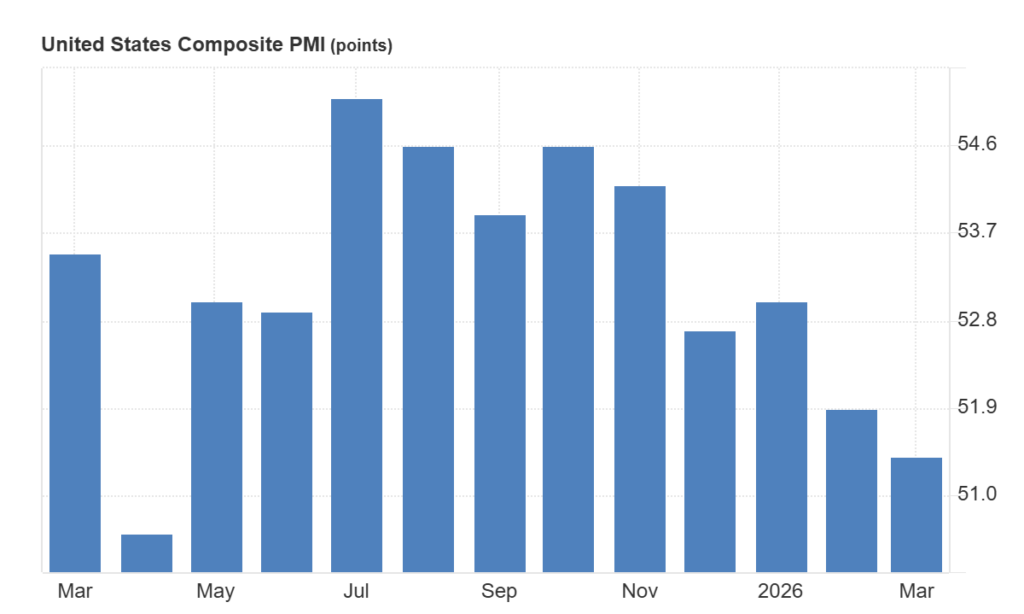
PMI has now declined for two straight months. The drop this month was in the services sector, with flash PMI slipping to 51.1 from 51.7 in February, also coming in below estimates.
Manufacturing activity improved, with flash PMI rising to 52.4 from 51.6 in February, confounding economists’ expectations for a drop to 51.3, partly reflecting some easing in the impact of tariffs on order books. ⁽⁹⁾
The measure of prices paid by businesses for inputs jumped to 63.2 this month from 60.0 in February, with both services and manufacturing enterprises reporting increases, widely linked to the war-related spike in energy costs and tightening supply conditions.
Those higher prices were passed on to consumers. The gauge of output prices rose to 58.9 from 56.9 in February.
Economists are bracing for an increase in inflation, with producer prices rising prior to the Middle East conflict. The Federal Reserve last week left interest rates unchanged and projected higher inflation, steady unemployment and a single reduction in borrowing costs this year.


