

 ar

- Global bond yields surged after the conflict surrounding the Persian gulf sent oil prices above $119 a barrel, raising inflation fears across major economies.
- Japan, the US, the UK, and Europe all saw sharp market moves, with investors rapidly shifting from expecting rate cuts to pricing in possible rate hikes.
- Yields partially recovered as oil prices retreated and G7 nations discussed releasing emergency reserves, but uncertainty over the conflict’s duration kept markets on edge.
Financial markets around the world are feeling the pressure of the conflict in the Middle East, which sent oil prices sharply higher, raised fears of inflation, and forced investors to rethink their expectations for interest rates.
Government bond yields in Japan, the United States, the United Kingdom, and Europe have all moved significantly as traders try to figure out what happens next.
Treasury Yields Ease but Uncertainty Remains
Yesterday, US Treasury yields climbed sharply, with the 10-year rising 7 basis points (0.07%) to 4.2%, hitting 4-week highs while the 30-year rose to 4.8%.
When yields rise, bond prices fall due to risk-off mood, and the speed of yesterday’s moves reflects just how quickly investor sentiment shifted.
Now, Treasuries yields have eased off after oil prices pulled back from their latest surge, reaching their highest level since 2022 after rising 25% in a single session as GCC nations cut production after the Strait of Hormuz was closed.
The 10-year yield fell 3 basis points alongside the 2-year yield. Oil prices dropped and risk-on sentiment stabilized after President Trump noted that the war could end “very soon”.
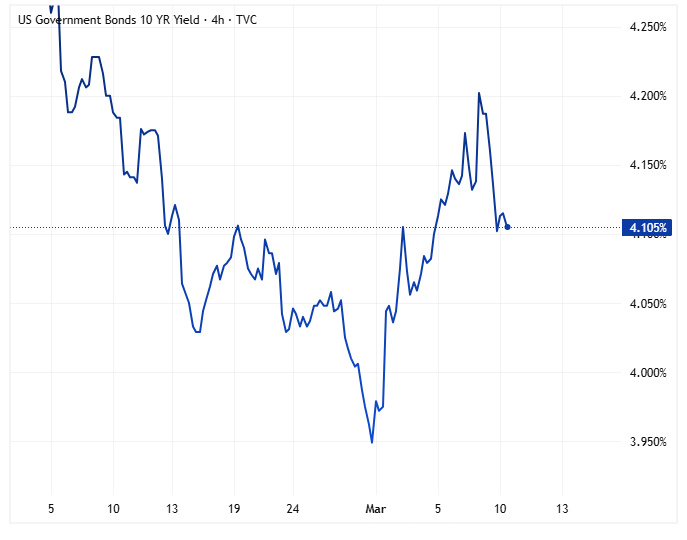
Analysts at Morgan Stanley noted that investors had focused more on the risk of higher inflation than on slower growth. They added that a prolonged rise in oil prices could shift that focus, pushing traders to price in more rate cuts if economic growth weakens. ⁽¹⁾
This week, markets face yet another test with $119 billion worth of Treasury bond auctions scheduled across Tuesday, Wednesday, and Thursday. ⁽²⁾
Bond Markets Across Europe Stabilize
The sell-off in bonds wasn’t just in the US, but it spread across the globe. Bonds in Europe declined as investors priced in the risk of higher inflation and weaker economic growth, which equals stagflation.
Germany’s Bund futures slid to an almost 15-year low, with the 10-year yield rising to 2.90%, its highest in a year, while the 2-year Bund yield surged 10 basis points (0.1%), reaching September 2024 highs. Today, 10-year Bund yield slightly fell after the pullback in oil prices.
Money market traders now fully expect the ECB to raise rates by about 1 percentage point in 2026, with around a 25% chance of a second. Prior to the conflict, markets had priced about a 40% chance of a rate cut by year-end. ⁽³⁾
In the United Kingdom, short-term government bond prices were hit the hardest. The 2-year gilt yield surged by 37 basis points to 4.239% in early trading, its biggest single-day rise since former Prime Minister Liz Truss unveiled her failed economic agenda in September 2022.
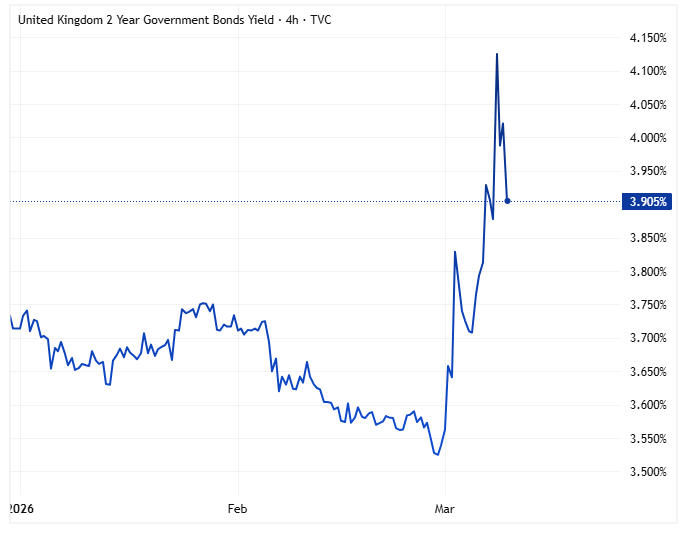
Investors see the UK as especially vulnerable to an energy price shock. The country’s weak public finances leave little room for the government to absorb higher costs, and there is pressure on ministers to step in with support measures for households facing bigger energy bills. ⁽⁴⁾
UK’s Prime Minister Starmer stated that protecting the working British people as his main priority, a comment markets read as a possible hint of new spending. Finance Minister Rachel Reeves said the best solution was a swift end to the conflict but added that the government was ready to support the release of emergency oil reserves. ⁽⁵⁾
JGB Yields Fall as Oil Prices Stabilize
Japan also felt the pressure. Government bond yields jumped to 3-week highs. Given Japan’s heavy reliance on Middle Eastern oil, rising energy costs could increase import prices and push the Bank of Japan toward raising interest rates.
Japanese government bonds then rallied earlier today after oil prices pulled back, with the 10-year yield dropping 3.5 basis points to 2.15%, while the five-year yield fell 2 basis points to 1.6%. Japan also saw a 0.3% expansion in its economic growth in Q4 2025, driven by strong business investment. ⁽⁶⁾
The Stagflation Threat
The main factor driving these major moves in the bond market is stagflation fears. Stagflation, the toxic combination of rising inflation and slowing economic growth, is every policymaker’s nightmare.
Normally, when inflation climbs, central banks raise interest rates to cool things down. But higher rates also squeeze businesses and consumers, slowing the economy further.
According to the IMF, Managing Director Georgieva stated that a 10% rise in oil prices that stretches out for a year could push global inflation up by around 0.4% and reduce global growth by 0.2%. ⁽⁷⁾
In the US, early signs of strain were already visible before the oil shock. Employers unexpectedly cut jobs in February, and the unemployment rate edged higher, pointing to cracks in the labor market just as price pressures are picking up.
Federal Reserve Rate Cut Hopes Pushed Back
The inflation fears triggered by rising oil prices have forced traders to rethink their expectations for Federal Reserve interest rate cuts.
Before the war began at the end of February, markets had fully priced in a rate cut by July. Now, traders have pushed that expectation back to September. Some bond market participants are even betting that the Fed will not cut rates at all in 2025. ⁽⁸⁾
Federal Reserve officials are currently in their pre-meeting blackout period ahead of the March interest rate decision, meaning they cannot publicly comment on developments.
Investors are also watching a busy week of economic data, including February inflation figures on Wednesday, the personal consumption expenditures index, and January job openings data on Friday.


